Quick answer
The operating answer
Sample a batch where its conditions can differ, not where the product happens to look best. Define the production run and its approved customer-facing standard, then select representative finished pieces from early, middle, and late points—or from the actual points where the route changes, such as a new pan, oven load, filler, operator, or hold. Cool, finish, package, and inspect each sample at the same product stage customers receive. Record the result and the release, hold, or next-test decision. There is no universal sample count that proves a bakery batch is acceptable; the plan must match the product, batch size, production route, and risk of drift.
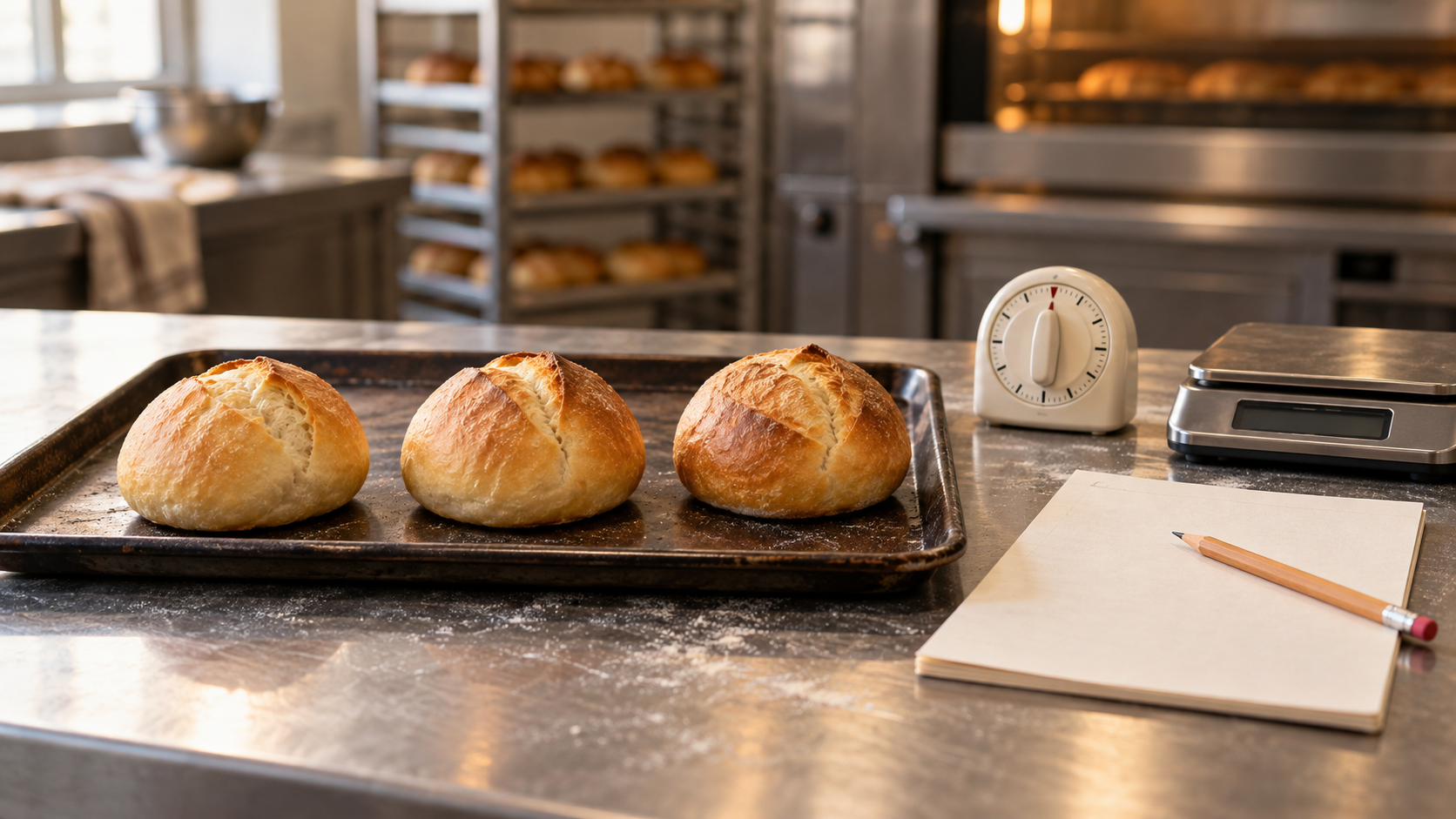
- A single good-looking roll is an observation, not evidence that the full production run met the same standard.
- Start with the batch boundary and the customer-facing endpoint, then select samples across the parts of the route that can differ.
- Use early, middle, and late samples only when they represent meaningful variation; add a sample when a pan, load, ingredient, person, or holding condition changes.
- Record an observed result separately from the release or corrective decision. A quality sample does not validate food safety, shelf life, allergen controls, or legal sale.
A sample represents a route, not the nicest piece on the tray
Before service, an owner or shift lead often has only a few minutes to decide whether the product in front of the team still matches the standard promised to customers. The tempting shortcut is to pick the most attractive roll, take one photo, and call the batch fine. That is not a useful sample. It hides the question that matters: does the selected piece stand for the conditions the rest of this identified production run experienced?
The American Society of Baking describes bread evaluation as comparison with a bakery-defined standard and recommends random, representative samples from each production run. Its point is practical for a small bakery: each bread has its own quality characteristics, so the sampling decision has to begin with the product you actually sell. A warm roll, a cold filled bun, and a re-baked garlic bread may need different finished-stage checks even when the team uses one shared record.
Define the batch and the decision before choosing pieces
Write the batch boundary in operational terms: the approved product version, the start and end of the run, and the route that makes the pieces comparable. A batch can be one mixer bowl, one filling run, one oven-load sequence, or another locally defined unit. Do not silently join product made with a substituted ingredient, an altered oven setting, a different package, or a later service hold just because it carries the same menu name. Those changes may create a new comparison question.
Next, name the decision the samples will support. It might be release to the counter, hold for a quality review, continue a controlled trial, or investigate a first drift. It is not a calculation of a universal pass rate. The observation needs enough detail to support a calm next action: a sample position, the product stage, the condition seen, the approved reference used, and the person responsible for the decision.
| Plan element | What to define locally | Why it matters |
|---|---|---|
| Batch boundary | Product version, run start and finish, and any named change in ingredient, equipment, route, or handoff | Prevents one sample from standing in for pieces made under a different condition |
| Customer-stage check | The point at which the customer receives the product: cooled, filled, re-baked, packaged, displayed, or handed over | Stops an attractive oven-exit sample from masking a later quality loss |
| Sampling positions | Early, middle, late, plus any meaningful route-change point such as a fresh pan, new oven load, operator handoff, or unexpected hold | Makes likely process variation visible without pretending every item was individually tested |
| Decision rule | The observable pass, hold, or investigation language and the person who owns the response | Keeps an observation from becoming an undocumented assumption |
Choose positions that can reveal drift
Early, middle, and late is a useful starting pattern because time in a production run can change dough condition, queue length, oven loading, cooling space, filling flow, or service pressure. It is not a magic three-piece rule. If the run is short and one tray moves through one stable route, three positions may not add information. If the route changes halfway through, three evenly spaced pieces may miss the important boundary. Sample the location that lets the team compare the normal condition with the changed condition.
For example, a Salt Bread run might need samples from the first and last oven loads plus the first load after a rack position changes. A Milk Cream Bun run might need samples before and after a planned filling-batch handoff, then after the normal package and service interval. Korean cream cheese garlic bread may need a sample from the first and last re-bake queue, but also one after an oven-queue interruption. These are planning examples, not MasterBaker results or universal sample requirements. The method is to make the likely source of difference visible before choosing a correction.
- Open the approved product reference and identify the production run being reviewed.
- Mark the points in the route that could have changed condition: time in queue, tray or rack, oven load, filling batch, operator, package, or service hold.
- Select finished pieces from the normal early, middle, and late positions only when those positions cover the likely variation; otherwise include the actual change point.
- Bring every sample to the same customer-stage check. Do not compare a warm oven-exit roll with a cooled, packaged roll unless that difference is the stated test.
- Compare structure, appearance, texture or eating quality where appropriate, package condition, and the product-specific endpoint against the approved reference.
- Record the observation, then choose release, hold, repeat, or one controlled next test under the bakery's written procedures.
Use a short record that tells the next person what happened
The record should be short enough to complete during service and specific enough to help when a pattern repeats. It is not a scorecard designed to create false precision. The American Society of Baking separates external and internal bread characteristics and notes that properly trained personnel may score samples. For a small bakery, translate that into plain, product-specific language the team can use consistently: the defined shape, color, crumb or cut, finish, package, and handoff condition that distinguish a pass from an exception.
If one sample misses, do not immediately change flour, proof, oven, package, and display together. First preserve the result: which sample position missed, what condition was different, and whether the rest of the identified run must be held or reviewed under the local procedure. Then read the batch record in process order and choose one defensible next check. A sample plan reduces guessing; it does not prove a cause by itself.
| Record field | Example entry type | What it supports |
|---|---|---|
| Run identity | Product version, batch or run identifier, date, and intended sales route | A clear boundary for the result |
| Sample position | Early / middle / late or a named route-change point | A comparison of where drift appeared |
| Finished-stage observation | Observed product attributes against the approved reference, including the package or handoff where relevant | A decision based on the customer-facing product |
| Decision and owner | Release, hold, investigate, or repeat; plus the responsible person and next check | A traceable response instead of a vague note |
Keep quality sampling separate from safety and sale decisions
A representative quality sample can help a bakery decide whether a defined product still matches its own customer-facing reference. It cannot establish that a food is safe, extend its shelf life, verify allergen controls, replace required temperature or sanitation records, or authorize sale. Those questions belong to the bakery's product-specific program and the rules that apply where it operates.
The FDA presents the Food Code as a model used by jurisdictions, not a universal operating rule. Use the applicable local authority and your written program for food-safety and legal requirements. When quality sampling identifies an exception, follow the bakery's established hold, disposition, escalation, and documentation process rather than inventing a release route at the counter.
Use the sample result to find the next useful quality decision
- K-Bread Batch Records: Find the First Drift Before It Becomes Waste
Use the sample position and observation to trace the earliest meaningful process change instead of guessing at the final symptom.
- K-Bread Visual Standards: Train the Shift to Recognize the Product Before It Drifts
Use this guide to make the approved reference clear enough that different operators can inspect the same product consistently.
- Bakery Shift Handover: Keep Product Quality Consistent When the Team Changes
Use this next when the sampling record reveals an open hold, pending check, or named action that must move safely between people.
Frequently asked questions
Questions operators ask
How many pieces should I sample from a bakery batch?
There is no universal number that proves every bakery batch is acceptable. Start by defining the run and the points where your route can differ, then select enough representative finished pieces to compare those conditions against the approved product reference. Add a sample when the route changes rather than copying a number from another bakery.
Is early, middle, and late always the right plan?
No. It is a practical pattern when time through the run is likely to create variation. If a relevant change occurs at a different point—such as a new oven load, filling batch, operator handoff, or hold—sample that boundary instead. The positions should answer a real operating question.
Can I inspect a roll straight from the oven?
Inspect it only at the stage your question requires. If customers receive the roll cooled, packaged, or after a service interval, include that stage in the release sample. A warm product can look or behave differently after it completes the actual route.
Does a passed quality sample prove the product is safe to sell?
No. A quality sample supports a local product-standard decision only. Food safety, allergen control, sanitation, holding, date marking, shelf life, labelling, and legal sale require the bakery's applicable program and local regulatory requirements.
Technical references
Sources used for this field note
Related field notes

Why learn from MasterBaker
First-hand bakery work, translated into measurable decisions
MasterBaker.io is led by Joonho Jang (장준호), a Le Cordon Bleu-trained owner-chef who develops, produces, and sells bakery products in Korea. The flagship salt bread grew from a product sold and locally praised in Joonho Jang's bakery. These field notes turn that operating experience into temperatures, weights, endpoints, QC, costing, and release decisions rather than anonymous recipe summaries. Read Joonho Jang's method and evidence policy.