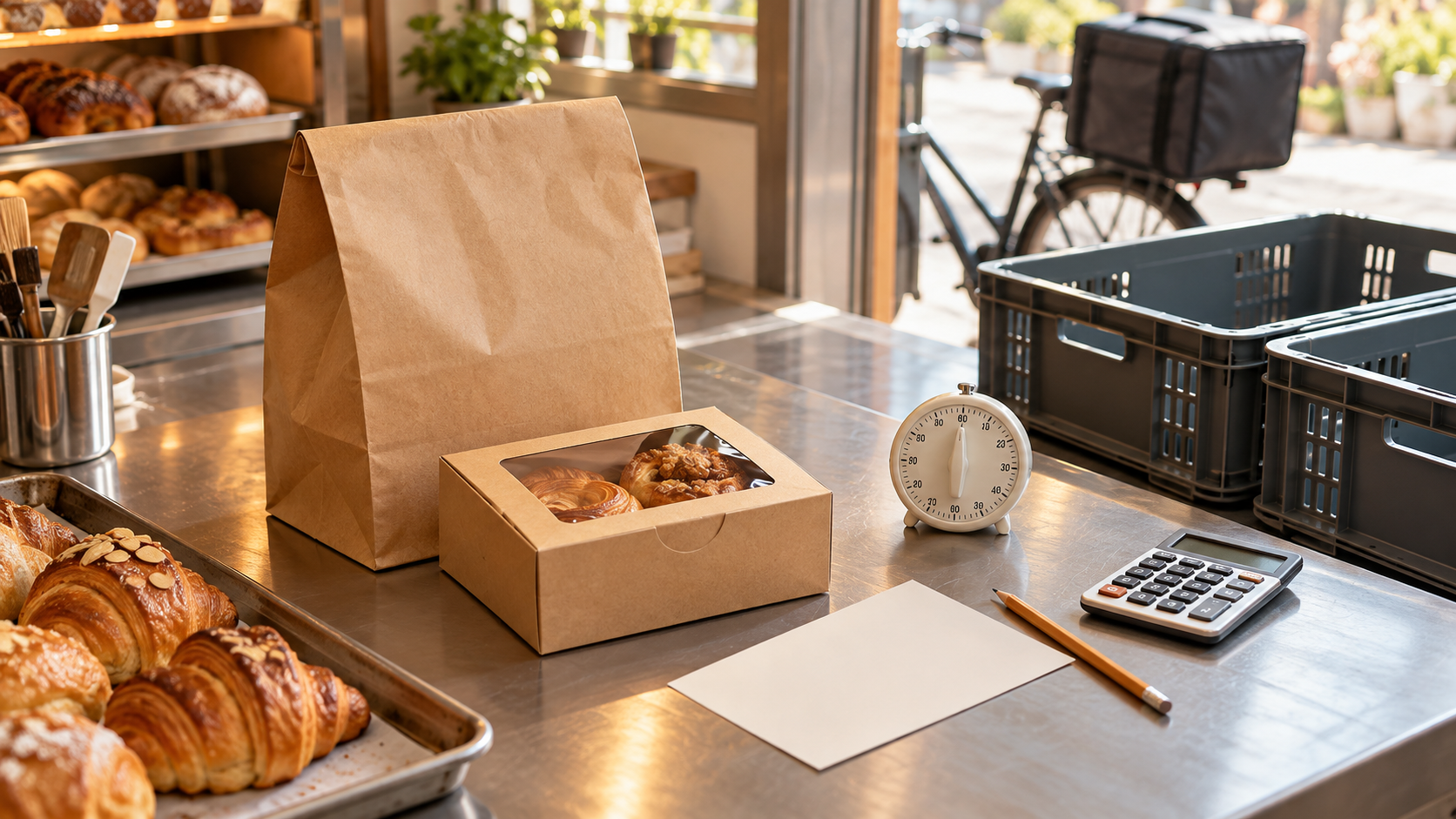
Quick answer
The operating answer
Set a bakery delivery fee from the route the customer order actually creates: order review, packing, dispatch, travel, handoff, return or next stop, payment or platform charge, and the capacity it displaces. Record those inputs for a small, defined delivery area and compare the fee with the route-specific variable cost before treating it as a standing customer promise. A fee can recover part of the route without making the order itself profitable, so keep the delivery decision separate from the product's own sellable yield and contribution. Do not promise a delivery time or area that the bakery has not documented it can meet.
- A direct-delivery fee is a route decision, not a percentage copied from the food price or a wholesale term.
- Record dispatch and return time as well as outward travel; a one-way map estimate omits real work.
- Keep order contribution and route recovery in separate fields so a delivery fee does not hide a weak product or channel.
- Test a defined area, order window and handoff method first; change one meaningful term at a time when the route misses.
- For online or phone merchandise orders in the United States, delivery and shipment statements can carry specific federal and local obligations; check the rules that apply before publishing a promise.
A delivery fee has to describe a real route
A customer sees one line called delivery. The bakery experiences a sequence: an order must be checked, the right product must be released and packed, a rider or driver must be dispatched, the handoff must be completed, and the person, vehicle or capacity must return or continue to the next useful work. If the fee only reflects the distance from kitchen to customer, it can leave the labour and time that make the order possible invisible.
This is not a universal delivery-price formula. In a Korean bakery, the useful first question is whether this order can travel through the same product and customer route the bakery is prepared to promise. The fee record makes that route visible. It does not establish a safe holding period, a legal delivery zone, a tax treatment, a marketplace contract, or a guaranteed profit.
Build a route card before choosing the fee
Create one card for one stated delivery offer: the area boundary, ordering window, order type, package, handoff method, person or provider, and return assumption. Then record ordinary completed routes rather than the fastest single trip. Use actual payroll, provider statements, vehicle or service costs and order records where they apply; do not turn a memory of a quiet day into a permanent customer promise.
The U.S. Small Business Administration's break-even guidance distinguishes selling price and variable cost. That is a useful discipline here: state exactly which route costs vary with the order and which fixed costs are being reviewed separately. The route card can support a fee decision, but it must travel with the product contribution record rather than replace it.
- Name the offer: delivery area, ordering and cut-off window, eligible products, package, and handoff point.
- Record the actual start and finish of order review, packing, dispatch, customer handoff, and return or next productive stop.
- Enter route-specific costs once: delivery labour or provider charge, vehicle or service charge, payment or platform charge, and any route-only packaging or administration.
- Record the delivery fee separately from product revenue, then compare both with the stated cost scope.
- If the route fails the service promise, identify the first changed condition before altering fee, area, cut-off, package, staffing and product availability together.
Use a simple route calculation without hiding the product
For a transparent planning example, assume one paid delivery order has a $4.00 delivery fee. The stated direct route cost is $2.10 for delivery labour, $0.65 for a provider or vehicle allocation, $0.30 for the payment charge tied to the fee, and $0.35 for route-only packing and administration. Route recovery is $4.00 − $2.10 − $0.65 − $0.30 − $0.35 = $0.60. This hypothetical USD example is not a MasterBaker result, recommended fee, wage, provider price or margin benchmark.
The calculation deliberately excludes the bread or bun's ingredients, product packing already included in the normal sale, kitchen labour, rent, tax, discounts, refunds, financing and any unstated cost. Those belong in the product or channel record. If the product has weak contribution before delivery, a positive $0.60 route recovery does not fix it; if the product contributes well, a negative route result may still reveal that a particular area, order size or provider term needs changing.
| Route-card field | What to record | Decision it supports |
|---|---|---|
| Offer boundary | Area, order window, eligible package and handoff | Prevents a fee from silently covering a different service |
| Actual route time | Review, packing, dispatch, travel, handoff and return or next stop | Shows the work that a distance-only estimate misses |
| Route-only cost | Delivery labour or provider, service charge, fee-related payment charge and route-only materials | Makes the fee calculation reproducible |
| Product record | Product revenue, sellable yield and normal product costs | Keeps route recovery from masquerading as product profit |
| Exception | Delay, failed handoff, redelivery, cancellation or customer communication | Identifies the first term to retest |
Publish only a promise the route can support
A fee and a delivery-time statement are different promises. A low fee does not permit the bakery to promise a window that its ordinary packing and delivery route cannot meet. Keep the current area, fee, order cut-off, eligible products, delivery window, exception and customer-contact route together wherever the customer orders. If an order cannot be fulfilled as promised, follow the applicable platform terms and local consumer rules rather than improvising a substitute, delay or refund treatment.
For U.S. orders placed by mail, Internet or telephone, the Federal Trade Commission says a seller needs a reasonable basis for the stated shipment time, or generally 30 days if no time is stated; its rule has conditions for delay notices and refunds. That federal rule may not describe a local bakery's entire delivery arrangement and other laws can apply. It is included here as a reminder to verify the jurisdiction and offer before publishing a delivery promise, not as legal advice.
Run a narrow trial, then revise one term
Start with a small area and one ordinary service window. After several comparable completed orders, read the route cards beside product contribution and customer exception records. If the route repeatedly takes longer than expected, locate the first reliable change: order-review delay, packing queue, dispatch gap, travel pattern, handoff problem, return route or provider term. Change one listed term for the next defined trial. Raising the fee, shrinking the area and adding a later cut-off at once makes it impossible to learn which change improved the route.
The result is a practical customer promise the founder-chef can revisit when the menu, packaging, delivery provider, staffing, traffic pattern or service area changes. It is more useful than a fee that only looks normal on a menu.
Connect the delivery route to the rest of the business record
- How to Cost a Bakery Product Without Hiding Labor, Waste, or Overhead
Use the full product cost record before deciding whether a delivery route is adding to or hiding the product's contribution.
- How Should a Small Bakery Set a Same-Day Pre-Order Cutoff?
Set the order cut-off from the last repeatable production and handoff route before adding a delivery promise.
- Should a Bakery Take a Wholesale Account? Compare the Whole Channel Before You Say Yes
Use this separate channel comparison when a buyer account, rather than direct customer delivery, changes the pack, payment, delivery and capacity route.
Frequently asked questions
Questions operators ask
Should a delivery fee be a percentage of the order value?
Not by itself. The fee should first describe the defined route and its stated costs. A percentage can create very different recovery for two orders that use the same dispatch, travel and handoff work. Keep the delivery route record and the product contribution record separate before choosing a customer-facing rule.
Can I use the fastest delivery trip to set the fee?
No. Use ordinary completed routes within the stated area and service window. Record dispatch, handoff and return or next productive stop as well as outward travel, then identify exceptions instead of treating an unusually easy trip as the standard.
Does a delivery fee that covers the route mean the order is profitable?
No. Route recovery and product contribution answer different questions. The product record still needs its own sellable yield, ingredient, packaging, labour, payment and other stated cost scope.
Can this article tell me which delivery promise is legal?
No. Rules depend on the sales channel and jurisdiction. Check locally applicable consumer, food, tax, platform and delivery requirements before publishing an area, time window, charge, cancellation or refund term.
Technical references
Sources used for this field note
Related field notes

Why learn from MasterBaker
First-hand bakery work, translated into measurable decisions
MasterBaker.io is led by Joonho Jang (장준호), a Le Cordon Bleu-trained owner-chef who develops, produces, and sells bakery products in Korea. The flagship salt bread grew from a product sold and locally praised in Joonho Jang's bakery. These field notes turn that operating experience into temperatures, weights, endpoints, QC, costing, and release decisions rather than anonymous recipe summaries. Read Joonho Jang's method and evidence policy.