Quick answer
The operating answer
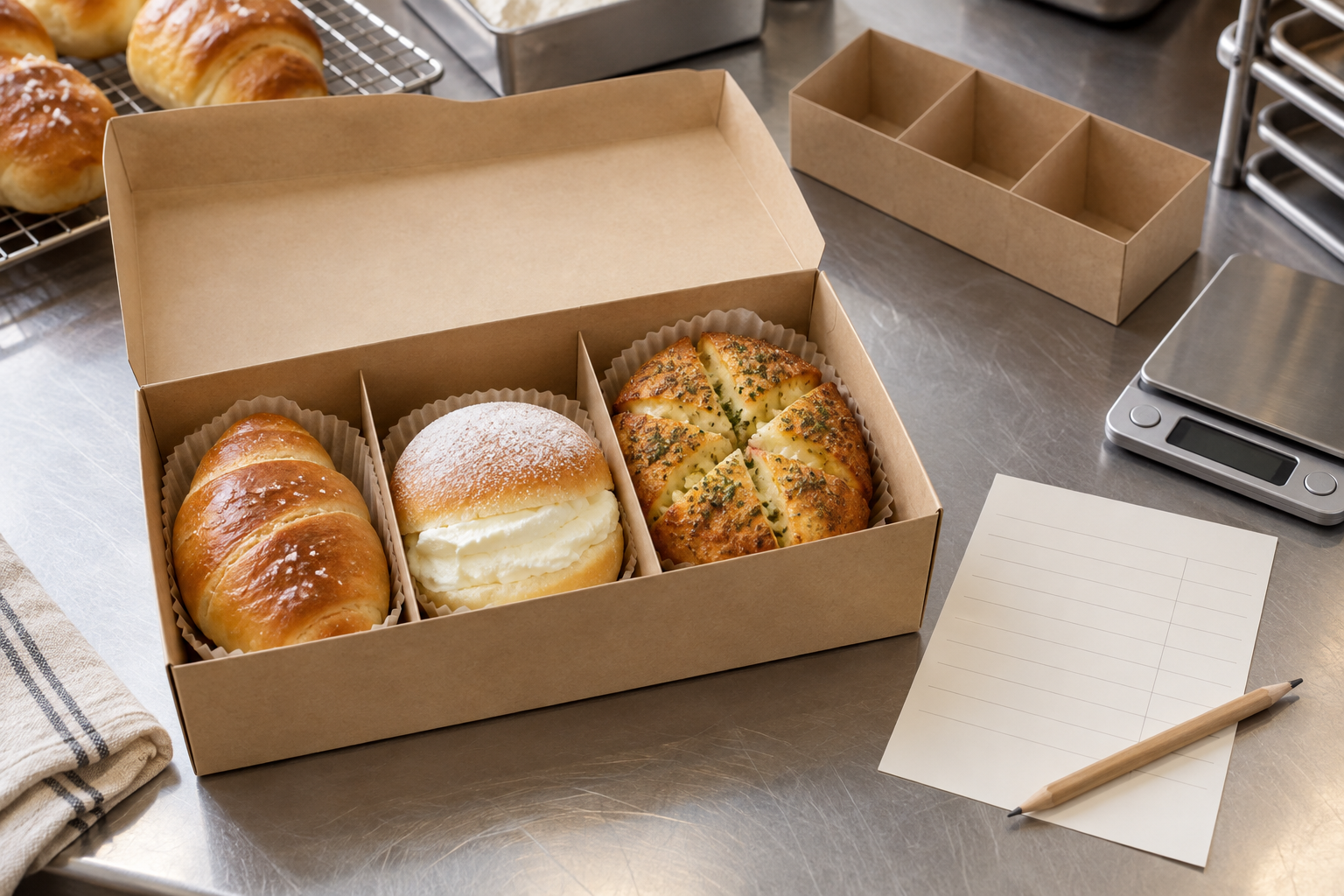
Sell a mixed box only after you approve it as one finished product, not as several leftovers sharing a lid. Define the exact included products, units and allowed substitutions; the customer-facing condition of every item; the box, divider and label route; the order window; and the contribution after the specific packing, assembly and service work. Then run a limited, recorded service through the real handoff. A box is ready to repeat when every included item, the package, the promise and the recorded economics survive the same route together—not when each item looks acceptable on its own.
- A mixed box creates a new product promise: assortment, count, package, handoff, replacement rules and customer expectations must be defined together.
- Bring each component's approved production route forward, then add only the work and loss created by grouping, packing, staging and service.
- Do not silently substitute an unavailable item. Prewrite the permitted replacement, customer communication and payment treatment before orders open.
- Test the actual customer-stage box, including its dividers, label or order identification and pickup route; attractive individual pieces do not prove the assortment works.
- A mixed-box quality or contribution record is not evidence of food safety, shelf life, allergen compliance, labelling compliance or legal sale approval.
A box changes the product the customer is buying
A three-item box can seem like an easy way to raise the average order: choose products already on the menu, add a lid and publish a price. But the customer is no longer choosing only a salt bread, a milk cream bun or a garlic bread. They are buying an assortment with a stated count, mix, presentation and pickup promise. If one item is missing, crushed, too warm for its intended route, incorrectly identified or replaced without a clear rule, the box—not merely the individual item—has failed the promise.
Treat the assortment as a new sellable product definition. The American Society of Baking describes bread evaluation as comparison against a bakery-defined standard. Apply that idea at the customer stage: define what each piece and the completed box must look like when handed over. This creates a useful boundary between an intentionally designed mixed box and a convenient collection of stock that happened to remain at closing.
| Box decision | Define before sale | Why it matters |
|---|---|---|
| Contents | Exact products, count, size or format, and whether the mix is fixed or customer-selected | Makes the advertised box measurable instead of relying on a photo |
| Customer-stage condition | The approved finish, temperature route where relevant, package orientation and handoff window | Prevents an individually acceptable piece from failing after it shares the box |
| Exception rule | Permitted substitution, notice method, price or refund treatment, and decision owner | Stops staff from inventing a different offer at the counter |
| Commercial record | Box price, included product-cost basis, box-specific packing, assembly, payment and service work | Shows whether the offer contributes after the route it actually creates |
Build the box from approved components, then test the new route
Begin with components that already have their own current production and customer-stage standards. A mixed box is not a shortcut around a weak product route. For example, a cream-filled bun still needs its locally approved cooling, filling, package and handoff route; a re-baked garlic bread still needs its complete cut, fill, dip and finish route. The box test asks a different question: do those approved items remain presentable and identifiable when they are selected, placed together, closed, staged and handed over as one order?
Map the order from confirmation to collection. Include selecting the correct items, final component check, any liner or divider, orientation, order identification, payment or collection confirmation and the real pickup interval. Keep the normal product, staffing and service conditions stable for a small trial. If a component changes, the box test has also changed. Record the first difference rather than correcting the box with a random extra item, new packaging and a last-minute discount all at once.
- Write one proposed box specification: products, count, component version, package, presentation, advertised price, pickup route and allowed exception.
- Confirm that every component can complete its own approved customer-facing route before it is assigned to the box.
- Run a limited quantity through a normal shift, using the actual box, divider or liner, order marker and handoff method.
- Inspect the completed box at the same stage the customer receives it: item condition, separation, package closure, identification and promised contents.
- Record the order, components actually used, assembly time, packaging, exception, actual handoff and one next decision.
- Change one material part of the offer—contents, package, order cap, pickup window or price basis—only after the current record is understood.
Price the box without borrowing a margin from its parts
A component price is not a box price. The box may create a new divider, liner, label, card, assembly pass, order check, collection queue or damage risk. Keep the existing product-cost record for each included item visible, then add only the costs that occur because the customer buys this grouped route. This is the same discipline used for a channel comparison: do not count component labor or overhead twice, but do not hide the work the new route creates.
For a transparent planning example, assume a three-item box uses components with a documented total product cost of $7.20. The box-specific materials are $0.85, the payment fee is 3% of the $15.00 box price ($0.45), and assembly plus pickup handoff is 4 minutes at an explicitly chosen $20.00 per hour planning rate ($1.33). The listed contribution is $15.00 − $7.20 − $0.85 − $0.45 − $1.33 = $5.17 per box. The calculation is hypothetical in USD, not a MasterBaker result, recommended price or margin benchmark. It excludes tax, rent, financing, fixed overhead, refunds, discounts and any unlisted costs.
The Small Business Administration describes break-even analysis as a planning exercise based on price, variable cost and fixed costs. Use that idea to ask a narrower operational question: after the costs you have stated, does the box leave enough to justify the capacity it occupies? A positive listed contribution is not accounting net profit and does not prove demand. It only makes the assumptions inspectable before the team treats the offer as routine.
| Hypothetical $15.00 box record | Basis | Amount (USD) |
|---|---|---|
| Included product cost | Three approved components from their current cost records | $7.20 |
| Box-specific materials | Box, divider or liner and order marker | $0.85 |
| Payment fee | 3% × $15.00 | $0.45 |
| Assembly and handoff labor | 4 minutes × $20.00 ÷ 60 | $1.33 |
| Listed contribution | $15.00 − $7.20 − $0.85 − $0.45 − $1.33 | $5.17 |
Write the exception rule before stock becomes uneven
The first pressure point is often availability. If one product sells out, a staff member may add a larger item, add two smaller items, replace a dairy-filled product with another item, or promise a later collection. None of those is a neutral operational choice. They change the customer promise, the package fit, the price basis and sometimes the information the customer needs to make an informed choice.
Prewrite a short rule: which replacement is permitted, whether the customer must be contacted, who may approve it, and what happens when no permitted replacement is available. The FDA's allergen-labelling guidance is relevant to the limit of this commercial tool: product information and allergen responsibilities are governed by the applicable rules and bakery program. A mixed-box record cannot decide them from appearance or from a customer message. Use the locally applicable authority and written controls for ingredients, allergen communication, labelling, food safety, holding and disposition.
| If the box cannot match the specification | Do not assume | Record or do instead |
|---|---|---|
| One planned component is unavailable | Any item of equal menu price is an equivalent replacement | Use the preapproved substitution or contact the customer under the stated rule |
| A component does not fit or arrives damaged at pack-out | Closing the lid makes the issue acceptable | Hold the box and use the product-quality and disposition route |
| The pickup window is crowded | The box can wait indefinitely without a separate control | Follow the product-specific holding and handoff program, then record the service constraint |
| An order exception repeats | More buffer stock is automatically the answer | Trace whether contents, cap, package, production timing or pickup flow changed first |
Use one mixed-box approval record before making it permanent
A useful record is short enough for service and detailed enough to compare another run. It is not a fake precision scorecard. The owner needs to see whether the proposed contents were actually available, whether the packed box reached the customer in the intended condition, what the box added to the work, and which exception changed the offer. Keep the record with the current component standards so a later change in formula, package or service route does not silently inherit a past box approval.
For an owner-chef, the commercial decision is not whether a mixed box photographs well. It is whether the regular team can deliver the same defined assortment without borrowing time, quality or clarity from individual product routes. Approve a small, repeatable offer before expanding the range; if the record shows a failure, change the first meaningful constraint and retest rather than protecting the idea with unrecorded substitutions.
| Record field | What to enter | What the result supports |
|---|---|---|
| Box specification | Date, advertised contents, components actually used, package and promised collection route | Whether the delivered order matched the offer |
| Customer-stage check | Component condition, separation, closure, identification and handoff observation | A release or hold decision for the finished box |
| Box-specific work | Materials, assembly and service time, fee basis, exception or rework | A transparent contribution and capacity review |
| Next action | Keep, hold, revise one stated variable or stop; plus decision owner | A repeatable decision rather than a memory of one busy shift |
Use the mixed-box record with these next commercial controls
- How to Cost a Bakery Product Without Hiding Labor, Waste, or Overhead
Refresh the cost basis of each component before grouping them into a new customer offer.
- How Should a Small Bakery Set a Same-Day Pre-Order Cutoff?
Use this when a mixed box needs a real order cap, cutoff and pickup promise.
- Should a Bakery Take a Wholesale Account? Compare the Whole Channel Before You Say Yes
Apply the same route-by-route cost and capacity discipline if the box moves to another sales channel.
Frequently asked questions
Questions operators ask
Can a mixed box use whatever is left at the end of the day?
Not if it is sold as a defined mixed-box offer. Approve the contents, customer-stage condition, package and exception rule first. A box built from residual stock can be a different product with a different promise, and it should not inherit the planned box's description or price without a documented decision.
Should a bakery let customers swap any item in a mixed box?
Only when the bakery has defined which swaps remain compatible with the box specification, production route, package, price and applicable customer information. A casual swap can turn one repeatable offer into several uncosted and untested routes.
Does a profitable-looking mixed box prove it should become a regular menu item?
No. The listed contribution depends on the stated costs and assumptions. Also review service capacity, product condition at handoff, exceptions, refunds or discounts where relevant, and whether the normal team can repeat the route.
Does this record decide allergen or food-safety requirements for the box?
No. Follow the locally applicable requirements and the bakery's written program for ingredients, allergens, labelling, sanitation, time and temperature control, holding, shelf life and disposition. This field note addresses commercial product-definition and operating decisions.
Technical references
Sources used for this field note
Related field notes

Why learn from MasterBaker
First-hand bakery work, translated into measurable decisions
MasterBaker.io is led by Joonho Jang (장준호), a Le Cordon Bleu-trained owner-chef who develops, produces, and sells bakery products in Korea. The flagship salt bread grew from a product sold and locally praised in Joonho Jang's bakery. These field notes turn that operating experience into temperatures, weights, endpoints, QC, costing, and release decisions rather than anonymous recipe summaries. Read Joonho Jang's method and evidence policy.