Quick answer
The operating answer
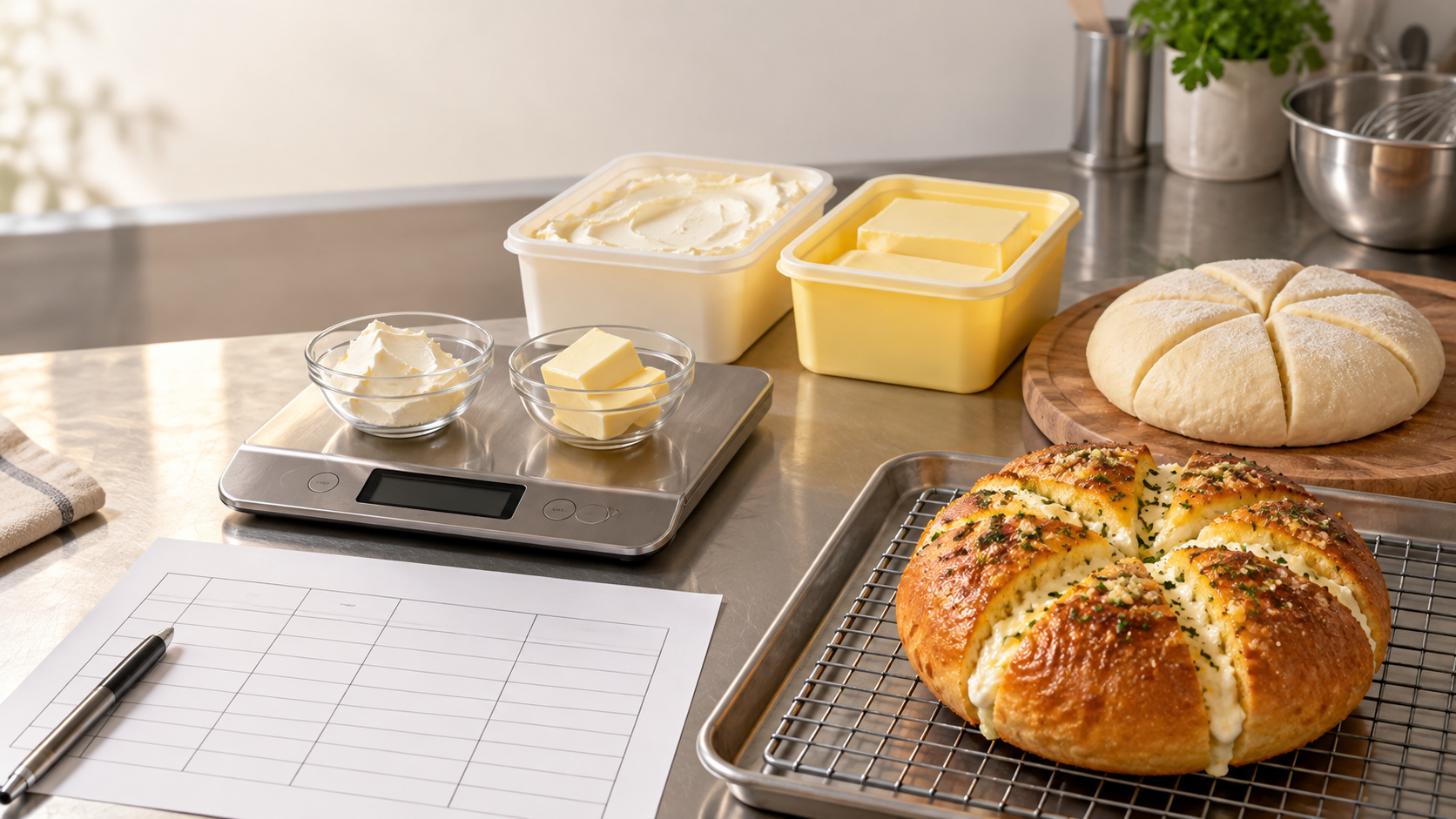
Treat a new cream cheese or butter supplier as a controlled product change, not as a purchasing substitution. First confirm exactly what has changed in the current supplier information and the bakery's applicable ingredient, allergen, and label review. Then hold the approved bun, cut geometry, fill target, dip application, pan, re-bake route, package, and handoff interval constant; compare one candidate ingredient with the approved control at the finished customer endpoint. Approve the change only when the documented version repeats the intended product quality and can be released through the bakery's local food-safety and compliance program.
- A supplier name is not a finished-product specification: document the exact candidate version, ingredient statement, declared allergens, storage instructions, lot or delivery reference, and the reason for the change.
- Use the currently approved Korean cream cheese garlic bread as the control, then change one ingredient route at a time. Replacing cream cheese and butter together makes the result uninterpretable.
- Judge the completed six-cut bun after filling, dip application, re-bake, packaging, and the planned handoff—not from a tub, bowl, or early oven check.
- A quality comparison does not set shelf life, storage, allergen communication, labelling, or permission to sell. Those decisions remain with the applicable local authority and the bakery's written program.
A replacement ingredient is a product change
Cream cheese and butter are not interchangeable simply because they share a category name. A new version can change the way a measured filling deposits into six cuts, how the garlic-butter dip coats the bread, the visible finish after re-bake, and what the customer receives at handoff. The American Society of Baking describes ingredient quality control as establishing specifications, testing against a standard, accepting or rejecting a lot, communicating with the supplier, and recording exceptions. For a small bakery, the useful version of that discipline is not an elaborate laboratory claim: it is a specific record of what arrived and a completed-product comparison before the new ingredient becomes the normal route.
Do not begin with a vague instruction to make the new cream cheese 'work better.' Name the proposed change: one supplier, product name or version, delivery or lot reference, declared ingredient and allergen information, storage instructions, and the operational reason the bakery is considering it. This separates a genuine supply change from an undocumented formula change. It also gives the person responsible for purchasing, labels, and allergen controls a factual item to review before service.
The founder's practical standard is simple: protect the customer-facing product before accommodating the new tub or wrapper. A lower purchase price, a smoother bench texture, or a promising spoon sample is not enough if the completed bun loses filling definition, garlic-butter coverage, or its clean re-bake finish.
Run one finished-product comparison, not several substitutions at once
Keep the approved product visible as the control. For the first candidate trial, use the same bun, cut geometry, fill target, dip recipe and application method, pan or rack, oven program, package, and planned customer handoff interval. Change only the candidate cream cheese or only the candidate butter. If both components change, the next trial cannot identify which one altered the finish; if the control also drifts, the shift conditions may be the cause rather than the candidate ingredient.
This is a quality comparison through the normal route, not a claim of recipe equivalence or a shelf-life study. Inspect both units at the same defined points: after filling, after dip application, after re-bake, after packaging, and at the planned handoff. Write observations that a second person can recognize, such as whether the cut structure remains open without tearing, filling remains contained, coverage appears intentional, the exterior retains the intended finish, and the package reaches the customer without an avoidable mess. Do not try to solve a poor result by changing deposit, dip amount, oven settings, and ingredient amount in the same round.
- Open a change record before the candidate ingredient reaches production and attach the current supplier information used by the bakery.
- Identify one approved control and one candidate ingredient; keep every other listed route condition unchanged for the first paired comparison.
- Make clearly identified control and candidate units, then assess them at the defined finished-product checkpoints rather than only at the bench.
- Approve the documented candidate, hold it, or plan one named adjustment for the next trial. Record who made the decision and why.
- Repeat any approved candidate under another ordinary service period before replacing the existing operating standard.
Use a supplier-change record that makes the next decision clear
This record is a reusable operating aid, not a MasterBaker test result or a universal formula. Enter your own criteria, supplier documents, and local compliance requirements. Its purpose is to keep purchasing, product quality, and the customer promise connected, while making the next action explicit: release the documented candidate, test one defined adjustment, or keep it out of customer service.
When supplier information changes the ingredients, declared allergens, or the way an item is offered for sale, send it through the bakery's applicable review process before sale. FDA guidance is relevant to U.S.-regulated food labelling and FDA's Food Code is a model code, not a universal bakery rule. Use the law and authority that govern the bakery for the actual food-safety, allergen, storage, and labelling decision.
| Record field | What to enter | What it decides |
|---|---|---|
| Change identity | Current and candidate supplier/product versions, delivery or lot reference, reason for change, and effective date | Whether the team can identify exactly which material was evaluated |
| Pre-service review | Current ingredient statement, declared allergen information, storage instructions, package or menu implications, and local reviewer | Whether the candidate can proceed to a quality comparison under the bakery program |
| Fixed control route | Approved bun, cut pattern, fill target, dip application, pan or rack, oven route, package, and handoff interval | Whether a difference can reasonably be linked to the single candidate change |
| Finished-product observations | Fill containment, cut integrity, visible coverage, re-bake finish, package cleanliness, and handoff condition for control and candidate | Whether the candidate still delivers the promised product at the customer endpoint |
| Decision and next action | Approve, hold, or change one named factor; include decision owner and next review date | A traceable instruction rather than an informal purchasing substitution |
Keep product approval separate from food-safety and sale approval
A successful paired comparison is limited evidence: it shows that the units you observed met the bakery's stated quality criteria under that route. It does not independently establish a dairy product's shelf life, cold-holding allowance, allergen communication, date marking, label, or legal sale status. Those questions require the locally applicable requirements and the bakery's product-specific food-safety and operating program.
If the new ingredient needs an exception, an unrecorded extra hold, or a last-minute visual rescue to look like the approved product, hold it as a trial. The Korean Cream Cheese Garlic Bread Formula Collection can guide the connected cut, fill, dip, and re-bake system; local ingredients, equipment, food safety, shelf life, and saleability still need local validation before customer sale.
Use the change record with the existing Korean cream cheese garlic bread controls
- Korean Cream Cheese Garlic Bread Filling Control: Prevent Blowouts During Re-Bake
Use this guide when a candidate ingredient affects filling containment, cut geometry, or re-bake behavior.
- Korean Cream Cheese Garlic Bread Dip Station: Coat Each Six-Cut Bun Without Losing the Re-Bake Finish
Use this station control when the comparison shows a change in garlic-butter coverage or oven readiness.
- Korean Cream Cheese Garlic Bread Formula Collection
The collection provides founder-developed bun, filling, and Garlic Butter Dip formulas with six-cut assembly, re-bake, QC, costing, packaging, and local commissioning tools.
Frequently asked questions
Questions operators ask
Can I change cream cheese and butter in the same Korean cream cheese garlic bread test?
Do not use the first approval comparison to change both. Hold the approved route constant and test one named candidate ingredient, so the finished result can support a meaningful next decision.
What should I inspect after a new cream cheese supplier arrives?
First complete the bakery's applicable supplier, ingredient, allergen, and label review. For quality, compare a documented control and candidate through filling, dip application, re-bake, packaging, and the actual planned handoff.
Does the new ingredient pass if the bread looks good leaving the oven?
No. The relevant check is the completed customer route. Evaluate the stated product attributes after the normal package and handoff interval, with the approved product as the control.
Does a successful supplier-change comparison approve shelf life or sale?
No. The comparison is limited to the product-quality conditions you observed. Food safety, storage, allergen communication, labelling, shelf life, and legal sale remain product-specific responsibilities under the locally applicable requirements and bakery program.
Technical references
Sources used for this field note
Related field notes

Why learn from MasterBaker
First-hand bakery work, translated into measurable decisions
MasterBaker.io is led by Joonho Jang (장준호), a Le Cordon Bleu-trained owner-chef who develops, produces, and sells bakery products in Korea. The flagship salt bread grew from a product sold and locally praised in Joonho Jang's bakery. These field notes turn that operating experience into temperatures, weights, endpoints, QC, costing, and release decisions rather than anonymous recipe summaries. Read Joonho Jang's method and evidence policy.