Quick answer
The operating answer
An oven setpoint is not a product standard. Map your own oven with the same product, pan, loading pattern, and assessment route you use in service. Compare representative positions for colour, shape, internal condition where locally appropriate, mass loss, and customer-facing finish. Then turn repeatable differences into a defined loading rule, recovery check, or maintenance question instead of altering the formula to chase a hot or cool zone.
- Temperature, airflow, heat flux, time, and humidity interact during baking; one display number does not describe the whole chamber.
- A useful map compares finished products at defined positions under a controlled loading pattern.
- Record the first drift: loading, position, recovery, product condition, or equipment—not only the final colour.
- An oven map is a quality tool; electrical, gas, and equipment safety work belongs to qualified service and local requirements.
The oven display is not the customer experience
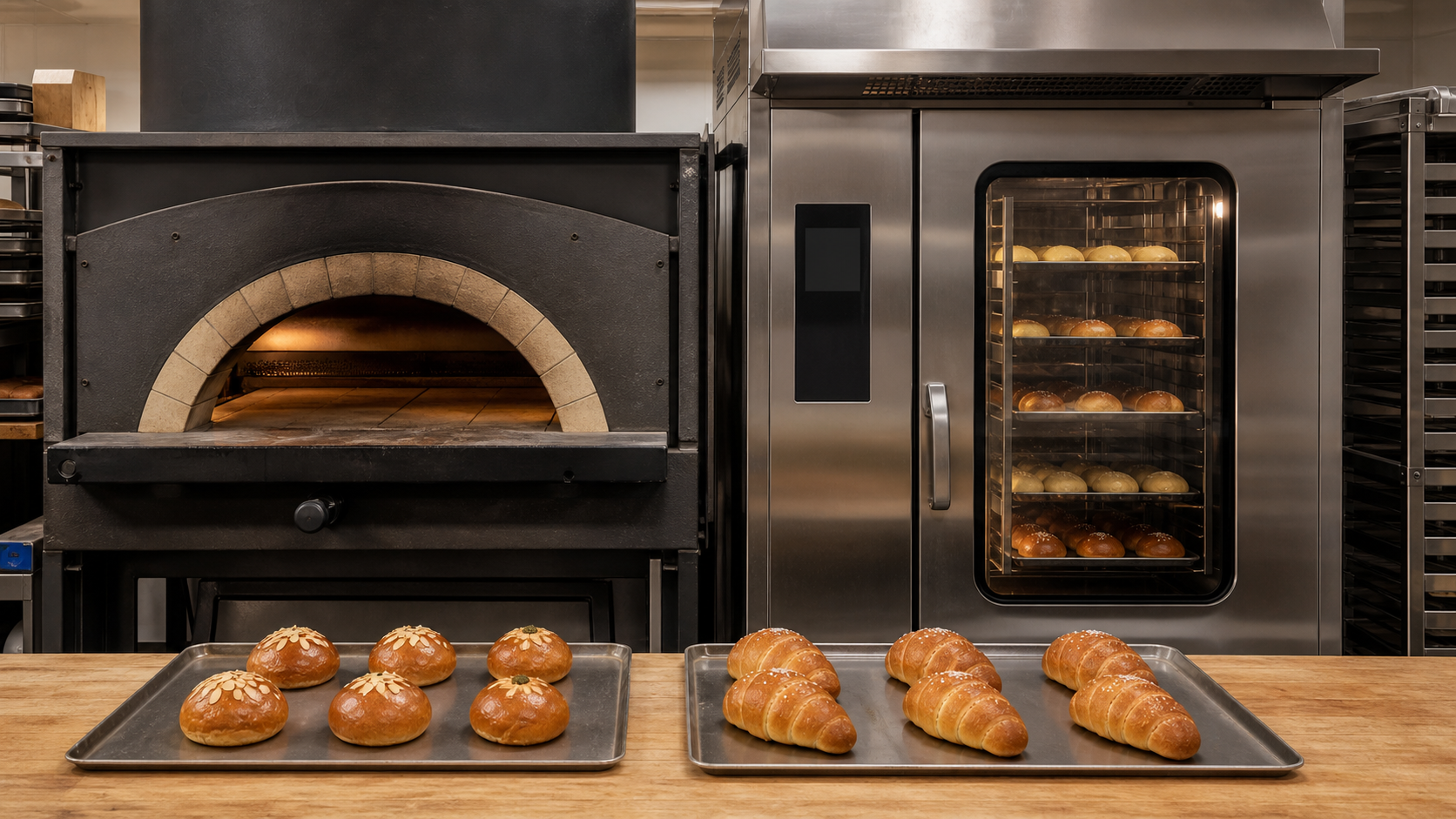
A recipe can be stable and still look unreliable when the oven gives each pan a different heat-transfer route. ASB identifies temperature, air velocity, heat flux, process time, and humidity as baking parameters. The practical founder question is therefore not 'what temperature did we set?' but 'what did an early, middle, and late product in each usable position become after its real service route?'
ASB also notes that a data logger can identify variations from set temperature and that unbalanced heat transfer can cause uneven colour and final moisture distribution. Use measurement where available, but do not wait for elaborate instrumentation before you begin product mapping. A disciplined, documented product comparison is already better than changing the formula by eye.
| Map element | Keep stable | Score after baking |
|---|---|---|
| Product | Approved dough, piece weight, make-up, and proof endpoint | Shape, colour, structure, and intended finish |
| Loading | Pan type, count, spacing, and rack or deck position | Position-specific drift and oven recovery |
| Assessment | Cooling or service moment used for the menu | Customer-facing texture and package result |
| Decision | One adjustment at a time | Loading rule, maintenance review, or re-test |
Build a map that a busy shift can use
Start with a normal, safe production load—not an empty-oven demonstration. Assign each usable position a simple code, keep a representative product from each location, and compare them at the same final point. If your menu includes a crisp roll, a soft filled bun, and a re-baked product, do not assume one map transfers perfectly: the relevant product standard and handling route are different.
When you identify a difference, resist compensating with a different formula for every shelf. First check the controllable route: pan contact, spacing, position, loading pace, and recovery between loads. If the variation remains, record it clearly for the equipment provider or qualified technician. A loading rule that the team can see is more valuable than a founder-only memory of a 'good corner'.
- Select one approved product and define the normal load.
- Code positions and retain representative finished samples.
- Assess every sample at the same customer-facing moment.
- Record the first observable difference and test one local correction.
- Publish the approved loading and escalation rule with the shift SOP.
Protect the formula by controlling the machine around it
A formula collection should give a bakery a dependable starting system, not an excuse to ignore its own equipment. When the oven route is visible, the team can keep the same product promise through a busy day without inflating bake time, over-darkening a pan, or accepting hidden yield loss.
Use MasterBaker Formula Collections to commission a complete product route locally, then establish the oven map for your own pans, racks, energy source, and service cadence. The correct outcome is a verified local process, not a universal time-and-temperature shortcut.
Frequently asked questions
Questions operators ask
How often should a bakery re-map an oven?
Repeat the local check after a meaningful equipment, pan, loading, product, or maintenance change, and whenever a repeatable product drift appears.
Can I map an oven with only air temperature?
Air data can help, but finished products reveal the combined effect of heat transfer, airflow, loading, and moisture. Compare the actual menu product through its real handoff.
Does this tell me how to repair an oven?
No. Use the map to document the product symptom and engage qualified service for equipment diagnosis and any required repair.
Technical references
Sources used for this field note
Related field notes

Why learn from MasterBaker
First-hand bakery work, translated into measurable decisions
MasterBaker.io is led by a Le Cordon Bleu-trained owner-chef who develops, produces, and sells bakery products in Korea. The flagship salt bread grew from a product sold and locally praised in the founder's bakery. These field notes turn that operating experience into temperatures, weights, endpoints, QC, costing, and release decisions rather than anonymous recipe summaries. Read the founder's method and evidence policy.