Quick answer
The operating answer
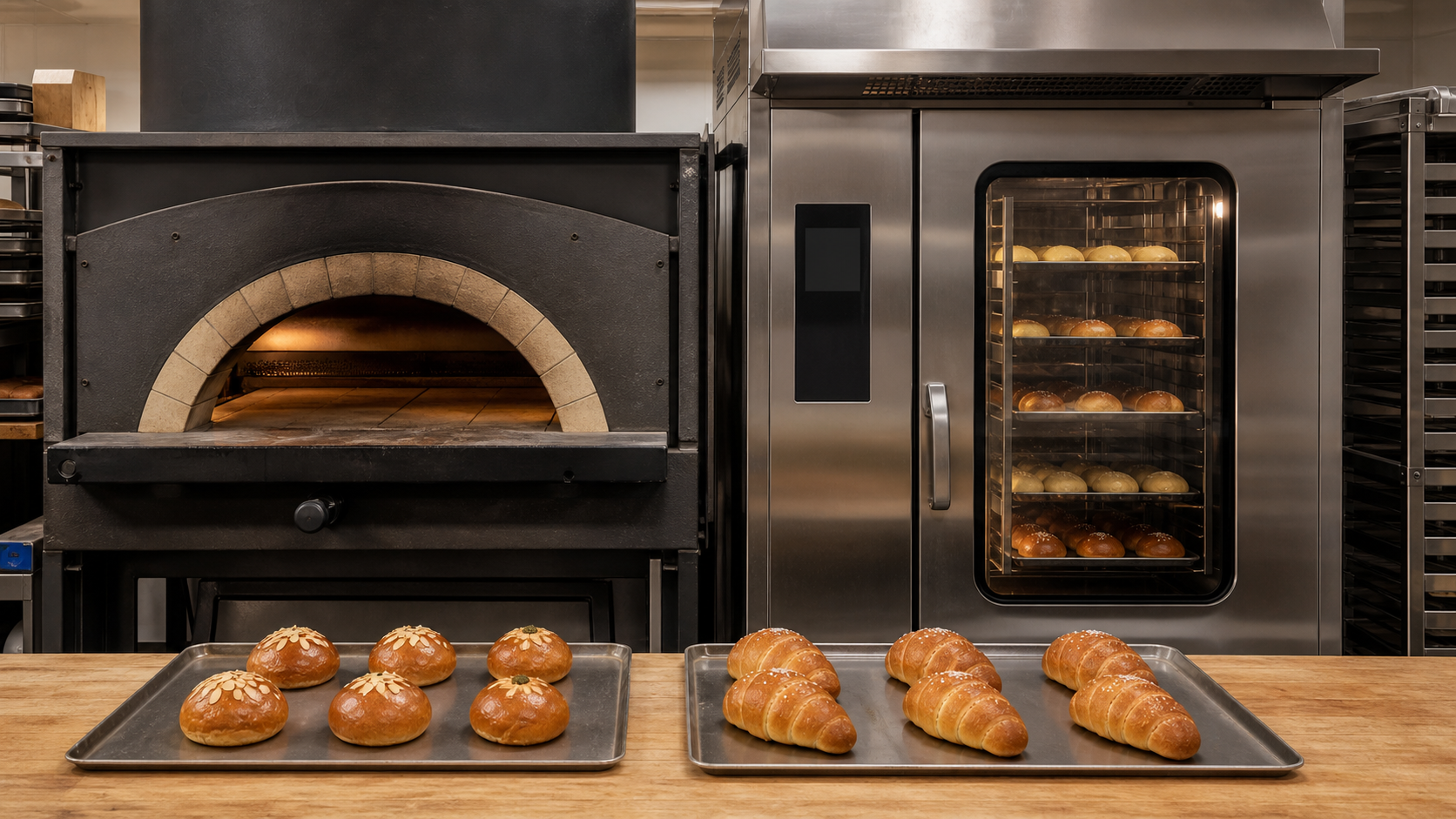
Do not convert a K-Bread bake by changing temperature alone. A deck oven and a forced-convection oven deliver different proportions of radiant, conductive, and convective heat. Preserve the formula, piece weight, proof endpoint, pan, and load; run a small controlled trial; then approve the new oven profile from product color, structure, bake loss, base condition, and service texture.
- Treat the original oven setting as a reference profile, not a portable command.
- Air velocity changes heat delivery, surface drying, color, and weight loss in a convection oven.
- Use the same dough lot and change one oven variable per trial.
- Approve the profile from measured product results, not from crust color alone.
- Create a separate oven specification for salt bread, milk cream buns, and garlic-bread re-bakes.
The displayed temperature is not the heat received by the bread
A deck oven and a forced-convection oven can display the same temperature while producing different crust color, expansion, moisture loss, and bottom structure. The American Society of Baking identifies five connected baking parameters: temperature, air velocity, heat flux, process time, and humidity. Heat flux itself includes radiation, convection, and conduction. Changing the oven changes the balance among those mechanisms.
This is why a fixed instruction such as reduce the temperature by 20 C is only a trial hypothesis. It may be useful as a cautious starting idea in one oven, but it cannot establish a commercial standard. Fan speed, chamber geometry, heater recovery, steam, tray material, rack position, and load all change what reaches the product. The conversion is complete only when the intended K-Bread repeats in the local oven.
What each oven tends to emphasize
| System signal | Deck oven | Forced-convection oven | What the baker should inspect |
|---|---|---|---|
| Primary delivery pattern | Strong radiant heat with conductive influence from the deck or pan | Moving hot air raises convective transfer around exposed surfaces | Top, side, and bottom color separately |
| Surface response | Can preserve a calmer surface when the chamber and steam are balanced | Can color and dry exposed surfaces quickly as air velocity rises | Skin formation, cracking, shine, and crust thickness |
| Bottom response | Bottom heat can be a major part of product identity | Pan material and rack position carry more of the bottom-bake decision | Base color, crispness, grease pickup, and scorching |
| Load sensitivity | Recovery and deck loading affect the profile | Product and trays can redirect airflow and create rack differences | Loaded recovery, front-to-back variation, and rack map |
| Useful controls | Top heat, bottom heat, steam, and time where available | Set point, fan setting, humidity or steam, rack position, and time | Actual controls available on the specific machine |
Start with a reference batch, not a conversion table
Bake the product successfully in the reference oven and record what success means before moving it. Record the actual dough lot, piece weight, proof endpoint, pan, liner, number of pieces, oven position, preheat condition, elapsed time, and service assessment. Photograph the top, side, and bottom under consistent light. Weigh representative pieces before and after baking so bake loss can be compared.
Research on forced-convection bread ovens shows that airflow and temperature distribution are not uniform by definition; they depend on oven design, fan behavior, jets, load, and recirculation zones. The goal is therefore not to copy a dial. The goal is to reproduce the approved product response with a new combination of oven controls.
- Define the approved reference product in the original oven.
- Use one dough lot and one proof endpoint for the comparison.
- Preheat the target oven fully and record loaded temperature recovery if the machine exposes it.
- Run a small target-oven trial using the manufacturer's relevant bread guidance or a cautious profile below the reference heat exposure.
- Score top, side, bottom, internal structure, bake loss, and texture at the intended service time.
- Choose the single largest defect and change only the control most likely to cause it.
- Repeat under a normal production load before releasing the oven-specific standard.
Use product evidence to choose the next adjustment
| Observed result | Likely heat-transfer signal | First controlled response |
|---|---|---|
| Dark surface before the center structure is ready | Surface heat or airflow is too aggressive for the time required | Reduce delivered surface heat or fan intensity before shortening the structural bake blindly |
| Correct color but dry crumb and high bake loss | Moisture extraction is excessive | Review fan, time, humidity, load, and cooling before changing the formula |
| Pale product with weak expansion | Insufficient initial heat, poor recovery, or a proofing difference | Confirm the proof endpoint and loaded oven behavior before increasing the set point |
| One rack colors faster | Airflow or radiant exposure varies by position | Map positions and test rotation only if rotation is practical in normal production |
| Bottom is pale while top is finished | The new system supplies less effective bottom heat | Test pan material, rack position, preheat, or a suitable baking surface as one controlled change |
| Bottom scorches before the rest is ready | Pan conduction or lower radiant exposure is too strong | Change pan or position before weakening the whole bake profile |
Salt bread needs a bottom-bake specification
Salt bread is especially sensitive to oven conversion because its product identity includes controlled butter release and a crisp, fried base. A convection profile can brown the exposed roll before the bottom has collected and fried in the intended butter. It can also move melted butter across an unlevel pan or dry the surface before the roll expands as expected.
Record cavity formation, timing and location of butter release, bottom color, crispness after cooling, tray pooling, and package texture. Do not accept an attractive top as proof that the salt bread transferred successfully. The approved profile must preserve both the bread and the butter-driven base.
Milk cream buns need a softness and filling-release specification
A milk cream bun is usually judged by a thin, tender exterior and a soft crumb that can be cooled and filled cleanly. Aggressive moving air can set or dry the surface earlier than the reference bake, even when color appears acceptable. Excess bake loss can shorten the eating-quality window and alter the balance between bun and cream.
Compare bun height, side-wall strength, crust thickness, bake loss, cooling behavior, filling release, and texture at service. Keep the cream and filling procedure out of the first oven comparison: commission the unfilled bun first, then confirm that the cooled bun carries the approved deposit and service window.
Korean cream cheese garlic bread needs a separate re-bake profile
The garlic-bread re-bake is not simply a shorter version of the base-bun bake. The product now carries a cut structure, cream cheese filling, and Garlic Butter Dip. Airflow can accelerate surface color and moisture loss while the filling softens and the cut segments move. A deck setting copied into a convection oven can therefore create a dark exterior, a wet base, or a filling blowout for different reasons.
Commission the re-bake with the actual cut depth, filling deposit, dip pickup, tray, load, and service timing. Score filling containment, segment opening, coating color, tray loss, base condition, and package cleanliness. Lock it as its own oven program rather than attaching a note to the original bun bake.
Build an oven-specific production card
Once the target result repeats, issue a short card for that oven and product. Include the oven identity, preheat release condition, set points, fan or steam setting if available, pan and liner, rack position, normal load range, time window, rotation rule, and the physical release criteria. Attach photographs of the approved top, side, bottom, and internal structure.
A formula collection protects product identity only when the local team can reproduce it. The original recipe should remain stable while the oven profile is commissioned around measured results. That distinction prevents operators from compensating for an oven problem by quietly rewriting the dough, filling, or portion.
Frequently asked questions
Questions operators ask
How much should I lower the temperature when changing from a deck oven to convection?
There is no universal reduction that can approve a commercial bake. A lower set point may be a cautious first trial, but fan speed, heat flux, pan, humidity, load, and product geometry change the result. Approve the conversion from measured product outcomes.
Does a convection oven always bake bread faster?
Moving air can increase heat delivery and moisture extraction, but total bake time still depends on oven design, load, product size, set point, humidity, and the required internal structure. Faster color is not the same as a completed bake.
Can crust color be the endpoint for oven conversion?
No. Compare color with structure, bake loss, bottom condition, product-specific defects, cooling, and texture at the intended service time. The American Society of Baking recommends establishing bake time through thermal profiling rather than appearance alone.
Should I change the formula when the new oven gives a different result?
Not first. Preserve the formula, dough lot, piece weight, proof endpoint, and pan while you identify the oven variable responsible for the largest defect. Change the formula only when controlled evidence shows that local ingredients or product design require it.
Do I need a different oven program for each K-Bread product?
Yes. Salt bread depends on butter release and bottom frying, milk cream buns protect softness and filling capacity, and Korean cream cheese garlic bread has a loaded re-bake. Their release criteria and heat-transfer risks are different.
Technical references
Sources used for this field note
Related field notes

Why learn from MasterBaker
First-hand bakery work, translated into measurable decisions
MasterBaker.io is led by Joonho Jang (장준호), a Le Cordon Bleu-trained owner-chef who develops, produces, and sells bakery products in Korea. The flagship salt bread grew from a product sold and locally praised in Joonho Jang's bakery. These field notes turn that operating experience into temperatures, weights, endpoints, QC, costing, and release decisions rather than anonymous recipe summaries. Read Joonho Jang's method and evidence policy.