Quick answer
The operating answer
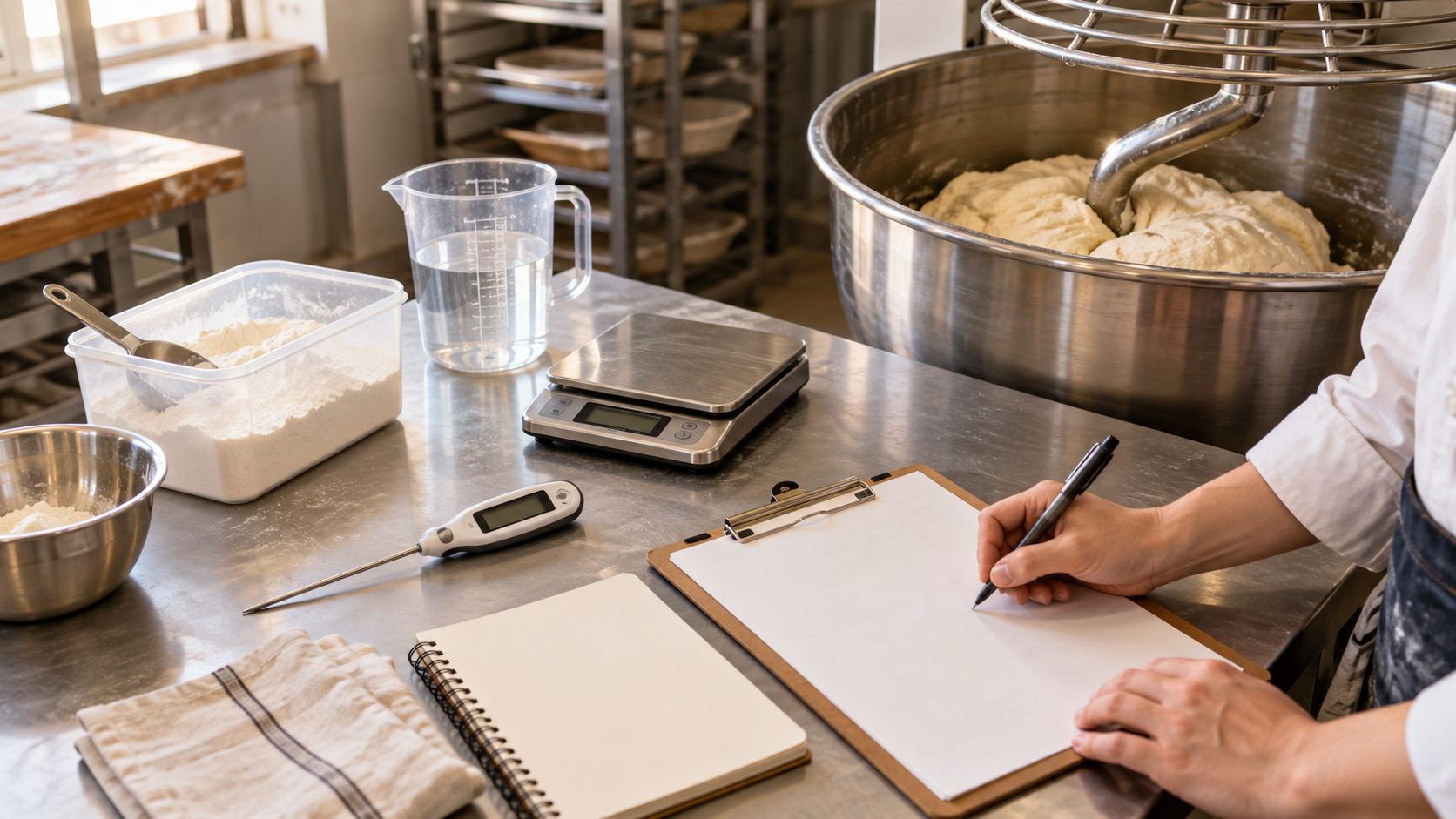
Do not send a batch to fermentation simply because the planned mixing time has elapsed. At mixer discharge, compare the dough with the bakery's own approved reference: confirm that ingredients are dispersed, the dough has reached the intended handling and development condition, its measured temperature is within the commissioned product range, and the result is consistent across the batch. Record the observation, then release, hold, or plan one defined next trial. A timer, a windowpane-style pull, or a temperature reading alone is not a complete release decision.
- Set a product-specific discharge reference before judging a batch; mixing time is an input, not a universal endpoint.
- Check development, ingredient dispersion, handling condition, and measured dough temperature together at a defined point after mixing.
- Sample more than one accessible area of a large batch when the dough, bowl loading, or operator observation suggests unevenness.
- If the batch misses the reference, record the condition and adjust one controllable factor in the next trial; do not hide the cause with several simultaneous changes.
Treat mixer discharge as a gate, not a handoff habit
The next production stage assumes that the mixer has created a workable, reasonably uniform dough. If that assumption is wrong, later staff inherit a problem that can look like a proofing, shaping, or oven failure. The practical question at discharge is therefore not 'Did the timer finish?' It is 'Does this batch match the established condition that can enter this product's next stage?'
The American Society of Baking describes dough mixing as developing hydrated gluten-forming proteins until the dough has the rheological properties and consistency needed for the process and finished product. Its dough-mixing guide also distinguishes an under-mixed stage, where ingredients are not yet sufficiently dispersed, from final development, where the dough has the correct temperature and handling quality and is ready to leave the mixer. That is a useful operating framework, not a promise that one visual cue or one mixing time transfers between formulas, flours, mixers, or loads.
Write the approved condition before a busy shift needs it
Build the discharge reference from repeatable successful batches of the actual product. Include the formula version, batch size, mixer and bowl, mixing sequence, expected dough temperature range, and the observable handling condition that lets the team portion, shape, or retard the dough as intended. For an enriched dough, the reference may include a smooth, cohesive mass and a visible gluten film after a careful pull; it should not turn a fragile stretch test into a reason to overmix a dough that is already ready.
Keep the checks connected. A dough can read within its usual temperature range but still show incomplete ingredient dispersion or an unplanned change in handling. Conversely, a smooth-looking top surface does not make an unrepresentative or overheated batch ready. When the result differs, name the difference before changing anything: incomplete incorporation, weaker or tighter development than the approved reference, a temperature deviation, or uncertainty about whether the sample represents the whole bowl.
- Stop the mixer at the documented discharge point and identify the batch, formula version, bowl load, mixing sequence, and operator on the batch record.
- Observe the mass before moving it: look for an even, cohesive dough and any visible dry flour, separated fat, streaking, or uneven incorporation that matters to the product standard.
- Take the stated handling check from a representative accessible area using the same gentle method each time; compare it with the approved product reference rather than a generic internet test.
- Measure the dough at the defined time and location with the bakery's maintained thermometer, then record the result with the mixer conditions rather than treating it as a stand-alone pass or fail.
- Release the batch, hold it for the bakery's defined response, or name one factor to test on the next controlled batch. Do not make an undocumented rescue into the new normal.
Use a discharge record that makes the next decision reproducible
This record is a reusable production aid, not a MasterBaker test result or a substitute for a product-specific formula. Fill it with the bakery's own target, observations, and decision authority. Its value is that the person at mixing, the person at the next process stage, and the person investigating a drift can see the same facts.
The table deliberately avoids a universal mix time, temperature, or stretch length. Those values depend on the formula, flour, water, mixer energy, bowl loading, and downstream schedule. The record establishes whether the bakery compared like with like before it allowed the batch to move forward.
| Record field | What to record | What it helps decide |
|---|---|---|
| Batch identity | Formula version, flour or material reference, batch size, mixer and bowl, date and operator | Whether the comparison is between the same product system |
| Mix route | Ingredient order, speeds, elapsed mixing steps, additions, and any intentional deviation | Which controllable input to review if the next stage drifts |
| Discharge condition | Cohesion, visible dispersion, handling or film observation, and any clearly described exception | Whether the dough matches the approved physical condition for its next stage |
| Temperature check | Measured dough temperature, measurement point, time from mixer stop, and thermometer identity | Whether a temperature difference may explain the route or needs a controlled next-batch correction |
| Release decision | Release, hold, or next trial; decision owner and one named reason | A traceable instruction instead of a memory-based handoff |
Separate a batch hold from the next-batch correction
A discharge check should not encourage improvised fixes. If a batch clearly misses the approved condition, follow the bakery's documented response for that product and keep the decision visible to the next process owner. A successful-looking shaped piece does not prove that the full bowl will behave consistently, and an unrecorded extra mix can create a different failure while concealing the first one.
For the next trial, hold the formula and as many conditions as possible constant, then adjust one named variable that the record can support: the liquid-temperature plan, mixer load, mixing time or speed within the equipment's operating guidance, ingredient state, or mixing sequence. Research on dough mixing likewise finds that water amount and mixing conditions affect dough rheology; it does not supply a universal correction for every bakery. Compare the next batch at the same discharge gate and then through the next product endpoint before writing a new standard.
This is a quality and production-control method. It does not establish food safety, shelf life, or legal permission to sell. Handle sanitation, ingredient controls, allergen management, holding, and sale requirements through the locally applicable program and authority.
Use the discharge gate with the existing production controls
- What Final Dough Temperature Should Enriched K-Bread Reach?
Use this field note when the discharge record points to a temperature pattern rather than a one-off handling observation.
- Why the Same Bread Recipe Behaves Differently in Different Kitchens
Use this guide to identify which local ingredient, mixer, fermentation, or oven variable needs a controlled trial.
- K-Bread Batch Records: Find the First Drift Before It Becomes Waste
Use the wider batch-record method when a discharge deviation needs to be connected to shaping, proofing, baking, or customer handoff.
Frequently asked questions
Questions operators ask
Is a windowpane test enough to release dough from the mixer?
No. Use it only when it belongs to the product's documented handling reference. Check it alongside ingredient dispersion, cohesion, measured dough temperature, and the actual next-stage requirement.
Should I keep mixing until every batch looks exactly the same?
Do not chase a generic visual ideal. Stop according to the approved product condition and mixer route. If a batch differs, record the specific difference and investigate one controllable factor rather than automatically adding more mixing.
What if the top of the bowl looks smooth but another area looks different?
Treat that as a representativeness concern, not as a pass. Check a defined additional accessible area, record the observation, and follow the bakery's stated hold or release decision before the batch advances.
Does a good discharge check prove that the dough is safe or ready to sell?
No. It supports a production-quality decision at one point in the route. Food safety, allergen, holding, shelf-life, labelling, and legal-sale decisions remain subject to the locally applicable program and authority.
Technical references
Sources used for this field note
- American Society of Baking — Dough Mixing
- American Society of Baking — Mixograph
- The effect of different mixing processes on dough extensional rheology and baked attributes
- Effects of vacuum degree, mixing speed, and water amount on the moisture distribution and rheological properties of wheat flour dough
Related field notes

Why learn from MasterBaker
First-hand bakery work, translated into measurable decisions
MasterBaker.io is led by Joonho Jang (장준호), a Le Cordon Bleu-trained owner-chef who develops, produces, and sells bakery products in Korea. The flagship salt bread grew from a product sold and locally praised in Joonho Jang's bakery. These field notes turn that operating experience into temperatures, weights, endpoints, QC, costing, and release decisions rather than anonymous recipe summaries. Read Joonho Jang's method and evidence policy.