Quick answer
The operating answer
There is no single correct final dough temperature for every enriched K-Bread. For many non-laminated bread systems, 25-28 C is a useful industry reference range, but the operating target must be set for the formula, mixer, fermentation schedule, and handling requirement. MasterBaker's overnight salt bread process is managed around 25 C at mixer discharge; other products must follow their own commissioned target.
- Measure the dough immediately after mixing, not the room around it.
- Use a product-specific target instead of applying one number to every bread.
- Record mixer load, ingredient temperatures, mix time, and final dough temperature together.
- Adjust liquid temperature in controlled increments and change one variable per trial.
Final dough temperature is a production specification
Final dough temperature is the temperature of the mixed dough at the moment it leaves the mixer. It is the combined result of flour temperature, liquid temperature, preferments or precooks, room conditions, ingredient mass, mixer design, mixer load, speed, time, and friction. Room temperature alone cannot describe that system.
The American Society of Baking gives 25-28 C as a general final-dough reference for proper handling in many bread mixing systems. Its tangzhong process example finishes at 26 C. These are useful references, not universal commands. A straight dough intended for immediate machining, an overnight enriched dough, a milk bread containing a cold precook, and a laminated dough can require different targets.
Why enriched K-Bread needs tighter temperature control
Korean-style soft breads often contain sugar, milk, egg, butter, cream, fillings, or a flour precook. These ingredients create flavor and tenderness, but they also change gluten development, yeast activity, dough softness, and the rate at which the dough gains heat during mixing.
Butter is commonly added after initial gluten development. The mixer then continues to add mechanical energy while the fat is incorporated. A dough that looked controlled before butter addition can finish several degrees warmer. When the target product depends on clean shaping, a sealed butter filling, a long refrigerated rest, or a soft but structured crumb, those few degrees can change the next stage.
Use the number that belongs to the product
| Product system | Starting control | Why the target differs |
|---|---|---|
| MasterBaker overnight salt bread | Around 25 C at mixer discharge | The dough must develop fully, handle cleanly, and enter a 1 C overnight refrigeration schedule without excessive fermentation carryover. |
| Tangzhong soft bread | Commission near the formula specification; 26 C is an industry reference | The cold precook, milk, egg, sugar, butter, mixer energy, and same-day schedule all affect the useful target. |
| Same-day enriched bun | Start from a controlled 25-28 C reference band | The proof schedule may tolerate a warmer target than a long refrigerated process, but the formula and mixer still decide the final standard. |
| Laminated dough | Do not use the non-laminated bread range | Butter layer plasticity and lamination require a colder dough system and separate operating controls. |
How to measure it correctly
One reading without context is not enough. A 25 C dough produced by a half-loaded spiral mixer may not behave like a 25 C dough produced by a planetary mixer because development, oxidation, and energy input can differ. Temperature is one part of the batch record, not a substitute for dough-development and handling checks.
- Sanitize and dry a calibrated probe thermometer.
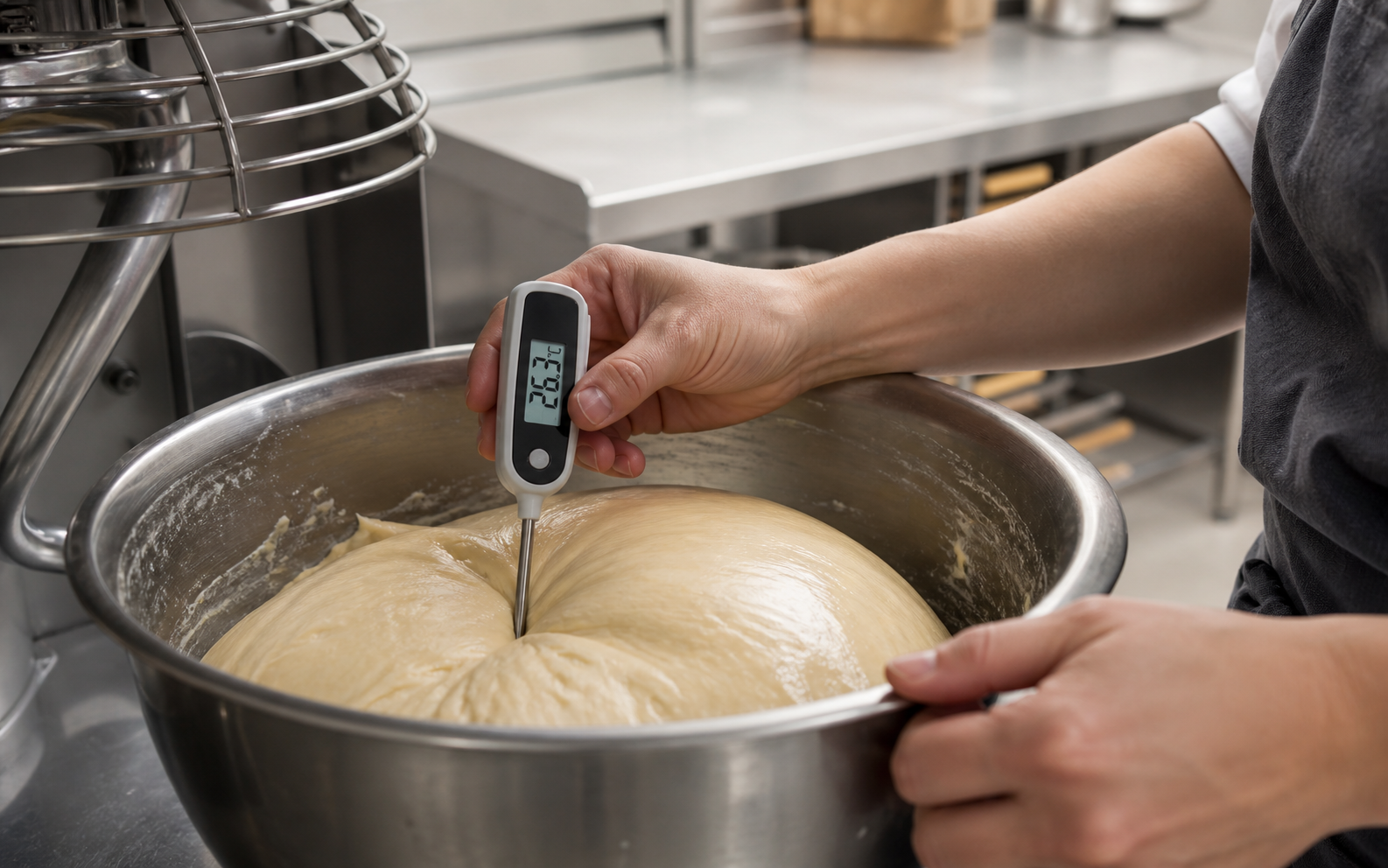
- Measure immediately after the mixer stops and before the dough rests in a warm bowl or on a cold bench.
- Insert the probe into the center mass of the dough, away from the bowl wall and exposed surface.
- Check a second point in a large batch to identify temperature unevenness.
- Record the result with the mixer, batch size, speeds, total mix time, and ingredient temperatures.
- Clean and sanitize the probe after use.
Control the temperature before the mixer starts
The easiest variable to adjust is usually liquid temperature. Record room, flour, liquid, precook, dairy, and final dough temperatures for at least three successful batches. If the final dough repeatedly finishes warm, reduce the controllable liquid temperature in a small, defined increment on the next trial. If it finishes cold, make the opposite adjustment. Do not change liquid temperature, mix time, yeast, and proof temperature in the same trial.
Cold milk, eggs, and tangzhong can help manage heat in enriched dough. A hot or even warm precook should not be added directly to yeast dough. The American Society of Baking specifies cooling tangzhong under refrigeration before use both for dough-temperature control and to protect yeast from heat stress.
Read the dough when it finishes too warm or too cold
| Condition | Likely production signal | Controlled response |
|---|---|---|
| Too warm | Slack or sticky handling, faster proofing, softer butter, weaker seams, greater fermentation carryover during cooling | Record the deviation, move promptly into the defined cooling process, shorten no stage blindly, and correct ingredient temperature or mixer energy in the next batch. |
| Too cold | Tight handling, slower proofing, poor relaxation, firm fat, delayed expansion | Protect the dough from drying, follow physical proof endpoints, and correct the next batch rather than placing the dough against uncontrolled direct heat. |
| On target but inconsistent | Different proof or shaping result at the same temperature | Check flour lot, development endpoint, mixer load, ingredient state, operator handling, and actual proofer or refrigerator temperature. |
Build a three-batch commissioning record
Set a provisional temperature band, then run three controlled batches with the same formula, batch size, mixer, and schedule. Record final dough temperature, gluten-development endpoint, dough feel, time to the next process endpoint, shaping condition, proof completion, baked volume, crumb, and any leakage or collapse.
Keep the target only when the result repeats. A target is not validated because one attractive batch happened to land on that number. It becomes an operating standard when employees can measure it, deviations predict a recognizable problem, and the corrective action can be repeated without changing the product identity.
The commercial lesson
Customers buy the finished bread, but the bakery must control the invisible variables that create it. Final dough temperature is one of the fastest ways to distinguish a recipe copied as text from a product commissioned as a system.
MasterBaker formula collections pair founder-developed formulas with temperatures, endpoints, scaling, quality checks, costing, and local commissioning records. The purpose is not to promise that one number works everywhere. It is to give the operator a controlled starting system and a disciplined way to adapt it without losing the intended product.
Frequently asked questions
Questions operators ask
Is 25 C the correct final dough temperature for every K-Bread?
No. It is the founder's operating reference for the MasterBaker overnight salt bread process. Other doughs need a target commissioned for their formula, mixer, schedule, and handling requirements.
Can room temperature replace a final dough temperature measurement?
No. Mixer friction, ingredient temperatures, batch size, and mixing energy can make dough warmer or colder than the room. Measure the dough itself immediately after mixing.
Should tangzhong be cold before mixing?
Yes. Cool it safely before use. A refrigerated precook helps control final dough temperature and avoids exposing yeast to unnecessary heat.
Should I add flour when dough finishes too warm and sticky?
Do not use extra flour as an automatic temperature correction. It changes the formula and can hide the real cause. Record the deviation and correct controllable temperature or mixing variables in the next batch.
Does a warmer dough always mean a faster and better result?
It can ferment faster, but faster is not automatically better. Excess heat can reduce handling tolerance, soften fat, accelerate proofing, and create too much fermentation carryover before refrigerated dough cools.
Technical references
Sources used for this field note
Related field notes

Why learn from MasterBaker
First-hand bakery work, translated into measurable decisions
MasterBaker.io is led by Joonho Jang (장준호), a Le Cordon Bleu-trained owner-chef who develops, produces, and sells bakery products in Korea. The flagship salt bread grew from a product sold and locally praised in Joonho Jang's bakery. These field notes turn that operating experience into temperatures, weights, endpoints, QC, costing, and release decisions rather than anonymous recipe summaries. Read Joonho Jang's method and evidence policy.