Quick answer
The operating answer
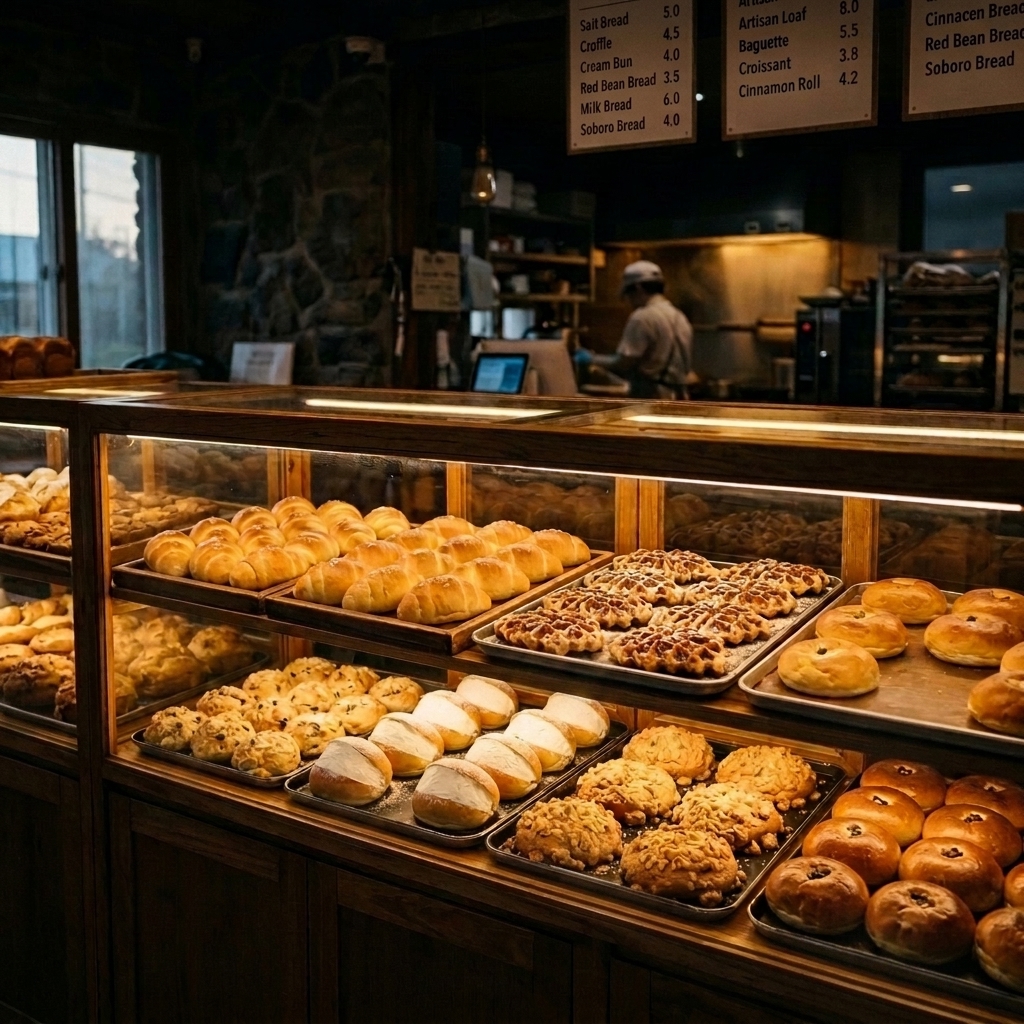
Launch one K-Bread product as a controlled operating system, not as a finished recipe plus a photoshoot. First define the customer-facing standard, production route, selling route, batch record, and acceptance decision for one product. Test it at normal speed with the real team, equipment, packaging, display, and demand. Only add flavors, fillings, or formats after the base product repeats and its failure signals are traceable. That protects product quality, training capacity, and sellable yield at the same time.
- A recipe is an input; a launch standard includes the product the customer receives, the route that produces it, and the decision when it misses.
- Start with one approved Salt Bread, Milk Cream Bun, or Korean Cream Cheese Garlic Bread route before multiplying variants.
- Write observable acceptance criteria for exterior, interior, flavor, service condition, packaging or display, and sellable yield.
- Run the trial at a realistic production and service pace, because a quiet test batch cannot prove a rush-hour system.
- When a trial fails, trace the first changed handoff and adjust one controlled factor before releasing another version.
A menu launch is a production promise
A new Korean bakery item can be exciting long before it is operational. A Salt Bread may look right in a single tray, a Milk Cream Bun may taste beautiful just after filling, or a Korean Cream Cheese Garlic Bread may photograph perfectly after re-bake. Those moments are valuable, but they do not yet prove that the same product can be mixed, made up, baked, cooled, packed or displayed, and sold by a full team on an ordinary day.
The American Society of Baking describes bread evaluation as comparison with a defined standard, including external and internal characteristics. That is the owner-chef discipline I use when deciding whether a K-Bread idea is ready for a menu. The standard must describe the product the guest receives, not merely the strongest sample from development. A launch becomes credible when the bakery can explain what passes, what does not, and where to look first when the product drifts.
| Launch component | What to define before service | Why it matters commercially |
|---|---|---|
| Customer-facing standard | Appearance, structure, aroma, texture, flavor, serving state, and the approved sales route | It gives the team one product promise instead of personal opinions |
| Production route | Approved formula version, ingredient identity, dough or filling condition, make-up, bake or re-bake, cooling, and handoffs | It makes a defect traceable to a process rather than to a vague bad batch |
| Service route | Packaging or display method, replenishment approach, handoff, and locally documented quality decision | It tests the product at the moment the customer actually buys it |
| Batch record | Lot, operator, first-middle-last observations, exceptions, and action taken | It separates a repeatable signal from a one-off impression |
| Release decision | Who can approve, hold, rework only under an approved route, or remove product | It protects the menu promise and prevents loss from becoming invisible |
Choose the base product before the variations
The fastest way to lose the learning from a launch is to change dough, filling, topping, size, packaging, and oven profile at once. Each variation can create a distinct product system. A garlic bread with a different filling load can change re-bake response and service handling. A Milk Cream Bun flavor may change filling viscosity and cold-chain behavior. A new Salt Bread topping may change bake, butter release, display, and margin. Treat the first product as the reference; every later variation earns its own trial against it.
ASB notes that dough processing and handling directly affect finished-product quality, and that mixing must create the dough condition needed for the intended process. Those principles are a useful warning against treating a development formula as portable across every menu idea. Keep the base route stable enough to learn from it, then test one change at a time.
| If you want to add... | Do not assume | Controlled next step |
|---|---|---|
| A Salt Bread flavor or topping | The base bake and crisp-butter release will remain unchanged | Compare one topping level or finishing method while holding the approved dough, butter, pan, proof, and oven route |
| A Milk Cream Bun filling | Flavor is the only difference | Test the filling's handling, fill weight, cold route, package, and customer-facing texture against the reference bun |
| A Korean Cream Cheese Garlic Bread format | A larger or fuller product needs only more bake time | Commission the complete cut, fill, coating, re-bake, cooling, and service route as a separate trial |
| More daily production | The early tray proves the later trays | Sample across the actual run and compare production pace, holding, baked result, and sellable yield |
| A new sales channel | Counter, takeaway, and delivery preserve the same product | Run a realistic route test with the exact packaging, travel, and handoff that customers will use |
Run the test under the conditions that will pay the bills
A quiet development bake is useful for discovering a direction. A release trial has a different job: it must expose the handoffs that happen when the mixer, oven, filling station, counter, and customer demand are all real. Use the same equipment load, production pace, service fixtures, and people who will make the menu item after launch. Observe representative early, middle, and late product rather than declaring success from the first tray.
ASB's bakery-management guidance places product development alongside production management, quality assurance, training, and cost control. That is the correct frame for a small K-Bakery too. The best launch record is brief enough for service, yet specific enough to answer whether the change was ingredient, process, equipment, timing, service, or demand.
- Name one base product and freeze the approved formula version, key ingredients, equipment, product size, and intended sales route for the release trial.
- Write the customer-facing pass standard before baking: exterior, internal structure, flavor, texture, service state, and reason-coded defects.
- Map every handoff from receiving and scaling through mixing, make-up, bake or re-bake, cooling, filling where relevant, packaging or display, and sale.
- Run a representative batch at normal pace; sample early, middle, and late product and record the first meaningful exception with its time and route.
- Review sellable yield alongside sensory and visual scores. A beautiful product that cannot repeat through service is still a launch problem.
- If the result misses, identify the earliest changed handoff, change one locally controlled factor, and repeat the trial before expanding the menu.
- Release the production card, training reference, and service decision only after the standard repeats under normal conditions.
Train the decision, not just the motion
A menu grows safely when staff can recognize the approved product and act on an exception without improvising. Teach the visual and eating standard beside the workflow: what a correct raw piece, filled bun, or coated garlic bread looks like; what changes at the relevant proof, bake, cooling, filling, or display handoff; and what the team should record or escalate. Ingredient handling, mixing, and dough processing all influence the final product, so training should make those connections visible rather than assigning blame to the last person who touched the bread.
As a Le Cordon Bleu-trained Korean bakery founder, I would rather launch one product that the team can sell with calm confidence than build a long menu that depends on the founder rescuing every busy shift. The operating card is not bureaucracy. It is how a recipe becomes a shareable product standard, and how a customer receives the same promise after the launch excitement has passed.
Expansion should follow proof, not enthusiasm
Once the reference product repeats, its record tells you where expansion is safe. You may learn that the oven has capacity but the filling station is the constraint, that a display route limits the menu more than mixing capacity, or that one variant changes sellable yield enough to need a different price. That information is more useful than guessing from recipe cost or an attractive launch post.
MasterBaker's Formula Collections are designed for this next stage: founder-developed product systems, production controls, QC, costing, and local commissioning tools. Choose the collection that matches the base product you intend to sell, establish its local standard, then add range only when the original product remains protected.
Frequently asked questions
Questions operators ask
How many K-Bread products should a new bakery launch at once?
Start with the number your team can produce, assess, and sell to one documented standard. For a new route, one well-commissioned base product often teaches more than several simultaneous variations that obscure the source of defects or loss.
When is a test recipe ready for the menu?
It is ready when it repeats under normal production and service conditions with a defined customer-facing standard, a traceable route, a practical batch record, and a documented action for product outside the standard. A single attractive test batch is not enough.
Should I change the recipe if a launch trial fails?
Not automatically. First trace the earliest changed handoff: ingredient identity, mixing condition, make-up, proof, bake, cooling, filling, packaging, display, or service. Change one locally controlled factor at a time so the cause is not hidden.
What should a K-Bread launch batch record include?
Keep it concise: formula and ingredient version, product or batch identity, key production and service handoffs, early-middle-late observations, pass or fail against the stated standard, reason code, and action taken. Add only details your team can reliably capture during real work.
Can I add a new flavor after the original K-Bread product is stable?
Yes, but treat it as a controlled variation. Test its effect on the full route, including dough or filling behavior, bake or re-bake, cooling, packaging or display, customer-facing quality, and sellable yield before treating it as a standard menu item.
Technical references
Sources used for this field note
Related field notes
Why learn from MasterBaker
First-hand bakery work, translated into measurable decisions
MasterBaker.io is led by Joonho Jang (장준호), a Le Cordon Bleu-trained owner-chef who develops, produces, and sells bakery products in Korea. The flagship salt bread grew from a product sold and locally praised in Joonho Jang's bakery. These field notes turn that operating experience into temperatures, weights, endpoints, QC, costing, and release decisions rather than anonymous recipe summaries. Read Joonho Jang's method and evidence policy.