Quick answer
The operating answer
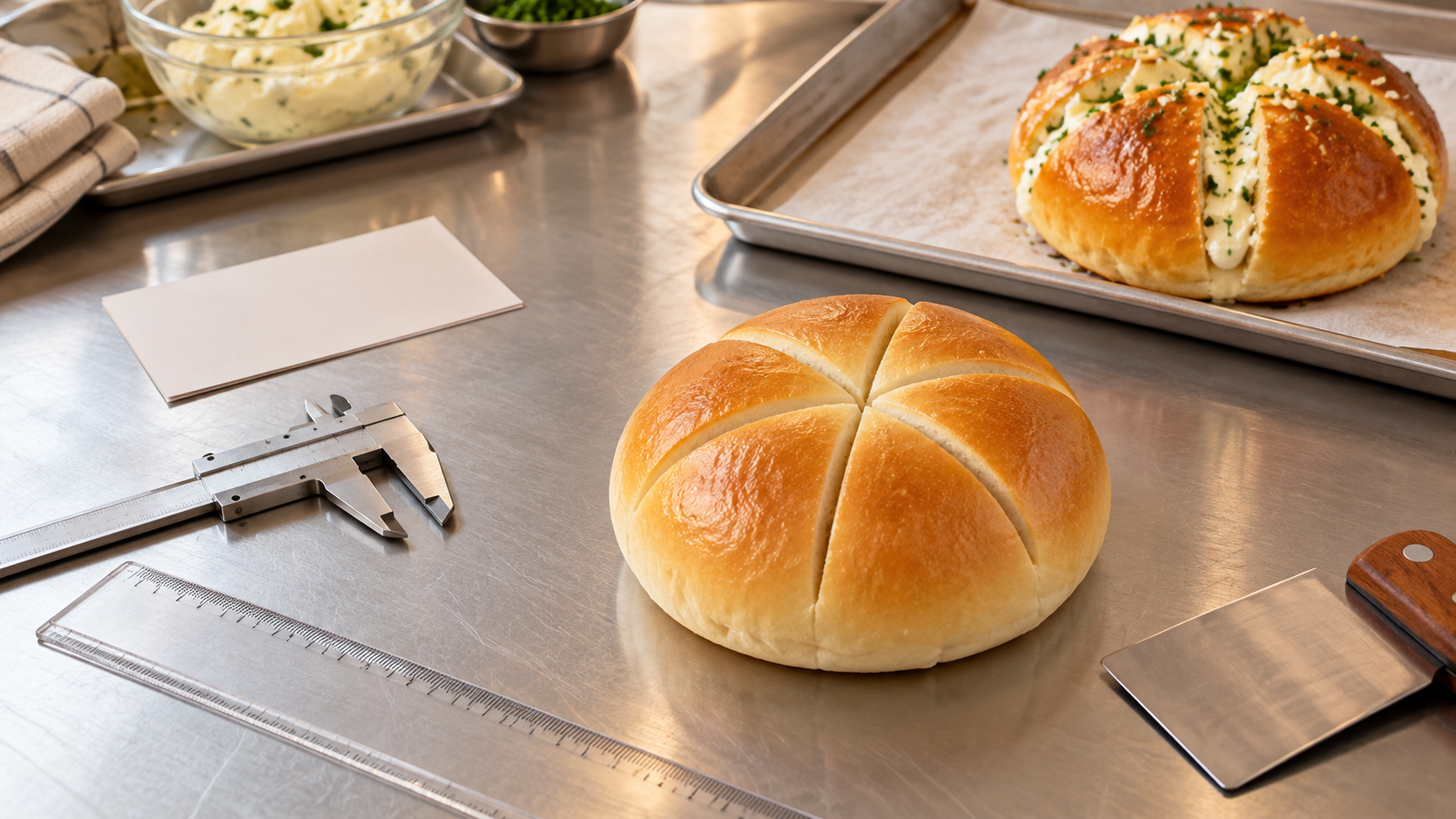
When the bun size changes, re-commission the six-cut layout instead of carrying over a cut depth by habit. Hold one defined bun, cutting tool, filling target, dip route, pan, re-bake route, and handoff interval constant; then compare a small set of deliberate layouts through the finished customer endpoint. Approve the layout that opens reliably for filling while retaining a stable base, even six sections, contained filling, and the intended re-bake finish. Record the bun dimensions and observable cut endpoint with the approved result. A cut that looks generous before filling is not automatically the layout that survives the complete route.
- Six cuts are a product-layout decision: their spacing and stopping point must work with the actual bun, filling, dip, re-bake, and handoff route.
- Do not treat a depth from another bun size, proof profile, or oven route as a universal setting. Start from the collection's reference, then commission locally.
- Compare one layout variable at a time and score representative finished buns against the same written endpoints.
- A layout approval is a quality decision. It does not establish shelf life, food safety, allergen controls, or legal permission to sell.
A six-cut bun is a layout, not a knife gesture
The six-cut form gives Korean cream cheese garlic bread its characteristic open sections, but it also defines where filling can sit, where garlic-butter dip can travel, and how much connected bread remains to hold the product together. A bun with a different diameter, height, proof profile, or crumb strength may not tolerate the same cut path as the approved reference. Copying a number without comparing the finished product can create weak bases, uneven wedges, poor filling access, or a re-bake blowout.
The useful question is not ‘what cut depth works for every six-cut garlic bread?’ It is: what repeatable cut geometry gives this locally baked bun six accessible sections while preserving the carrying structure required by its own filling, dip, oven, and customer route? MasterBaker's Formula Collection provides its own reference cut geometry; use that as a starting system, then document the local commissioning rather than presenting an imported setting as proof.
Set up a narrow comparison before changing the knife work
Choose one ordinary production condition. Use buns from the same approved dough and proof route, cool or hold them as the local assembly process requires, and identify the same cutting tool, operator, filling condition and target, dip condition, pan, re-bake route, and handoff interval. Measure and record the bun dimensions that matter to your own work—such as its diameter and height—so the next comparison has a defined starting point. Do not compare a taller bun on one day with a smaller bun on the next and call the difference a cut result.
Prepare a control layout from the current local standard or the collection reference. For the candidate, change one visible feature only: the depth endpoint, the radial spacing, or the place at which the cut stops above the base. Keep the intended number of sections fixed. American Society of Baking guidance describes bread evaluation as comparison against a defined standard and calls for representative samples; the same discipline prevents a single attractive bun from becoming the new layout rule.
- Write the control layout and the one candidate change before cutting.
- Cut representative buns with the same tool and route; reject neither control nor candidate merely because one bench sample photographs well.
- Fill, dip, pan, re-bake, and hand over both routes under the same locally approved conditions.
- Inspect the finished buns for six distinct sections, base continuity, filling access and containment, dip coverage, re-bake finish, and clean customer handling.
- Keep the layout only when it repeats across a defined local trial; otherwise return to the last approved layout and test one new change.
Use a layout record that makes the decision repeatable
This is a production-quality record, not a MasterBaker test result and not a food-safety log. Its purpose is to connect the opening made at the bench to the product the customer receives. Define the observation words before the trial. For example, ‘base continuous’ should mean a visible, intact connection that carries the bun through filling and handoff in your route—not a subjective impression that it looks sturdy.
The record should preserve the conditions that would make a future comparison fair. It gives the next operator a way to reproduce the approved starting point and a reason not to correct a filling or re-bake problem by randomly cutting deeper.
| Record field | What to enter | Decision it supports |
|---|---|---|
| Bun reference | Product version, production date or batch reference, measured local dimensions, and proof or cooling state | Whether the comparison used like-for-like buns |
| Cut layout | Six-section spacing, defined stopping point above the base, tool, and the single candidate change | Whether the layout can be repeated rather than described from memory |
| Assembly route | Filling condition and target, dip route, pan, re-bake route, and handoff interval | Whether a later defect belongs to the cut or a changed downstream condition |
| Finished checks | Section definition, base continuity, filling containment, visible coverage, exterior finish, and customer handling observation | Release, hold, or next controlled trial |
| Next action | Approved layout or one named variable for the next test, with the responsible person | Whether the standard remains stable while the bakery learns |
Diagnose the endpoint before changing the layout again
If sections will not open enough for filling, first check whether the bun itself matches the reference, whether cuts are reaching the same local stopping point, and whether the filling's condition and deposit route are being held constant. Deepening every cut may create access while sacrificing the base. If filling escapes during re-bake, do not assume the knife is at fault: compare the cut record with deposit target, filling condition, dip pickup, pan loading, and oven route before selecting one next test.
If the exterior becomes soft or the sections lose definition at handoff, evaluate the whole route rather than making the cuts deeper or wider by reflex. Oven heat transfer, airflow, and moisture loss affect baked quality, as the American Society of Baking's oven-parameter guidance explains. The layout record makes it possible to ask whether a cut change actually improved the product or merely hid an oven, queue, or service-window problem.
Keep the quality trial inside the bakery's safety program
The layout record does not approve how dairy- and egg-containing components are stored, held, reworked, labelled, or sold. FDA's 2026 Food Code is a U.S. model rather than a universal rule, but it is useful for separating a visual quality comparison from the applicable time, temperature, utensil, cleaning, and record controls. Use the authority and written food-safety program that govern the actual bakery.
This distinction matters commercially: a bun may pass a local six-cut quality check and still require a separate decision about allergen information, package route, shelf life, or saleability. Commission the geometry honestly, then keep the other approvals with the controls designed to answer them.
Use the layout record with the existing Korean cream cheese garlic bread controls
- Korean Cream Cheese Garlic Bread Filling Control: Prevent Blowouts During Re-Bake
Use this when the layout comparison reveals a filling-containment question at the re-bake endpoint.
- Korean Cream Cheese Garlic Bread Dip Station: Coat Each Six-Cut Bun Without Losing the Re-Bake Finish
Use this to control dip application after the locally commissioned cut layout is stable.
- Korean Cream Cheese Garlic Bread Formula Collection
The collection provides founder-developed formula, reference cut geometry, filling, dip, quality-control, and local-commissioning materials. It does not replace local safety or legal-sale requirements.
Frequently asked questions
Questions operators ask
Should every Korean cream cheese garlic bread use the same cut depth?
No. Start from the approved collection or bakery reference, but commission a changed bun size or process through the finished local route. The repeatable endpoint matters more than copying a depth without context.
What should I change first if the filling blows out?
Do not deepen every cut immediately. Compare the approved layout with the filling condition and target, dip pickup, pan loading, oven route, and handoff result. Change one defined variable, then judge the finished bun.
Can the layout record approve food safety or shelf life?
No. It supports a product-quality decision. Holding, time control, cleaning, allergen management, labelling, shelf life, and legal sale must follow the locally applicable requirements and the bakery's written program.
Technical references
Sources used for this field note
Related field notes

Why learn from MasterBaker
First-hand bakery work, translated into measurable decisions
MasterBaker.io is led by Joonho Jang (장준호), a Le Cordon Bleu-trained owner-chef who develops, produces, and sells bakery products in Korea. The flagship salt bread grew from a product sold and locally praised in Joonho Jang's bakery. These field notes turn that operating experience into temperatures, weights, endpoints, QC, costing, and release decisions rather than anonymous recipe summaries. Read Joonho Jang's method and evidence policy.