Quick answer
The operating answer
Run Korean Cream Cheese Garlic Bread as a controlled re-bake queue, not as a pile of prepared buns waiting for an oven. Set one approved assembled reference, release only the number of buns your oven and service pace can finish consistently, and check the same customer-facing endpoints every time: intact six-cut structure, contained filling, even garlic-butter coverage, a crisp exterior, and a clean handoff. When the queue changes, change one local control at a time and prove the new route with the baked product—not with an attractive bench sample.
- The sellable unit is the re-baked, customer-ready six-cut bun; assembly alone is not a finished product.
- Limit the queue by a locally proven oven and service rhythm, rather than by how many buns fit on the bench.
- Use a single approved reference to judge cut opening, filling containment, dip coverage, color, crust texture, and package cleanliness.
- Test early, middle, and late queue samples to reveal whether the service route is changing the product.
- Keep quality release separate from the bakery's local food-safety, allergen, holding, and disposition procedures.
The re-bake queue is part of the formula
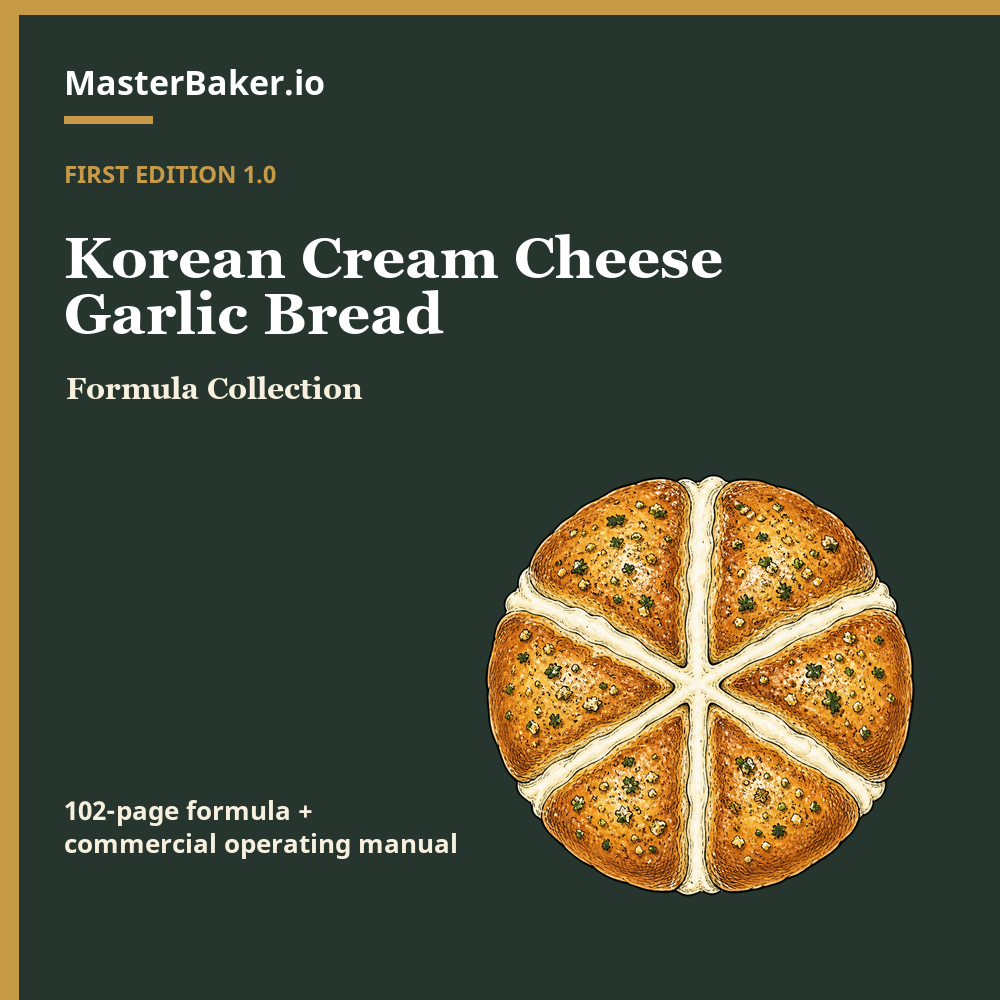
Korean Cream Cheese Garlic Bread often looks complete at the bench: the bun is cut, the filling is visible, and the garlic-butter dip has been applied. But the customer judges the product after re-baking. A bun that waits too long, sits in a crowded pan, or enters an uneven oven position can arrive with a soft exterior, an exposed filling edge, or a greasy, incomplete finish. In an operating bakery, the queue is therefore a production stage with its own release standard.
The American Society of Baking describes bread evaluation as comparison against a defined bakery standard, covering both external and internal characteristics. Apply that discipline to this product. Define one approved six-cut garlic bread under your own formula, pan, oven, service route, and customer handoff; use it as the reference when you change batch size, re-bake position, or pickup rhythm.
| Queue moment | What can drift | First controlled check |
|---|---|---|
| Assembly release | Cuts open too far, filling sits outside its intended boundary, or dip is visibly uneven | Compare the assembled bun with the approved reference before it joins the oven queue |
| Waiting before re-bake | Surface condition or dip distribution changes before heat is applied | Record the local queue condition and test a short, realistic service run rather than assuming the bench is neutral |
| Oven loading | Crowded pans or changed rack positions alter color, crispness, and filling movement | Load a repeatable count and position; sample early, middle, and late buns |
| Customer handoff | Crispness, cream presentation, or package cleanliness falls below the promise | Inspect the finished bun after the actual pickup or pack-out route |
Set the product reference before you speed up service
A photo is not an operating standard. Build a reference from a bun that has passed through the full local route: the stated bread size, six-cut geometry, filling application, Garlic Butter Dip, pan, oven, cooling moment, and service handoff. Describe what staff can actually see and touch—cut definition, filling containment, coverage, color, aroma, exterior texture, and clean presentation.
ASB notes that a bread standard is the basis for scoring and that samples should represent the production run. That means the most useful reference is neither the first bun from a quiet morning nor the best-looking bun selected after the fact. Keep a current reference and evaluate representative finished buns from the real rush.
| Reference point | Pass language | Do not substitute |
|---|---|---|
| Six-cut structure | Cuts are distinct enough for the intended pull-apart experience while the bun stays coherent | A larger cut merely because it looks dramatic before baking |
| Cream cheese filling | The approved fill remains presentable and contained through re-bake and handoff | A heavier deposit that creates a temporary visual impression but fails in service |
| Garlic-butter finish | Coverage, aroma, and surface finish match the locally approved reference | An unmeasured extra dip used to hide a pale or dry bake |
| Exterior and handoff | The finished bun has the intended crisp surface and clean customer presentation | A hot bench sample that has not experienced normal handling or packaging |
Make the oven release small enough to repeat
The fastest-looking queue is not always the most profitable one. If the oven receives more prepared buns than staff can finish, inspect, and hand off at the same standard, the final buns become a quality gamble. Start with the number and loading pattern that your team can repeat through a normal rush. Then increase only one local variable—count, rack, pan, service timing, or pick-up method—and compare finished product with the reference.
ASB's bread baking test guidance stresses control of operator, equipment, environment, and material variation when comparing process conditions. The same principle protects a commercial garlic-bread re-bake trial. A single changed condition provides a usable decision; several changes at once produce a story without evidence.
- Choose one approved assembled bun and document its visible release condition.
- Run the usual service queue with the normal pan, rack, re-bake program, pickup method, and package.
- Keep representative early, middle, and late samples; score them against the same product reference.
- Record the first meaningful divergence—cut spread, filling movement, uneven finish, exterior loss, or package soil.
- Change one controllable factor, repeat the route, and approve the new queue only when it repeats.
- Train the release decision in plain pass, hold, and escalate language that survives a busy shift.
Separate product quality from food-safety authority
A re-bake quality rule answers whether the customer receives the product you intend to sell. It does not replace a hazard analysis, allergen procedure, date marking, temperature control, or local legal requirement. This distinction matters for Korean Cream Cheese Garlic Bread because it combines bread with dairy, egg, and garlic-butter components and may travel through multiple handling steps.
ASB's bakery HACCP guidance treats processing, handling, and holding conditions as part of a product-specific hazard analysis. Use your written food-safety program and applicable local rules as the authority for safety and disposition. The operating standard in this field note is deliberately narrower: it gives the shift a way to recognize a customer-facing quality drift before it becomes routine waste or a complaint.
Protect the finish that makes the menu memorable
For an owner-chef, the commercial question is not whether the kitchen can produce one beautiful Korean Cream Cheese Garlic Bread. It is whether the last bun of a busy service still delivers the recognizable six-cut pull, cream cheese richness, garlic-butter finish, and crisp exterior that earned the menu its place. A smaller, proven queue can protect sellable yield more effectively than a bench full of nearly finished buns.
The Korean Cream Cheese Garlic Bread Formula Collection connects that final re-bake decision to the full production system: founder-developed bun, cream cheese filling, Garlic Butter Dip, six-cut assembly, re-bake controls, QC, costing, packaging, and local commissioning tools. Use the formula system to define the product, then use a disciplined queue to make the product repeatable at the customer handoff.
Frequently asked questions
Questions operators ask
How many Korean Cream Cheese Garlic Breads should I keep in the re-bake queue?
Use the number your own oven, pan, service pace, and handoff route can repeat at the approved standard. Prove it with representative finished buns rather than setting the count from available bench space.
Should I apply more garlic butter if the bun looks pale?
Do not use an extra dip as an automatic correction. Compare oven loading, rack position, bake condition, dip application, and the approved reference one local factor at a time so the cause is not hidden.
What should staff inspect after re-bake?
Use a concise local reference: six-cut definition, filling containment, garlic-butter coverage, color, aroma, exterior texture, and clean presentation at the actual customer handoff.
Can I judge the product at the bench before it goes into the oven?
Use the bench check only as an assembly release. The finished quality decision should be made on a bun that has completed your actual re-bake and handoff route.
Does a quality queue rule replace food-safety procedures?
No. Follow the bakery's documented food-safety and allergen program plus applicable local requirements for handling, holding, and disposition. The queue rule controls customer-facing product consistency.
Technical references
Sources used for this field note
Related field notes

Why learn from MasterBaker
First-hand bakery work, translated into measurable decisions
MasterBaker.io is led by a Le Cordon Bleu-trained owner-chef who develops, produces, and sells bakery products in Korea. The flagship salt bread grew from a product sold and locally praised in the founder's bakery. These field notes turn that operating experience into temperatures, weights, endpoints, QC, costing, and release decisions rather than anonymous recipe summaries. Read the founder's method and evidence policy.