Quick answer
The operating answer
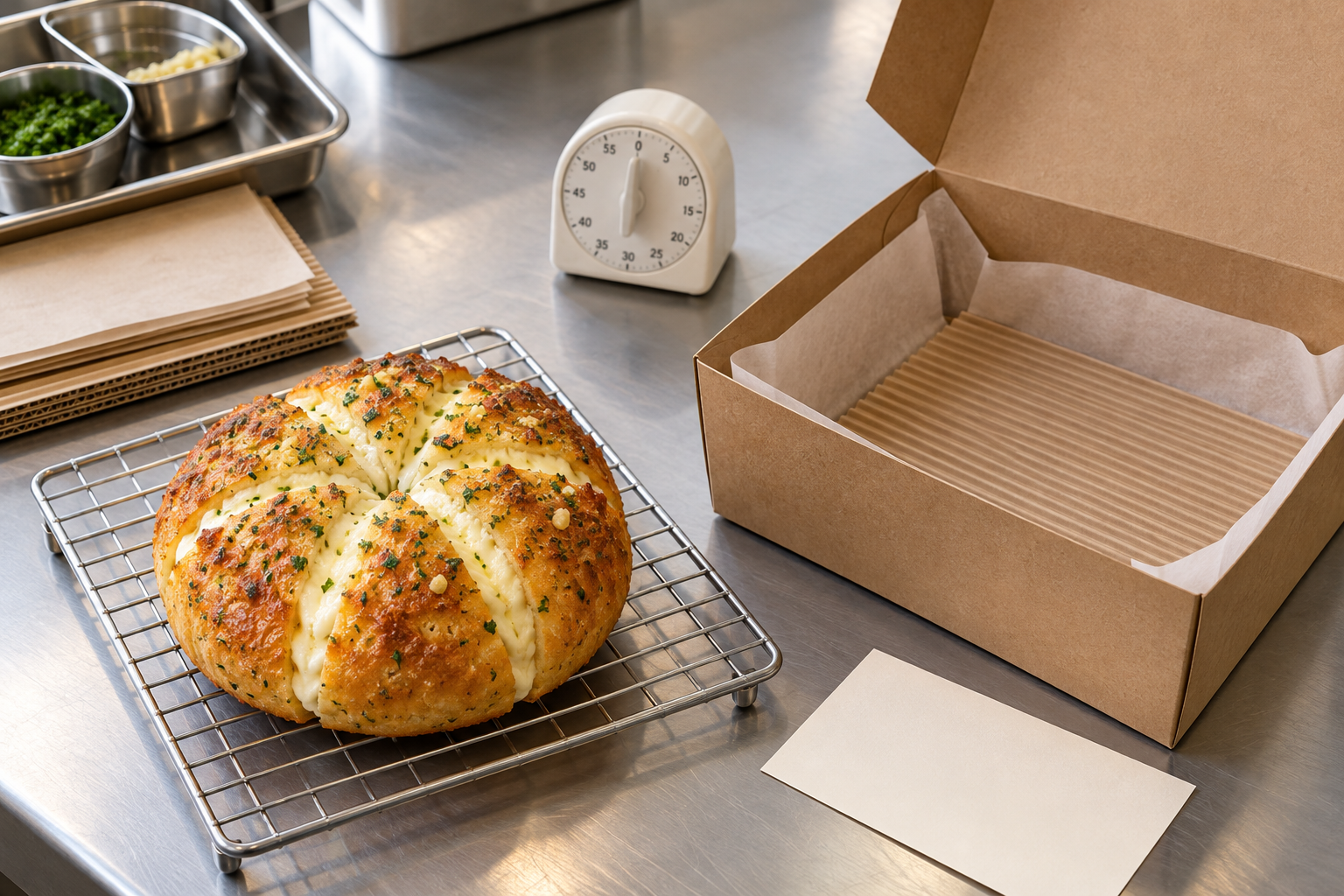
Pack Korean cream cheese garlic bread for pickup only after the complete customer route has passed a defined comparison: the normal re-baked bun, the actual box and liner, the intended closure, the expected wait, and the customer-stage check. Compare the crust, cut openings, filling appearance, base, box condition, and ease of carrying with the current approved handoff. An attractive bun on an open rack has not yet proved that its pickup box preserves the product. Treat the box trial as a quality decision, not as validation of food safety, shelf life, labelling, or legal sale.
- A pickup box is part of the product route: liner, insert, closure, carrying orientation, wait, and customer-stage opening can each change the finished result.
- Compare a defined box route with the current approved handoff, using representative buns from an ordinary re-bake run rather than a specially selected sample.
- Inspect more than crust crispness: score six-cut separation, filling appearance, base condition, condensation, crush protection, box cleanliness, and the customer’s first opening.
- When the packed product changes, identify the first changed condition before changing cooling, re-bake, box, liner, and service timing together.
- A successful package-quality trial does not establish safe holding, shelf life, allergen communication, date marking, labelling, or legal-sale approval.
The pickup box completes a different product route
Korean cream cheese garlic bread can look finished at the rack and still arrive as a weaker customer product. The six-cut structure holds a soft filling beside a toasted garlic-butter exterior; once it enters a box, the liner, headspace, closure, carrying angle, and wait become part of the result. A box that prevents crush damage may also change how moisture leaves the product. A box that appears airy may protect the exterior differently while giving the filling, cuts, or customer presentation less support.
The American Society of Baking describes packaging as a system that contains, protects, communicates, and preserves the sensory integrity of baked goods. It also identifies temperature, relative humidity, product nature, and packaging material as interacting quality factors. That is a reason to compare a defined route, not a reason to copy a material or ventilation pattern from another bread. This article asks a narrower operating question: can this locally commissioned six-cut bun reach the customer through this proposed pickup box in the condition you intend to sell?
| Part of the pickup route | Define before comparing | Why it belongs in the decision |
|---|---|---|
| Finished product | Bun version, filling route, re-bake endpoint and ordinary rack condition | A different re-bake or filling condition cannot inherit a previous package result |
| Box system | Box size, insert, liner, closure, orientation and product-to-box clearance | The physical package changes support, headspace and contact points |
| Customer interval | Planned pickup wait, carrying path and first-opening check | The counter sample is not the customer-stage result |
| Release standard | Exterior, cut openings, filling, base, box condition and carrying experience | Prevents one attractive surface from deciding the whole finished product |
Run a box comparison through the real handoff interval
Begin with a current product route that the bakery already accepts at handoff. Select representative finished buns from an ordinary re-bake sequence; do not choose only the most even piece from the first tray. Set one as the current control and put another through the proposed pickup setup. Keep the bun version, filling, re-bake route, and initial handling comparable. Name the box, liner, insert, closure, orientation, and planned interval before service begins.
Open both at the defined customer-stage point. Look at the whole product: does the six-cut structure remain legible and supported; has filling shifted or marked the liner; does the exterior still have the intended bite; has the base become damp or damaged; is the box clean and easy to carry; and does the product still look like the menu item that was promised? A result is useful only when it can be compared with the reference rather than remembered as ‘still warm’ or ‘probably fine.’
- Write the current accepted customer-stage reference, including the bun version, filling route, re-bake endpoint, normal handoff and observations to compare.
- Describe one proposed box route: box and liner identity, insert, closure, product orientation, expected wait and customer opening point.
- Use representative buns from the normal run and hold the product route constant while the package route is compared.
- Carry the control and proposed package through their stated intervals; do not judge only at the packing bench.
- Score the customer-stage condition against the written reference and record release, hold, or one focused next trial.
- Repeat the check when the bun, filling, re-bake, box, liner, closure, pickup interval, or delivery route changes materially.
Find the first changed condition before redesigning the whole box
If the crust softens in the box, do not immediately blame the cardboard or make every package more open. First confirm that the product entered both routes at the same defined endpoint and that the comparison used the same filling and interval. Then identify where the difference first appears: on the rack, after the liner touches the base, after closure, during the stated wait, or when the customer opens the box. That sequence keeps a packaging observation from quietly becoming an unsupported re-bake or cooling change.
ASB notes that moisture exchange, packaging material, relative humidity, and product characteristics affect packaged baked goods; its packaging-temperature guidance also explains that a product continues to cool as internal and external temperature differences reduce. Those principles justify observing the actual route. They do not supply a universal packing temperature, box design, or selling window for a filled garlic bread. Set those locally from the product, package, customer route, and applicable safety program.
| Customer-stage observation | First useful comparison | Keep fixed in the next trial |
|---|---|---|
| Exterior loses its intended bite | Did both buns enter the route at the same defined re-bake and rack condition? | Bun, filling and customer interval while one package detail is checked |
| Base or liner is damp | At what point does visible moisture or softening first appear: rack, liner, closure, or wait? | The current product endpoint and box size |
| Filling shifts or marks the box | Does the written product orientation and clearance match the cut layout and fill volume? | Re-bake, filling route and proposed handoff interval |
| Bun arrives crushed or cuts close | Where does the product first contact the liner, insert, lid, or another item? | Product version and closure while support is compared |
| Result varies between trials | Which recorded condition changed first: product, box, liner, closure, wait, or carrying path? | All unchanged conditions while one named variable is retested |
Keep a pickup-box record that survives a busy shift
A practical record should let the founder-chef or shift lead reproduce the comparison when a supplier changes the board, a new box size arrives, or a delivery route becomes longer. It should not create false precision. Include the locally defined product endpoint, exact package components, stated interval, customer-stage observations, and one next action. A clean record also stops a later team from treating an open-rack approval as a box approval.
For a Korean bakery, the commercial question is not simply whether a box costs less or closes quickly. The approved box must carry the recognizable six-cut form, filling, garlic-butter finish, and customer-facing presentation through the route actually sold. If the route does not repeat, hold the proposed package, retain the current standard where possible, and change one condition before the next comparison.
| Record field | What to enter | Decision it supports |
|---|---|---|
| Reference product | Bun version, filling route, re-bake endpoint and current accepted handoff | A fair control rather than a vague ideal |
| Package route | Box, liner, insert, closure, orientation, wait and carrying conditions | A reproducible pickup setup |
| Customer-stage score | Exterior, cuts, filling, base, package condition, carrying and first-opening notes | Release, hold, or a targeted retest |
| Next action | Keep, stop, or one named variable to change with an owner | A usable decision instead of an informal preference |
Keep quality approval separate from food-safety and legal controls
This comparison tells you whether a particular customer route retains the quality and presentation you defined. It does not determine whether the cream cheese filling, garlic-butter component, or finished packed product has an approved holding time, shelf life, date mark, allergen statement, label, or legal sale status. Those decisions require the bakery's product-specific program and the rules that apply where it operates.
The FDA Food Code 2026 is a United States model, not a rule automatically binding in every market. It illustrates why packing or handling a food does not replace a documented safety decision: time/temperature control, packaged-food assessment, allergen communication, and retail requirements have their own scope. Use local authority guidance and competent food-safety advice for those decisions; do not infer them from a dry-looking crust or a successful box trial.
Use the pickup-box record with these Korean cream cheese garlic bread controls
- Why Korean Cream Cheese Garlic Bread Goes Soggy — and How to Control the Service Window
Use this first when the product is already drifting before it enters the proposed pickup box.
- Korean Cream Cheese Garlic Bread Re-Bake Queue: Keep Every Six-Cut Bun Crisp, Full, and Sellable
Use this when a customer-stage package result points back to inconsistent re-bake timing or release from the oven.
- How to Commission a Six-Cut Garlic Bread Layout When Your Bun Size Changes
Use this when box contact or filling movement exposes a cut-layout and support issue in the locally baked bun.
Frequently asked questions
Questions operators ask
Should I leave the pickup box open to keep the crust crisp?
Do not assume an open box is the answer. It changes protection, carrying, exposure, customer presentation, and possibly the product's safety controls. Compare one defined open or closed route against the current approved handoff through the real interval, then decide from the complete finished product and the applicable local requirements.
Can I approve the box with one fresh sample from the first tray?
No. Use representative buns from the ordinary re-bake route and compare them at the stated customer-stage point. One especially attractive early sample does not represent later trays, the normal filling route, the intended wait, or the customer handoff.
If the exterior softens, should I re-bake longer?
Not before finding the first changed condition. Hold the product endpoint steady and compare where the change begins: rack, liner, closure, wait, or carrying. A longer re-bake can hide a package-route problem while changing the crumb, filling, or customer product.
Does a successful pickup-box trial establish shelf life or safe holding?
No. This is a quality and presentation comparison. Food safety, time and temperature control, shelf life, date marking, allergen communication, labelling, and legal sale require the locally applicable rules and the bakery's product-specific program.
Technical references
Sources used for this field note
Related field notes
Why learn from MasterBaker
First-hand bakery work, translated into measurable decisions
MasterBaker.io is led by Joonho Jang (장준호), a Le Cordon Bleu-trained owner-chef who develops, produces, and sells bakery products in Korea. The flagship salt bread grew from a product sold and locally praised in Joonho Jang's bakery. These field notes turn that operating experience into temperatures, weights, endpoints, QC, costing, and release decisions rather than anonymous recipe summaries. Read Joonho Jang's method and evidence policy.