Quick answer
The operating answer
Fill only the number of Milk Cream Buns that your bakery can keep within its approved cold-service route and sell in the next defined replenishment interval; keep the remaining approved components in their proper controlled state and refill from a written trigger, not an attractive full case. Set the first display quantity from a short, ordinary-service trial, record what was filled, sold, replenished, held, and discarded or redirected under the bakery's program, then change one planning input at a time. A busy hour is not a reason to overfill, and an empty space is not proof that a cold dairy product can be released outside its food-safety controls.
- The display quantity is a quality-and-service decision, separate from the total number of buns the bakery can produce that day.
- Start with a defined replenishment interval and a small initial presentation quantity; record the actual customer route before raising either one.
- Use one display record to distinguish sold product, approved replenishment, quality hold, and disposition. Do not call every missing bun a sale or every remaining bun waste.
- Cold holding, time control, allergen information, date marking, and sale decisions belong to the applicable local rules and the bakery's written food-safety program—not to this quality-planning method.
A full display is not the same as a controlled service route
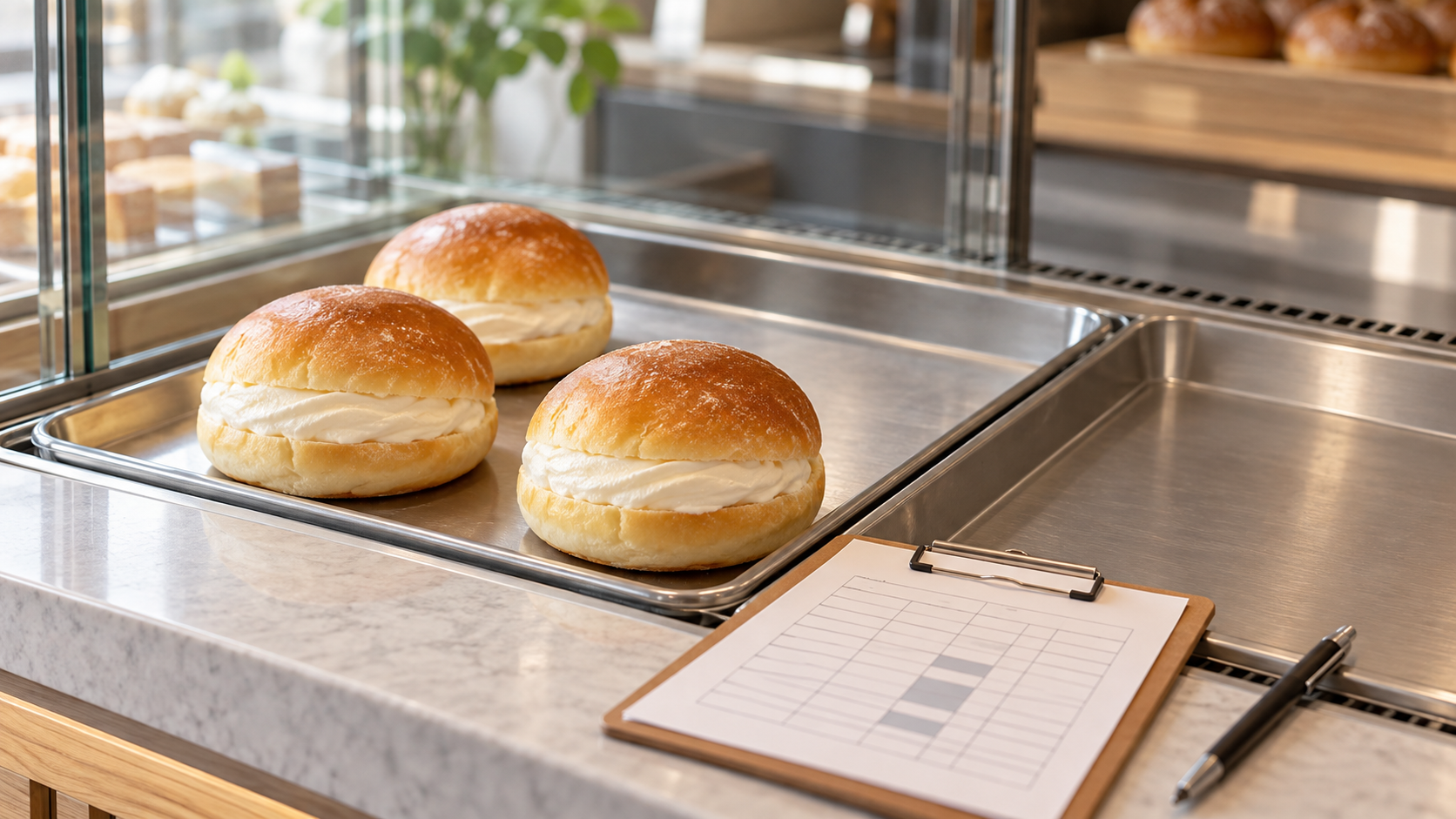
A Milk Cream Bun becomes a different operating problem once it is filled and placed for service. The bakery is now managing a soft bun, a dairy-containing filling, presentation, customer access, replenishment labour, and the limits of its own cold-service program at the same time. Filling every available bun because the tray looks better replaces a visible stock decision with an invisible exposure and quality decision.
The useful question is not ‘how many buns should every bakery display?’ There is no honest universal number. Ask instead: how many finished buns can this counter sell or replenish during one defined interval while the bakery still checks the actual condition of the product and follows its locally approved cold route? The American Society of Baking describes filling application as a process that must suit the finished bakery product; a display plan should therefore begin with the actual filled bun and handoff, not a forecast alone.
Set the first quantity from a narrow service trial
Choose an ordinary service period rather than a promotion, holiday, or one unusually busy rush. Define the display location, the intended replenishment interval, the initial number of finished buns, the backup condition, the named person who decides to replenish, and the local food-safety controls that already govern the product. Keep the formula, filling method, package or display format, staffing pattern, and offer stable enough to learn from the interval.
At each planned check, count only the states that change a decision: displayed and acceptable, handed to a customer, replenished, held for a defined reason, and disposed of or redirected under the bakery's approved procedure. Record the time and the trigger as well as the number. A tray that is empty because it sold through cleanly tells a different story from a tray that was removed for a temperature, presentation, label, or handling concern.
- Write the service interval and the initial display quantity before filling the first tray.
- Place only that finished quantity through the bakery's approved cold-service route; keep unfilled buns and filling under their separately defined controls.
- At the planned check, record condition and status before adding more product.
- Replenish only when the written trigger is met and the replacement product can enter the same approved route.
- Review the record after several comparable intervals. Adjust one planning input—such as initial quantity or the check interval—then compare the next ordinary service period.
Use a replenishment record that separates demand from loss
This is a reusable planning record, not MasterBaker sales data and not a substitute for a food-safety log. Its job is to show whether the display quantity served customers without asking the team to hide a quality concern. Set the bakery's own actions before the period begins. For example, ‘replenish’ should identify who acts and from which approved condition; ‘hold’ should identify the reason and its owner, not become a vague place for unwanted product.
| Record field | What to enter | Decision it supports |
|---|---|---|
| Service setup | Date, service window, display location, initial finished quantity, planned check interval, and responsible person | Whether another period is comparable |
| Customer route | Number handed off, remaining acceptable display buns, and time of each check | Whether the initial quantity fits actual service rather than an assumed rush |
| Replenishment | Trigger, quantity added, source condition, and who released it | Whether a refill was deliberate and repeatable |
| Exception | Quality concern, temperature or food-safety-program action, label or allergen-information issue, damage, or customer-service exception | Whether a count change is demand, a hold, or another operational problem |
| Close and next test | Final status by the bakery's procedure, one observed constraint, and one planned single-variable change | Whether the next interval should keep, reduce, increase, or redesign the display plan |
Keep the display decision inside the food-safety and information system
A neat cream bun can still be outside the bakery's approved route. FDA's Food Code is a U.S. model, not a rule that automatically governs a bakery elsewhere, but it makes the boundary clear: time and temperature must be considered together for foods requiring time/temperature control for safety. Use the locally applicable authority and the bakery's written program for whether the filling and finished bun need temperature control, how time is marked or monitored, when product is held or discarded, and what records are required.
Likewise, a new display plan does not remove ingredient or allergen-information duties. The FDA's current allergen-labeling guidance explains U.S. packaged-food requirements and is not a universal counter-service label template. It is still a useful reminder to keep the ingredient identity and customer information aligned when a bun is filled, packaged, or offered through a different route. The operational record here supports a quality decision; it does not establish safety, shelf life, labelling, or legal permission to sell.
Improve the cue, not only the quantity
If the record repeatedly shows an empty tray before the next check, first identify which constraint produced it: the initial quantity, the check timing, a slow filling station, an unavailable cooled bun, a packaging delay, or a customer pickup surge. Raising the number of finished buns may conceal a timing or staffing problem while widening the amount of product the team must manage. Change one constraint and observe the next comparable interval.
As a Le Cordon Bleu-trained owner-chef in Korea, I would rather present a smaller, replenishable Milk Cream Bun tray than ask a team to make a cold dairy product look plentiful at any cost. The customer should see a consistent finished bun; the bakery should be able to explain when it was released, why it was replenished, and what happens when the route no longer meets its standard.
Use the display record with the existing Milk Cream Bun controls
- Milk Cream Bun Cream Batch Release: Whip, Hold, and Deposit a Filling That Still Looks Right at Handoff
Use this before display planning to define when the filling and a finished bun are ready for the bakery's customer route.
- Milk Cream Bun Packaging: Protect the Soft Bun, Cold Cream, and Sellable Finish
Use this when a display plan includes takeaway packaging or pickup handoff rather than immediate counter service.
- Milk Cream Bun Formula Collection
The collection contains founder-developed formula and operating materials for the bun, dairy-cream route, quality control, packaging, costing, and local commissioning. It does not replace local food-safety or legal-sale controls.
Frequently asked questions
Questions operators ask
Should I fill every Milk Cream Bun before the counter opens?
Only if that quantity fits your defined service interval and approved cold-service route. Start with a written display quantity and replenishment trigger, then test it across comparable ordinary service periods rather than assuming a full tray is the best presentation.
How do I know whether an empty tray means I need to fill more buns?
Read the record before changing quantity. Separate clean sell-through from a late check, slow filling, unavailable components, a packaging delay, a quality hold, or another exception. Change one identified planning input at a time.
Can I use this display record as a cold-holding or shelf-life approval?
No. The record supports a quality and replenishment decision. Use the locally applicable requirements and your written food-safety program for holding, time control, date marking, disposition, storage, and shelf-life decisions.
Does a different display or pickup route change allergen information work?
It can. Keep ingredient identity and customer information aligned with the route you actually offer, and follow the applicable local allergen and labelling requirements. A display trial does not approve those controls by itself.
Technical references
Sources used for this field note
Related field notes

Why learn from MasterBaker
First-hand bakery work, translated into measurable decisions
MasterBaker.io is led by Joonho Jang (장준호), a Le Cordon Bleu-trained owner-chef who develops, produces, and sells bakery products in Korea. The flagship salt bread grew from a product sold and locally praised in Joonho Jang's bakery. These field notes turn that operating experience into temperatures, weights, endpoints, QC, costing, and release decisions rather than anonymous recipe summaries. Read Joonho Jang's method and evidence policy.