Quick answer
The operating answer
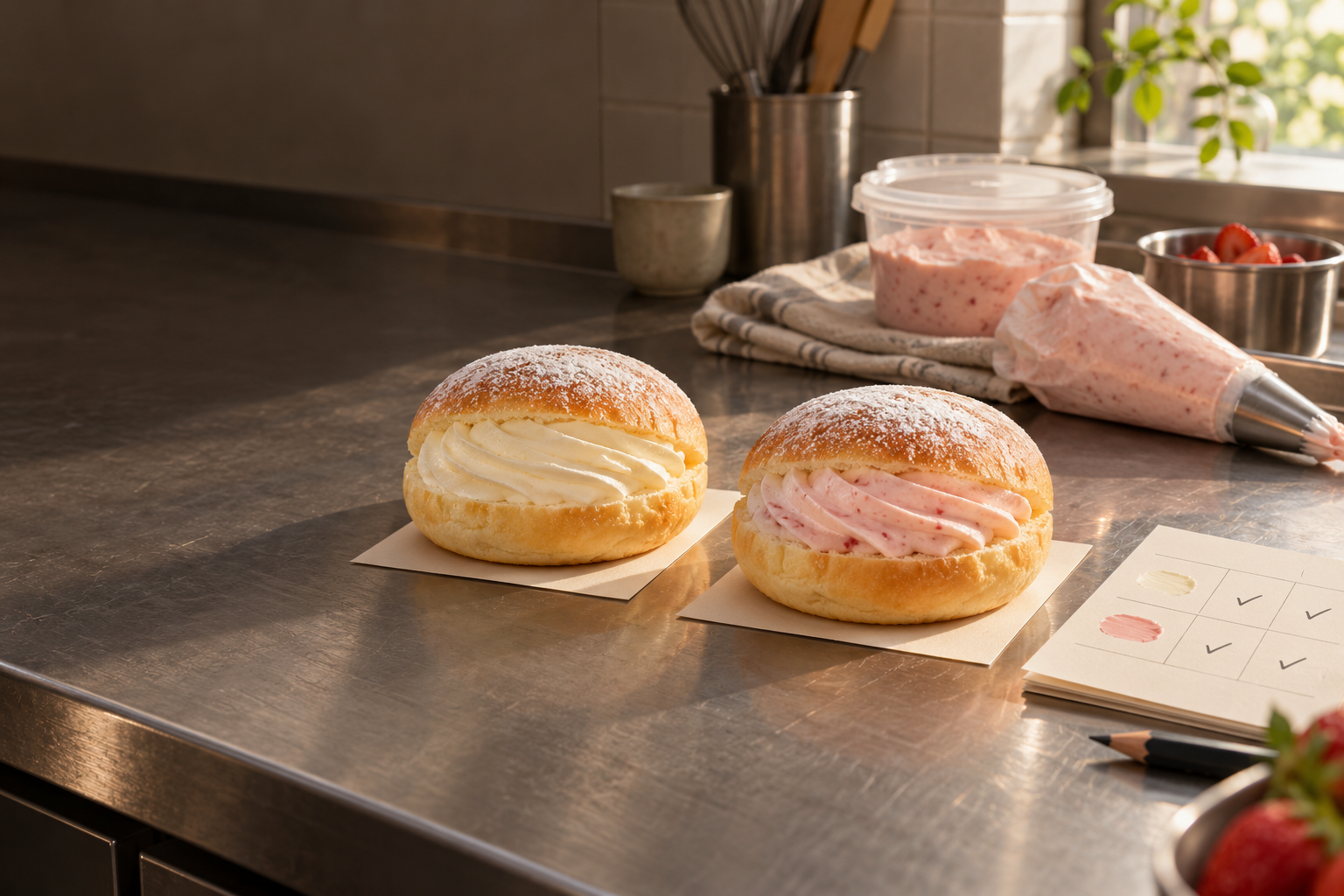
Treat a new Milk Cream Bun flavour as a new customer-facing route, not a colour change to an already-approved bun. Keep the base bun, cooling point, deposit method, package, service interval, and reference product fixed; change one defined flavour input; then compare the variation with the original after the normal handoff. Approve it only when the bakery can identify its ingredients and allergen implications, repeat its finished appearance and eating quality, and run its actual cold-service route under the locally applicable food-safety program.
- A new fruit, paste, powder, inclusion, colour, or topping can change a cream's appearance, deposit behaviour, ingredient declaration, and customer expectation; do not approve it from the mixer bowl alone.
- Use the plain, already-approved Milk Cream Bun as the control and hold the bun, piping setup, package, planned handoff interval, and evaluation criteria constant for the first variation trial.
- Record the exact ingredient version, amount, lot or supplier reference, allergen review, sensory result, package condition, and release decision so the next trial explains what changed.
- A successful quality comparison does not establish shelf life, cold-holding, allergen labelling, or legal-sale compliance; those remain product-specific local responsibilities.
A flavour is a change to the route, not only to the colour
A strawberry, matcha, coffee, black-sesame, or salted-caramel version may look like a simple extension of one bun. Operationally, it is a new promise: the filling must still deposit cleanly, remain where the customer expects it, look intentional after packaging, and arrive through the same cold-service route without asking the team to improvise. The American Society of Baking notes that fillings are chosen for sensory qualities as well as firmness, adhesion, and ease of depositing. Those are useful release questions for a filled bun, not a reason to assume that every flavour addition behaves like the original.
Start from the product that already passes. Keep its bun, bake and cooling release, cut or opening, piping tip, deposit target, package, pickup interval, and customer-facing reference visible. Name the single intended change precisely: for example, one supplier's strawberry preparation at one stated addition rate. If the bun, cream base, decoration, package, and handoff all change in the same trial, a poor result cannot tell the next baker what to correct—and an attractive result cannot tell the owner what actually repeated.
Run a paired variation check at the real handoff point
Prepare the original and candidate variation through the same planned shift conditions. This is a product-quality comparison, not a laboratory shelf-life study. Keep the product identity visible, use the same bun and package, and inspect both after the ordinary route from bench to customer. The control is valuable because it shows whether the day itself drifted before the flavour is blamed.
The first trial is not an invitation to chase a bigger piping peak, stronger colour, or more garnish. Change one meaningful factor at a time. If the candidate looks loose after packaging, the next test should change one documented input or process condition while retaining the rest of the route. A decision record that says only 'strawberry failed' teaches nothing; a record that shows the candidate ingredient, deposit, package, observation point, and difference from the control gives the team a defensible next action.
- Write the product claim and non-negotiable customer-facing attributes before making the variation.
- Choose one documented candidate ingredient or flavour input and complete the bakery's ingredient and allergen review before it reaches the production bench.
- Make a control bun and a variation bun with the same approved base route, then identify both units clearly.
- Evaluate deposit definition, bun support, flavour balance, visible finish, package cleanliness, and condition at the real planned handoff point.
- Approve, revise one defined variable, or hold the flavour. Repeat an approved candidate on a separate normal service period before adding it to the operating standard.
Use a flavour-variation approval record the team can repeat
The record below is a reusable template, not a MasterBaker test result or an approved recipe. Its purpose is to prevent a new flavour from becoming an undocumented substitution. Enter the bakery's own values, criteria, and local authority requirements. The result should make the next decision obvious: release the documented version, alter one factor, or hold it outside customer service.
Where a flavour introduces a new allergen or changes the ingredient statement, involve the person responsible for the bakery's applicable labelling and allergen controls before selling it. FDA guidance is relevant to U.S.-regulated packaged foods and recognizes that ingredient and major-allergen declaration obligations exist there; it is not a substitute for the rules that apply where the bakery operates.
| Record field | What to enter | What it decides |
|---|---|---|
| Control product | Approved plain bun, cream batch identity, deposit target, package, and handoff interval | Whether the comparison starts from a known customer-facing standard |
| One defined variation | Ingredient name and version, intended amount, supplier or lot reference, and any visible inclusion or finish | What actually changed and whether it can be repeated |
| Ingredient and allergen check | Current specification, ingredient statement, allergen/cross-contact review, and local labelling owner | Whether the candidate can move from a quality trial to the bakery's compliance review |
| Finished-product comparison | Deposit shape, bun support, flavour balance, colour, visible particles, package cleanliness, and handoff condition | Whether the customer receives the intended variation rather than a bowl-only success |
| Decision and next action | Approve, revise one named variable, or hold; include reviewer and next trial condition | A traceable operating instruction instead of an informal substitution |
Keep quality approval separate from safety and sale approval
A good-looking finished bun is evidence only about the limited quality comparison you made. It does not prove that a dairy-containing filling has a particular shelf life, cold-holding allowance, label, or legal sale status. The FDA Food Code is a U.S. model code that jurisdictions may adopt or adapt; use the food-safety and labelling authority that governs the bakery for the actual requirement. Treat every new ingredient and finished-product route as part of that local program.
As a Le Cordon Bleu-trained founder running a Korean bakery, I would protect the original standard first. A variation earns a place on the menu when it can repeat the promised bun-and-cream experience at the customer endpoint and the team can explain exactly what it is serving. If it needs a special exception, a different informal hold, or a last-minute decoration to look finished, it is still a trial—not a menu item.
Use the variation record with the existing Milk Cream Bun controls
- Milk Cream Bun Cream Batch Release: Whip, Hold, and Deposit a Filling That Still Looks Right at Handoff
Use this release standard to evaluate the candidate cream through the finished bun rather than from the mixing bowl alone.
- Milk Cream Bun Packaging: Protect the Soft Bun, Cold Cream, and Sellable Finish
Use the packaging field note when the variation passes at the bench but changes under the real customer route.
- Milk Cream Bun Formula Collection
The collection provides the bun and cold dairy-cream system, six defined applications, scaling, QC, costing, packaging, and local commissioning tools. Validate every local variation and service route before customer sale.
Frequently asked questions
Questions operators ask
Can I approve a new Milk Cream Bun flavour by tasting the cream before piping?
No. Bowl tasting may tell you about flavour, but it does not show whether the candidate deposits cleanly, works with the bun, survives the package, or still meets the customer-facing standard at handoff. Evaluate a finished control and variation through the intended route.
What should I change first when a flavour variation loses its shape?
Do not change several factors at once. Identify the first documented difference from the approved control—such as the candidate ingredient, amount, deposit, or service condition—then test one defined adjustment while holding the rest of the route constant.
Does a successful variation trial set the shelf life or cold-holding rule?
No. It is a quality comparison. Shelf-life, food-safety, allergen, storage, date-marking, labelling, and sale decisions require the locally applicable requirements and the bakery's product-specific program.
Do I need a new ingredient and allergen review for every flavour?
Use the bakery's applicable review process whenever the ingredient, supplier, formulation, or finished-product declaration changes. The specific legal obligations depend on the jurisdiction and how the product is offered for sale.
Technical references
Sources used for this field note
Related field notes

Why learn from MasterBaker
First-hand bakery work, translated into measurable decisions
MasterBaker.io is led by Joonho Jang (장준호), a Le Cordon Bleu-trained owner-chef who develops, produces, and sells bakery products in Korea. The flagship salt bread grew from a product sold and locally praised in Joonho Jang's bakery. These field notes turn that operating experience into temperatures, weights, endpoints, QC, costing, and release decisions rather than anonymous recipe summaries. Read Joonho Jang's method and evidence policy.