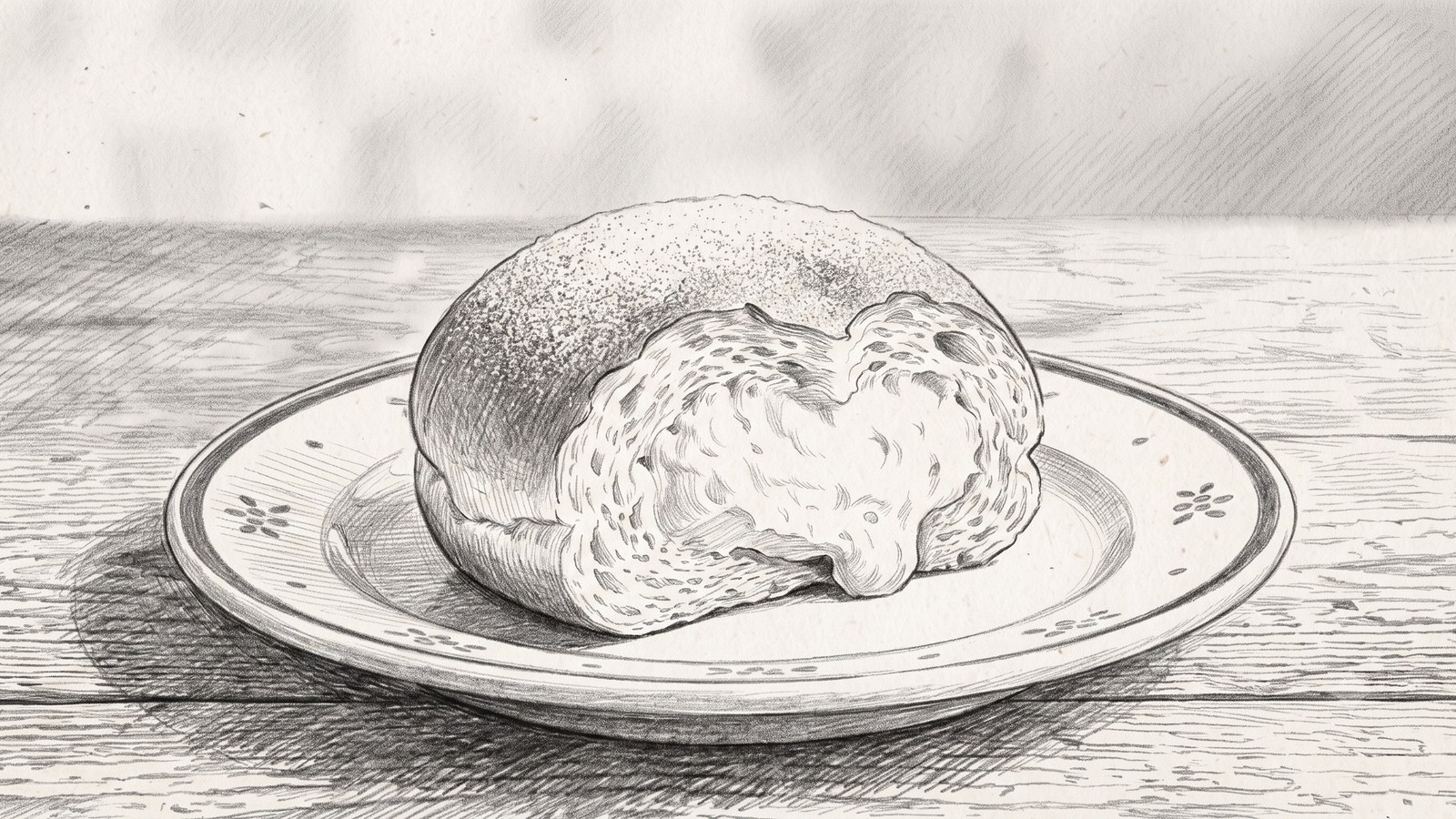
Quick answer
The operating answer
Release a Milk Cream Bun for filling only after a representative bun has cooled through the bakery's defined quality gate: the exterior is intact, the crumb can be cut without tearing or compression, and the finished bun can complete its actual cold filling and package route. Do not use a clock alone or fill the most attractive early bun. Compare early, middle, and late bake samples against one approved reference, then correct the first controllable condition that drifted—bake, unloading, cooling, cut, or handoff—before adding cream or changing the package.
- The fill-ready standard begins with a completely cooled bun; a warm crumb can tear or collapse during cutting and hides the finished product condition.
- Judge a representative bun after the real bake, cooling, cut, filling, package, and handoff route—not as an empty bun on a rack.
- Use simple pass language for exterior colour, shape, crumb support, cut cleanliness, and package clearance so the decision is transferable across a shift.
- Change one local variable at a time when the bun drifts. A larger cream deposit cannot correct an undercooled, weak, or poorly handled shell.
- Food-safety controls for dairy filling, cooling, storage, and disposition belong to the bakery's validated written program and local requirements.
A soft bun is not automatically a fill-ready bun
A Milk Cream Bun earns its place on the menu when the customer gets the intended contrast: a soft, supported bun and a cold, clean cream filling. The empty bun may leave the oven looking excellent yet still be a poor shell for the filling line. A warm cut can compress or tear, the opening can lose its shape, and the package test can reveal a problem that the rack never showed. Treat cooling as a release gate between baking and assembly, not as idle time after the oven.
The American Society of Baking describes bread evaluation as a comparison with a defined standard and notes that loaves must be completely cool before scoring because a warm crumb can tear or collapse during slicing. That principle is especially useful here: the relevant standard is not merely a handsome baked bun, but the bun that has been cooled, opened, filled, packed, and handed off as the customer receives it.
| Release moment | What can drift | Practical check |
|---|---|---|
| Oven exit | Colour or shape looks acceptable but the bun has not yet revealed its cut behaviour | Retain representative early, middle, and late bake samples rather than selecting only the best tray |
| Cooling gate | A warm crumb compresses, tears, or changes the opening during cutting | Use the locally defined fully cooled endpoint before cutting a quality sample |
| Cut and fill test | The opening does not support the planned deposit or soils the bun edge | Compare the opened, filled bun with the approved reference and defined deposit |
| Pack-out | The filled bun contacts the package or loses the intended first-bite presentation | Inspect a representative unit after the normal package and cold-service route |
Build one fill-ready reference, then score the whole route
As a Le Cordon Bleu-trained Korean bakery founder, I do not ask a shift to reproduce a vague instruction such as 'cool it properly.' I ask the team to work from one finished reference. It begins with the locally approved dough and bake, then records visible exterior condition, crumb support at the cut, the intended opening, the measured cream deposit, package clearance, and the customer-facing handoff. That turns founder judgement into a decision another trained baker can use.
The reference must survive the real route. Keep early, middle, and late buns from a normal bake, cool and fill them through the same bench and package process, then compare them at the same service point. If the final tray no longer opens cleanly or carries the deposit as intended, the production line has drifted even if its empty buns still look attractive.
| Reference point | Pass language | Do not substitute |
|---|---|---|
| Exterior | Evenly baked, intact, and consistent with the approved bun | A darker or larger bun chosen because it photographs well |
| Crumb and cut | Completely cooled crumb opens cleanly and retains enough support for the defined fill | A warm, compressed opening that will change once it cools |
| Filled presentation | Measured cream deposit stays centred with clean bun edges | Extra cream used to disguise a weak opening or uneven shell |
| Customer handoff | Finished bun clears the package and arrives in the locally approved service condition | An unwrapped bench sample that bypasses the actual route |
Diagnose the first drift instead of decorating the symptom
When a cream bun tears at the opening, loses its shape, or looks crowded after packaging, resist the instinct to change several things at once. The meaningful question is where the first departure from the approved reference occurred. Was it the bake result, unloading, cooling condition, cut, deposit, package, or service pace? Work through one factor while holding the others constant, and assess a completed bun after its true handoff route.
Bread does not become a fixed object when it leaves the oven. Research on bread staling describes water loss and water transfer between crumb and crust as contributors to texture change. That is not a universal instruction to cool for one number of minutes; each bakery still needs to establish its own endpoint on its own racks, room, dough, oven, and package. It is a reason to observe the product after cooling rather than assuming an oven-exit appearance proves fill readiness.
- Set aside representative early, middle, and late buns from one ordinary production run.
- Cool them using the current local process, then inspect exterior condition and cut behaviour before filling.
- Fill with one approved cream workflow and defined deposit; do not alter the formula while diagnosing the shell.
- Package and hold the samples through the normal customer route under the bakery's written program.
- Identify the first observable difference from the reference and change one controllable process factor.
- Keep the tested pass, hold, and escalate language with the shift's production record.
Keep cooling quality separate from food-safety authority
A cooling gate can protect a better cut, cleaner filling, and more dependable customer experience. It does not validate the safety, storage time, date marking, allergen control, or shelf life of a dairy-filled bun. Those decisions require the applicable local rules and the bakery's product-specific hazard analysis, monitoring, corrective action, and written program.
FDA presents its Food Code as a model used by jurisdictions to regulate retail and food-service operations. Use it as a technical reference where relevant, not as a substitute for the law that applies to your bakery. The fill-ready standard in this article is therefore a quality-release tool: it tells the team when a bun is ready for the approved assembly route, not how long any cream product may be held or sold.
Turn the cooling gate into a menu system
A dependable Milk Cream Bun is not the result of a lucky soft bake followed by a beautiful piping moment. It is a linked system: dough and bake create a shell, cooling makes its real cut condition visible, filling creates the product the customer buys, and pack-out proves the menu promise through handoff. When that gate is explicit, the team can protect sellable yield without waiting for the founder to rescue every batch.
The MasterBaker Milk Cream Bun Formula Collection connects founder-developed tangzhong bun and dairy cream formulas with six applications, scaling, filling controls, cold-chain prompts, QC, costing, packaging, and local commissioning tools. Use the collection to install the full product system, then use a fill-ready cooling gate to keep every handoff faithful to the bun-and-cream experience you intend to sell.
Frequently asked questions
Questions operators ask
How do I know when a Milk Cream Bun is ready to fill?
Use your locally approved quality reference: the bun should be completely cooled for the scoring and cut test, intact on the outside, supported at the opening, and able to complete its measured fill, package, and normal handoff route without losing the intended presentation.
Can I use one cooling time for every Milk Cream Bun batch?
A clock can support a local procedure, but it is not sufficient evidence by itself. Confirm the endpoint with representative finished buns from your own oven, cooling method, cut, fill, package, and service route.
Why does the bun look fine on the rack but tear during filling?
The empty rack sample may not reveal the final cut and assembly behaviour. Check whether the crumb is fully cooled for the local quality test, then trace the first drift through bake, unloading, cooling, cutting, filling, and pack-out one variable at a time.
Does a fill-ready quality gate establish shelf life for a dairy-filled bun?
No. It is a quality-control decision, not a food-safety or shelf-life validation. Follow the locally applicable requirements and the bakery's validated written program for cream handling, storage, monitoring, and disposition.
Technical references
Sources used for this field note
Related field notes

Why learn from MasterBaker
First-hand bakery work, translated into measurable decisions
MasterBaker.io is led by a Le Cordon Bleu-trained owner-chef who develops, produces, and sells bakery products in Korea. The flagship salt bread grew from a product sold and locally praised in the founder's bakery. These field notes turn that operating experience into temperatures, weights, endpoints, QC, costing, and release decisions rather than anonymous recipe summaries. Read the founder's method and evidence policy.