Quick answer
The operating answer
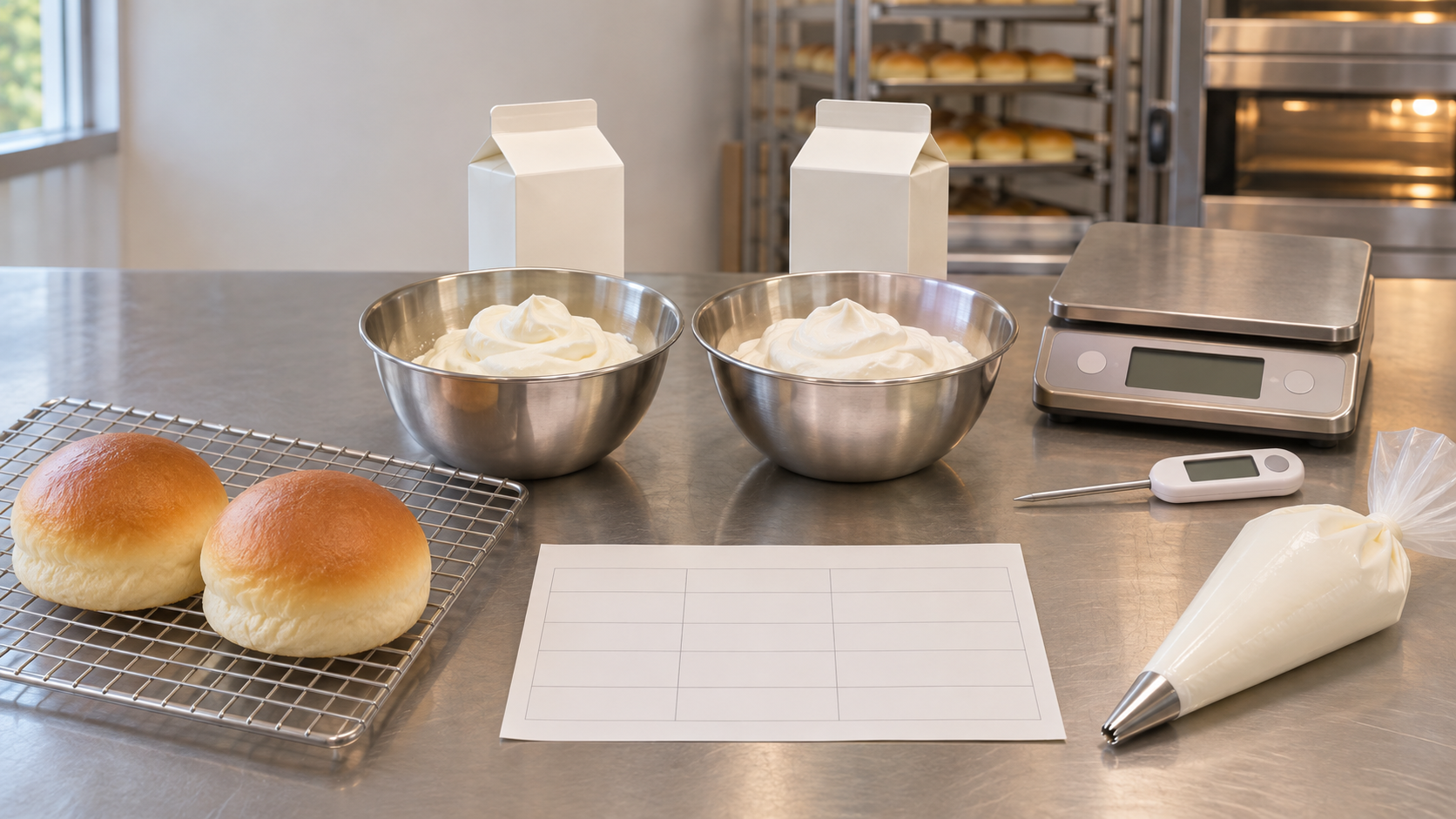
Approve a new whipping cream only by comparing it with the current approved cream as one controlled Milk Cream Bun route. Check the new product's specification and ingredient declaration, then keep the bun, cream formula, batch size, tools, temperature plan, whipping endpoint, deposit, package, and customer-stage review point explicit. A cream that reaches a good-looking peak in the bowl is not automatically a replacement: it must still produce the intended volume, texture, piping behaviour, bun support, package cleanliness, and finished handoff under your own conditions.
- A supplier change is an ingredient and process change, not simply a purchasing substitution.
- Compare the current approved cream and one candidate from stated packs and lots; do not change temperature, sugar, stabiliser, deposit, package, or service route at the same time.
- Record the product specification, ingredient declaration, lot and date information, actual weights, temperatures, whip endpoint, yield, deposit, and finished-stage result.
- Judge the filled and packaged bun at the normal customer-stage point, not only the cream in the mixer bowl.
- This quality comparison does not set shelf life, cold-holding, allergen communication, labelling, or permission to sell; those need the bakery's applicable local controls.
A cream supplier change can move more than the whip time
For a filled bun, the cream is not an isolated ingredient. It has to whip, accept the intended deposit, sit inside the actual bun opening, survive the package and still look and eat as intended when the customer receives it. A substitution can move that whole route even if both packs are sold as whipping cream.
Start with information you can verify from the candidate pack and supplier: product identity, fat declaration, ingredient list, allergen statement, storage and use directions, pack size, lot and date information. Tetra Pak's Dairy Processing Handbook describes whipping time and volume increase (overrun) as useful checks of whippability and notes that cream fat content affects that behaviour. Those principles explain why a like-for-like purchasing description is not sufficient product approval; they do not make one fat percentage or supplier universally right for every bun system.
| Keep fixed for the first comparison | Document for each cream | Why it matters |
|---|---|---|
| Approved bun batch, formula version, batch size, bowl, whisk, mixer programme, target endpoint and filling tool | Supplier, product name, declared fat content, ingredient declaration, pack, lot, date and actual weight | Separates the candidate ingredient from a hidden equipment or formulation change |
| Starting-temperature plan, room conditions, cream additions, whip procedure and deposit target | Actual ingredient and finished-cream temperatures, whip time, visual endpoint and usable yield | Makes a difference repeatable instead of reducing it to a remembered peak |
| Bun opening, package, cold-service route and customer-stage review interval | Deposit shape, bun support, leakage, package contact and finished appearance at review | Prevents a bowl-only preference from becoming a finished-product approval |
Run one paired comparison before you rewrite the cream card
Use the existing approved cream as the control and one candidate cream as the comparison. Make enough representative portions to inspect the route, but do not turn a supplier delivery into a broad launch. If both products cannot be processed together, document the time gap and repeat the approved control under comparable conditions before interpreting the candidate.
Whipping temperature is a meaningful condition, not a universal shortcut. Ihara and colleagues studied particular whipped creams between 5 and 15°C and found that temperature changed whipping time, overrun and rheological behaviour; their results support recording the actual temperature and choosing a local endpoint. They do not establish a substitute supplier's recipe, food-safety plan, or customer-service limit. Follow the candidate supplier's directions and the bakery's own cold-control programme.
- Write the current approved cream route exactly: product, formula version, batch size, tools, starting-temperature plan, mixer setting, observed endpoint, deposit target, package and review point.
- Check the candidate product documents and pack details before opening it. Record the same fields, plus the candidate lot and date information; resolve an identity, allergen or storage-direction question before treating it as a production replacement.
- Prepare the control and candidate with the same stated route. Do not compensate for a candidate by quietly changing added sugar, stabiliser, mixer speed, whip time, deposit, bun opening or package in this first comparison.
- Fill representative cooled buns, package them as sold and review both samples at the same planned customer-stage point. Score the physical result before asking tasters which one they prefer.
- Release, hold, or name one next variable to test. Repeat a promising candidate on another normal production occasion before replacing the standing cream card.
Judge the finished bun and name the first changed condition
A taller mixer-bowl peak can be less useful than a cream that remains neat after piping and packaging. The decision record should help the next operator locate the first meaningful change, rather than inviting several corrective changes at once. If the candidate misses the reference, keep it on hold and test the next condition deliberately instead of declaring the supplier good or bad from one symptom.
As a Korean bakery founder deciding whether an ingredient can enter a repeatable menu, I would ask whether the candidate preserves the customer-facing contrast between a soft bun and a cold, clean cream filling. A lower invoice price cannot repair an unreliable deposit, a changed package result, or a batch record that cannot explain what happened.
| Finished-stage observation | First useful check | Do not conclude |
|---|---|---|
| Candidate reaches a different apparent peak or yield | Were actual starting temperatures, weights, equipment and endpoint observations comparable? | The candidate needs a random longer whip time |
| Deposit loosens, grains, drains or changes shape after filling | Which first differed: cream condition, deposit, bun support, package contact or hold route? | More cream or a deeper cut will fix every failure |
| Packaged buns look different at handoff | Did the actual package, closure, chill route and review interval match the control? | The bowl texture alone approves the new supplier |
| Result changes across a second batch | What changed in candidate lot, pack age, receiving condition, temperature, process or service route? | One promising batch proves permanent interchangeability |
Keep a supplier-change card beside the cream batch record
A short paired record makes the purchasing decision auditable without turning the shift into a laboratory. It also stops a later lot change from being hidden behind the phrase 'same cream'. Keep the approved control visible until the candidate has passed the bakery's planned repeat checks.
This card is a quality and purchasing tool. It does not validate microbiological shelf life, local temperature requirements, date marking, allergens, labels or legal sale. The U.S. FDA Food Code is a model code rather than Korean law; its cold-holding and date-marking provisions illustrate why a supplier comparison cannot replace the rules and food-safety plan that apply to the actual bakery.
| Supplier-change card field | What to record | Decision it supports |
|---|---|---|
| Product identity | Control and candidate product details, pack, declared fat and ingredients, lot and dates | Traceable purchasing and a visible basis for the comparison |
| Controlled route | Formula version, actual weights and temperatures, equipment, observed endpoint and usable yield | A repeatable comparison rather than a supplier memory |
| Finished-bun score | Deposit, bun support, package contact, leakage, appearance and customer-stage result | Approval tied to the product sold, not only to bowl appearance |
| Next action | Release, hold, reject, or one named next test; date and decision owner | A controlled handoff to the next delivery or trial |
Use the supplier comparison with these Milk Cream Bun controls
- Milk Cream Bun Cream Batch Release: Whip, Hold, and Deposit a Filling That Still Looks Right at Handoff
Use this to define the local batch-release observations after a cream supplier has passed the paired comparison.
- Why Milk Cream Buns Collapse or Leak After Filling
Use the wider bun, cream, filling and hold diagnosis when the supplier comparison identifies a finished-product failure.
- Milk Cream Bun Packaging: Protect the Soft Bun, Cold Cream, and Sellable Finish
Check the actual pack-out route when a candidate looks acceptable before the package but not at handoff.
Frequently asked questions
Questions operators ask
Can I approve a new cream supplier by whipping one small sample?
No. A bowl sample can be an early screen, but approval needs a documented comparison with the current cream through the intended deposit, bun, package and customer-stage review. Keep the first test narrow and repeat a promising route before replacing the standing cream card.
Should I change the whipping time until the new cream looks like the old one?
Not in the first comparison. Record the actual endpoint and finished-product result under the current stated route. If the candidate misses, name one next condition to test; changing time, temperature, additions and deposit together makes the reason for the result unknowable.
Is the same declared fat percentage enough to treat two creams as interchangeable?
No. It is a useful specification to record, but it is not a finished-bun approval. Confirm the complete supplier information and compare the candidate with your approved route, because the bakery still needs a repeatable cream, deposit, package and handoff result.
Does this supplier comparison set the shelf life or cold-holding rule for Milk Cream Buns?
No. It is a product-quality and purchasing comparison. Follow the candidate supplier's directions plus the food-safety, temperature, shelf-life, allergen, labelling and legal-sale requirements that apply locally; obtain appropriate technical or regulatory support where needed.
Technical references
Sources used for this field note
Related field notes

Why learn from MasterBaker
First-hand bakery work, translated into measurable decisions
MasterBaker.io is led by Joonho Jang (장준호), a Le Cordon Bleu-trained owner-chef who develops, produces, and sells bakery products in Korea. The flagship salt bread grew from a product sold and locally praised in Joonho Jang's bakery. These field notes turn that operating experience into temperatures, weights, endpoints, QC, costing, and release decisions rather than anonymous recipe summaries. Read Joonho Jang's method and evidence policy.