Quick answer
The operating answer
Do not call Salt Bread reheatable merely because it becomes warm again. Approve a reheat route only after a representative, timed comparison shows that the warmed roll still meets your local standard for the butter-fried base, crust, crumb, salt finish, and actual handoff. Test one controlled route at a time, define the latest acceptable release point, and reject a route that improves warmth while creating a tougher crumb, damaged finish, or an unreliable customer promise.
- A reheat setting is a local service decision, not a universal temperature or time copied from another bakery.
- Compare the same product at a defined age, with the same oven, load, pan, cooling interval, package, and customer route that service will use.
- Score exterior and interior attributes separately: base crispness, crust color, salt retention, crumb resilience, aroma, flavour, and package condition do not move together automatically.
- Use the result to set a release window and a discard or alternate-use decision under the bakery's approved program; a quality check does not establish safety, shelf life, or legal holding requirements.
Warm is not the same as ready to sell
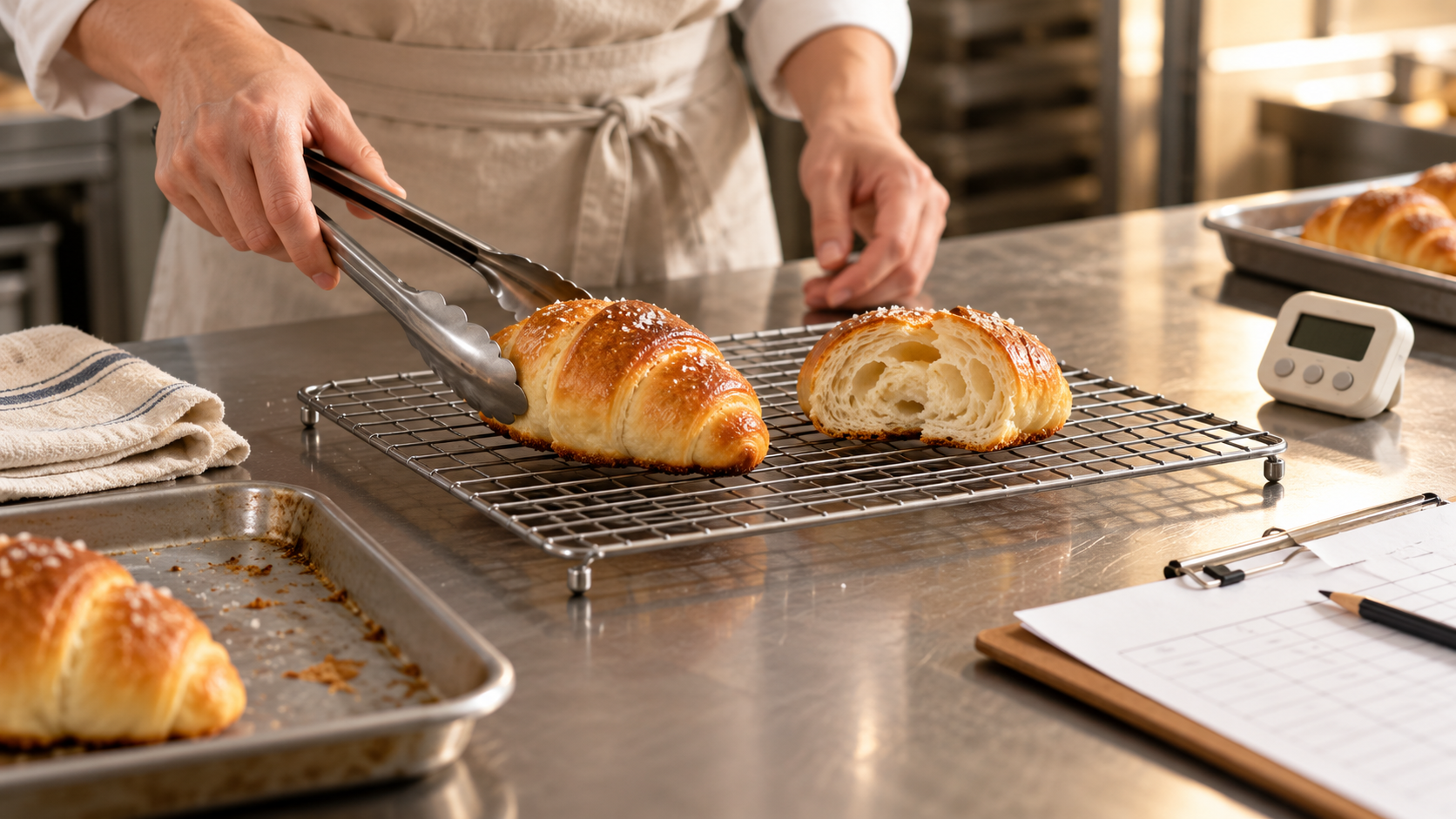
A customer may ask for Salt Bread warmed, or a quiet counter may tempt the team to reheat a roll that has lost its first-bake energy. That request creates a product decision: does the warmed roll still deliver the contrast the menu promises, including the crisp butter-fried base and tender interior? A warmer surface alone does not answer it.
The American Society of Baking describes bread evaluation as comparison against a defined standard, using both external and internal characteristics. That is the useful frame here. Write the product you want to release before choosing the reheat route, then compare a control roll and a reheated roll under the same light, at the same handoff point. Do not treat a freshly heated sample at the oven door as proof of the bagged or counter-served product.
Commission the route, not one attractive roll
Use rolls from a normal production batch that have reached the age at which the team expects to offer a warm-up. Keep the product version, storage condition, oven, tray, rack position, load, and intended package visible in the record. Then choose one candidate route. The first trial is a comparison, not a promise that the setting will transfer to another oven or another day.
Make only one meaningful change between trials. For example, if the first candidate restores surface energy but the crumb feels dry after the normal customer walk, compare a shorter exposure while holding the roll age, load, cooling interval, and package constant. If several inputs change together, record the result as a new route; it cannot tell the team which change caused the improvement or loss.
- Write the release standard in observable language and select representative rolls from the actual batch.
- Hold one control roll on the normal service route; reheat the paired roll through one defined candidate route.
- Allow the same short customer-facing interval before checking both rolls, including the real bag or serving presentation where applicable.
- Score exterior first, then cut a sample and assess crumb, aroma, flavour, and the butter base. Record the result and the time from reheat to handoff.
- Approve, revise one variable, or withhold the route. Repeat on a separate normal service period before writing it into the operating standard.
Use a paired release record the team can repeat
A useful reheat record turns preference into an operating decision. It does not need laboratory equipment, but it does need a named comparison and an honest release outcome. The table is deliberately product-facing: it asks what the customer receives, rather than assuming that heat input alone predicts quality.
The worked fields below are a reusable template, not MasterBaker test data. Add your own approved product reference, service conditions, and pass threshold. If the warmed roll is better in one column but worse in another, the decision is not automatically pass. Decide which characteristics are non-negotiable for the Salt Bread menu, then make the tradeoff visible to the person releasing product.
| Record field | What to enter or observe | What the result decides |
|---|---|---|
| Product at test | Bake batch identity, roll age, storage route, and control/reheat pair | Whether the comparison represents the product the customer will receive |
| Candidate route | Oven type, stated setting, rack or tray, load, exposure, and post-heat interval | What the next baker can reproduce without guessing |
| Exterior check | Base crispness, color, butter residue, salt retention, shape, and handling damage | Whether the visible Salt Bread promise survives warming |
| Interior and eating check | Crumb resilience, moisture perception, aroma, flavour balance, and any tough or gummy result | Whether warmth improved or compromised the eating experience |
| Handoff check | Package or serving condition after the normal short route to the customer | The latest approved release point and whether the route remains sellable |
| Decision | Pass, revise one variable, or hold; name the reason and owner | A traceable next action instead of an informal rescue habit |
Set a limit that protects the Salt Bread promise
Bread texture changes during storage and after heating; the research literature discusses crumb firming, crust crispness loss, and flavour change as parts of staling. Microwave reheating can also produce rapid toughening in bread-like products under the study conditions reported by Uzzan and colleagues. Those findings explain why a bakery should verify its own product route instead of assuming that any warming method is neutral. They do not provide a universal setting for Salt Bread.
As a Le Cordon Bleu-trained founder running a Korean bakery, I would make the release decision at the customer endpoint, not at the oven. If the control is cool but elegant and the reheated roll is warm but loses its base, salt finish, or crumb balance, the answer is to improve the route or decline the warm-up—not to redefine a weaker roll as the standard. Pair this check with the existing packaging and display controls so the team does not solve one service moment while losing the next one.
Connect the reheat decision to the rest of the Salt Bread route
- Salt Bread Packaging: Keep the Crisp Butter-Fried Base on the Way to the Customer
Use this field note when the reheat comparison passes at the bench but fails after cooling, bagging, or takeaway handoff.
- Salt Bread Display Control: Protect the Crisp Base Through the Counter Window
Use the display standard to decide whether the customer-facing issue began before reheat or at the counter.
- Salt Bread Formula Collection
The collection supplies founder-developed formulas plus butter handling, shaping, proofing, baking, QC, costing, and local commissioning tools. Validate any reheat route locally; the collection does not replace food-safety or legal-sale controls.
Frequently asked questions
Questions operators ask
What is the best temperature and time to reheat Salt Bread?
There is no transferable universal setting. Commission one route with your oven, roll age, load, pan or rack, cooling interval, package, and product standard, then approve it only after the normal customer handoff also passes.
Should I use a microwave to warm Salt Bread?
Treat it as a separate candidate route rather than assuming it matches an oven. Research on bread-like products found microwave reheating could toughen crumb when internal boiling occurred under its study conditions. Compare your locally controlled route at handoff and reject it if it misses the product standard.
Can a reheat test prove that Salt Bread is safe or has a longer shelf life?
No. This is a product-quality comparison. Follow the locally applicable food-safety, allergen, holding, date-marking, labelling, and shelf-life program for those decisions. The FDA Food Code is a U.S. model adopted differently by jurisdictions, not a universal bakery rule.
What should I do with a roll that misses the reheat standard?
Use the bakery's approved disposition and food-safety program. Record why it missed, and improve one controlled factor before returning the route to normal service; do not create an informal customer route just to hide a quality loss.
Technical references
Sources used for this field note
Related field notes

Why learn from MasterBaker
First-hand bakery work, translated into measurable decisions
MasterBaker.io is led by Joonho Jang (장준호), a Le Cordon Bleu-trained owner-chef who develops, produces, and sells bakery products in Korea. The flagship salt bread grew from a product sold and locally praised in the founder's bakery. These field notes turn that operating experience into temperatures, weights, endpoints, QC, costing, and release decisions rather than anonymous recipe summaries. Read the founder's method and evidence policy.