Quick answer
The operating answer
Treat the display case as the last production stage, not as storage for whatever came from the oven first. Set a locally approved Salt Bread standard for the customer-facing moment: shape, color, cavity, aroma, warmth or cooling state, butter-fried base, and eating texture. Check representative rolls when they enter the display and at planned replenishment points; record the first sign that the base, exterior, or eating quality moves outside the promise. Replenish only what your team can sell in the approved condition, and route unsellable product by a written local decision rather than quietly averaging its loss into the day.
- The accepted Salt Bread is the roll at handoff, not the best roll at oven exit.
- Define the display standard before the rush so a team can make a consistent replenish, hold, discount, or remove decision.
- Use representative samples from the first and later trays; early product does not prove late-service quality.
- Separate display quality records from food-safety requirements and follow applicable local rules for any held, repurposed, or discarded food.
- Use observed sellable time and loss reasons to set a local par level instead of filling the case from hope.
The counter is where the product promise is tested
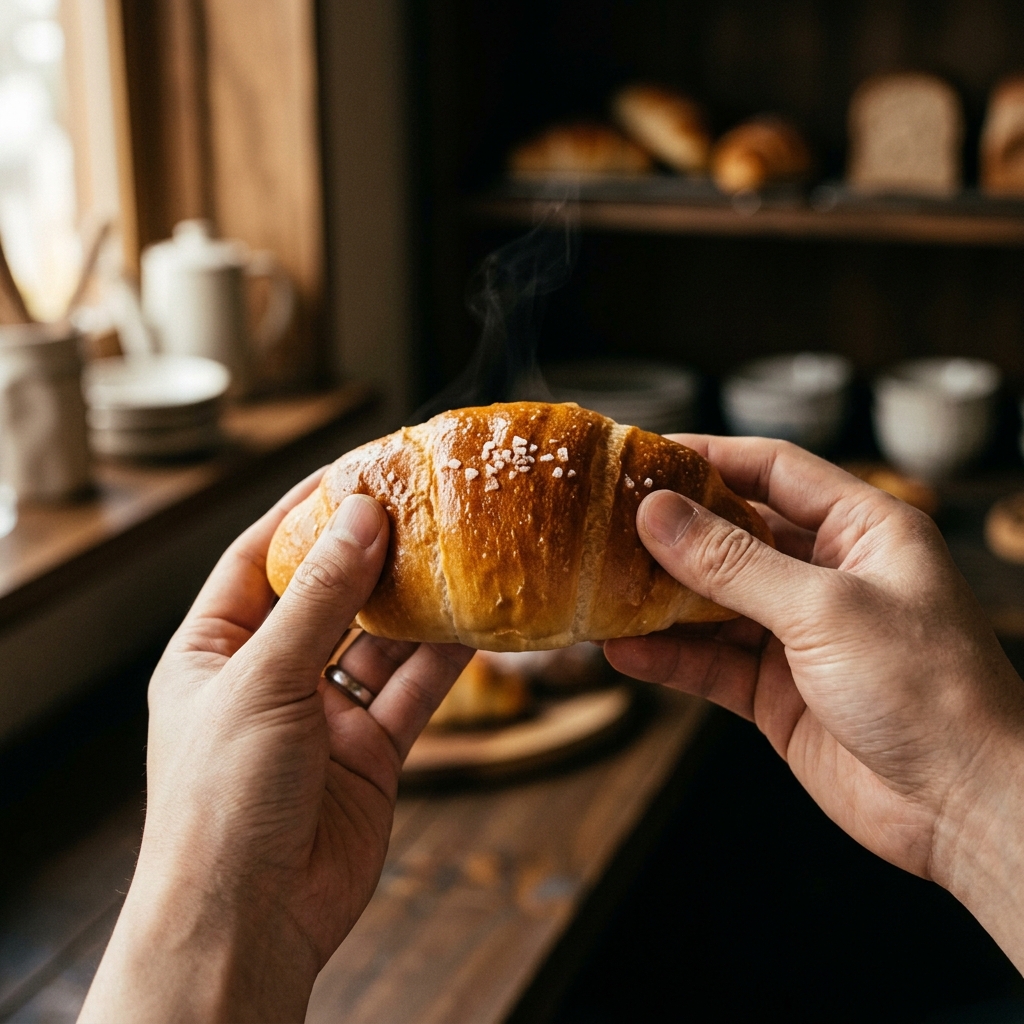
Salt Bread has a visual and textural promise: a light roll, intentional butter release, and a crisp butter-fried base. The oven can create that result, but the customer experiences it after cooling, handling, display, and a period of service. If the base softens, the exterior becomes greasy, or the roll no longer matches the standard, the display case has become a process variable—not a neutral shelf.
The American Society of Baking describes bread evaluation as comparison against a defined standard, using both external and internal characteristics. That is a useful commercial discipline for a Korean bakery. Do not ask a rushed team whether a roll still looks fine. Give it a short, teachable customer-facing standard and a record that shows when the product entered display, how it looked at the check, and what decision followed.
As a Le Cordon Bleu-trained Korean bakery founder, I want a display to show the roll I am prepared to sell again tomorrow, not merely the volume I made this morning. A calm replenish decision protects both the first customer and the last customer in the rush.
| Display checkpoint | What the team checks | Decision it supports |
|---|---|---|
| Release to counter | Approved shape, color, cavity, butter-release pattern, and base condition | Whether the tray is ready for the stated customer route |
| Planned service check | Representative exterior, base texture, aroma, and customer-facing appearance | Whether to replenish, hold, or remove product before quality becomes a complaint |
| Replenishment | How much product remains approved and how long the next batch can repeat the standard | A local par level based on observed sellable condition, not maximum tray capacity |
| Exception | Reason-coded soft base, excess grease, damaged shape, unsold product, or another stated defect | Where the loss originated and whether an upstream process needs review |
| Close-down | Disposition under the bakery's written quality and food-safety program | That product is not silently carried into an unapproved route |
Write a practical release and replenishment rule
A useful display rule does not need a universal clock. It needs an approved local observation. Start with one formula, butter portion, pan, bake profile, cooling release, display fixture, lighting, service method, and normal sales period. At defined points in the run, compare representative product with the approved reference. If the result moves outside the standard, use the written action rather than waiting for every roll to look the same.
ASB notes that cooling, temperature, and relative humidity affect moisture loss and staling, while its packaging-temperature guidance describes how moisture movement can soften crispy products. Those references do not provide a universal Salt Bread display time. They explain why a bakery should test its own counter environment, cover or wrapper route, and replenishment pattern rather than copying a holding limit from another product or city.
| When this happens | Do not assume | First controlled response |
|---|---|---|
| The base loses crispness | The bake profile is automatically wrong | Compare the display condition, cooling release, tray or liner, handling, and time in service before changing the oven |
| A tray looks full but sells slowly | More product will improve the display | Record demand and customer-facing quality, then test a smaller replenishment quantity |
| A later tray differs from the first | The first tray proves the full batch is acceptable | Compare its production and display route with the approved reference and identify the first divergence |
| Product is held after the approved standard | It is acceptable because it remains visible | Follow the local quality and food-safety disposition rule; record the reason for the decision |
| A new case, liner, or service method is introduced | Only presentation changes | Run a controlled local check before treating it as the normal Salt Bread route |
Commission the counter with the same discipline as the oven
The counter trial should use a realistic rush, not a quiet photo session. Ask the production and service team to run the actual release, replenishment, pickup, and packing sequence. Sample early and later product against the same local standard. Keep records concise enough to survive service: batch or tray, release time, check moment, observed result, and decision. The goal is to discover a repeatable display route, not to manufacture a precise-looking number that fails on a busy day.
ASB's storage-and-transportation guidance emphasizes documented holding conditions and acceptance criteria. Apply that idea at the counter: write what the bakery accepts, how it inspects it, and what happens when it is outside the standard. This is separate from a local food-safety plan, which remains the authority for safe holding, reuse, and disposition.
- Define the approved customer-facing Salt Bread: shape, color, cavity, butter release, crisp base, aroma, texture, and selling route.
- Map the route from oven exit through cooling, tray or liner, display fixture, service pickup, and any packaging handoff.
- Run a representative service trial with early and later samples from the actual production and sales pace.
- Record release, check, and decision points with clear reason codes for product outside the approved standard.
- Change one local display or replenishment factor, repeat the trial, and approve the new par level only when the result repeats.
- Review display loss beside production loss so the menu team solves the right part of the system.
Sell the last roll with the same confidence as the first
A full display can feel like good hospitality, but an owner-chef should measure hospitality by the roll the customer actually receives. A smaller, better-timed Salt Bread release can protect crispness and reduce quality loss more effectively than a counter filled beyond its proven selling window. The right decision belongs to the bakery's own formula, service speed, display equipment, and customer demand—not a generic holding target.
The Salt Bread Formula Collection connects that final counter decision to the earlier controls that make it possible: founder-developed formulas, butter handling, shaping, proofing and bake endpoints, QC, costing, and local commissioning tools. Use it to build a complete product route, then display only what your bakery can repeatedly sell with confidence.
Frequently asked questions
Questions operators ask
How long can Salt Bread stay in the display case?
There is no universal time that proves your product remains at its intended quality. Commission a local release and check rule using your formula, cooling route, case, handling, service pace, and approved customer-facing standard.
Should I fill the Salt Bread display case before a rush?
Set the replenishment quantity from observed sellable condition and demand. A visually full case is not a success if later rolls no longer meet the crisp-base and service standard.
What should I inspect at the counter?
Use a concise local standard that includes appearance, shape, color, butter-release pattern, base condition, aroma, and eating texture at the stated handoff moment. Record meaningful exceptions by reason.
If the crisp base softens, should I increase the bake?
Not immediately. Review the entire route: cooling release, tray or liner, display conditions, handling, service time, and packaging. Change one locally controlled factor at a time so the cause is not hidden.
Can I sell or reuse product that misses the display standard?
Follow your documented quality and food-safety program and applicable local requirements. Do not create an unapproved route merely to hide display loss; make the decision traceable and separate from the standard retail product.
Technical references
Sources used for this field note
Related field notes

Why learn from MasterBaker
First-hand bakery work, translated into measurable decisions
MasterBaker.io is led by Joonho Jang (장준호), a Le Cordon Bleu-trained owner-chef who develops, produces, and sells bakery products in Korea. The flagship salt bread grew from a product sold and locally praised in Joonho Jang's bakery. These field notes turn that operating experience into temperatures, weights, endpoints, QC, costing, and release decisions rather than anonymous recipe summaries. Read Joonho Jang's method and evidence policy.