Quick answer
The operating answer
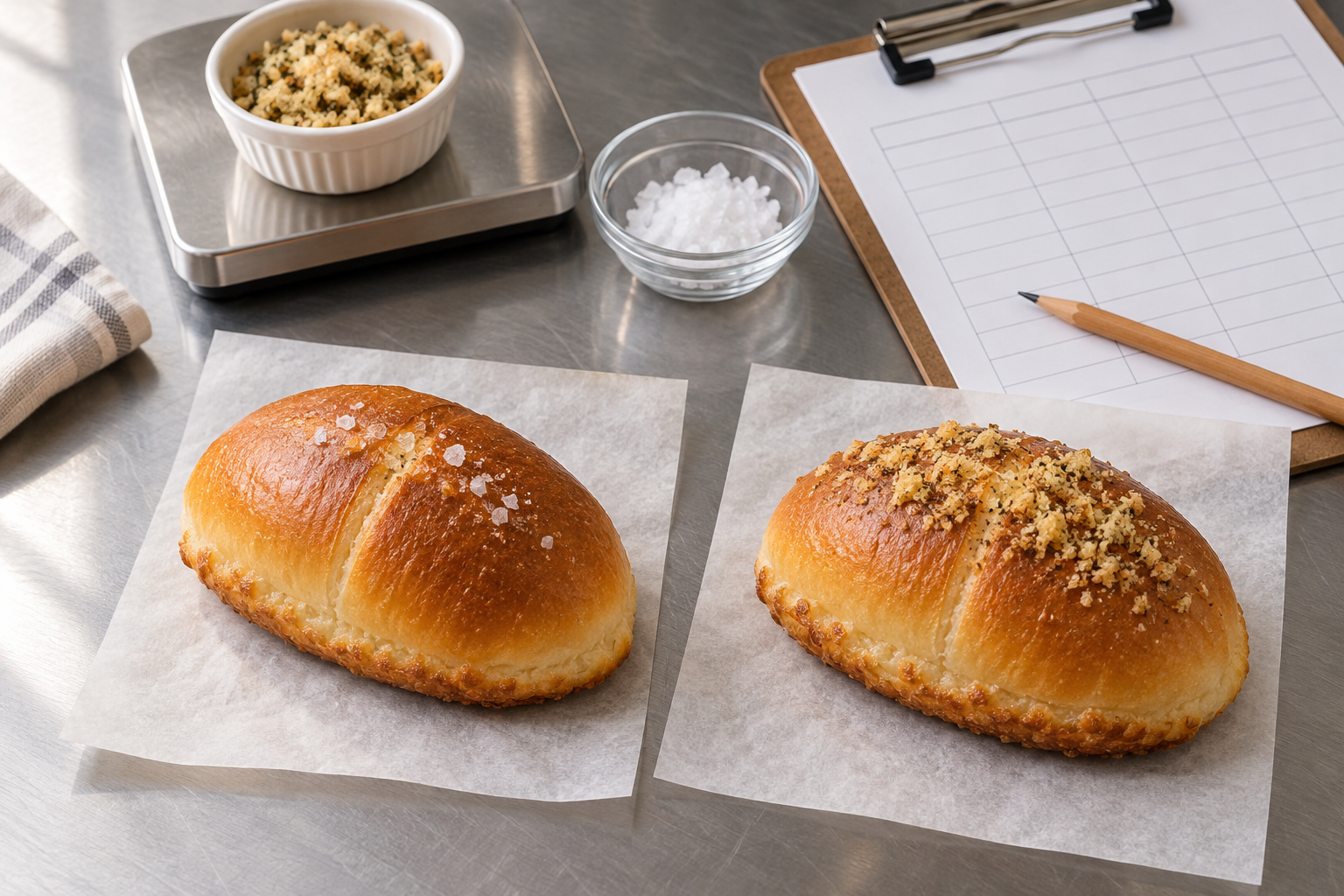
Do not add a Salt Bread topping to the menu because it looks good on a bench sample. Keep the approved plain roll as the control, define what the proposed finish changes, and compare one candidate route through the real bake, cooling, display or package, and handoff. Release the variation only when the topping, crisp butter-fried base, crumb, salt balance, handling, and customer-facing information all meet a written local standard. If it misses, change one meaningful variable and test again rather than borrowing the plain-roll approval.
- A new topping is a new finished-product route, not merely a visual adjustment to an already approved Salt Bread roll.
- Start with a defined plain-roll control and change one meaningful factor at a time: topping material, amount, application point, or the stated bake and service route.
- Score the base, top, crumb, flavour balance, loose material, package or display condition, and handoff together; a topping can pass visually while weakening another promised characteristic.
- Treat allergen, ingredient, label, and food-safety decisions as local compliance work. A quality comparison does not establish a safe holding time, label, or legal sale condition.
A topping changes the product route, not just the photograph
A new finish can be a useful menu idea, but it gives the baker more than one variable to manage. The topping may need a different application point, may shed in a bag, may change surface colour, and may alter how the customer experiences the salt, butter-fried base, and soft interior. Calling it an approved Salt Bread variation before those changes have been compared makes the plain-roll standard invisible.
Use the plain product as the control. The American Society of Baking describes bread evaluation as comparison with a defined standard, using both external and internal characteristics. For Salt Bread, write the customer promise in observable terms before trialing the variation: shape and colour, crisp base, crumb resilience, topping adhesion, salt balance, aroma, and the condition at the actual handoff. This is a product-quality method, not a universal recipe or a claim that one attractive sample predicts every oven or service route.
Write the candidate change before the first bake
Name the proposed finish precisely enough for another baker to repeat it: supplier and ingredient identity, preparation state, target amount or application method, point in the process, product version, pan or rack, oven, load, cooling interval, and intended display or package. Also name the control roll from the same batch. A vague note such as ‘garlic topping’ cannot distinguish a material change from an amount, timing, or bake-route change.
The first trial should answer one question only. If the topping burns or sheds, do not simultaneously change its amount, the bake, the roll weight, and the package; the result cannot identify what solved the problem. Hold the baseline formula and normal handling route constant, select representative paired rolls, and revise one meaningful variable only after the prior result is recorded.
- Define the plain control and the exact proposed topping route before production begins.
- Bake or finish paired, representative rolls through the same normal pan, oven load, cooling interval, and customer route.
- Inspect whole rolls first under the same light, then assess the base and cut a sample for crumb, aroma, flavour, and topping distribution.
- Check the real handoff condition: loose material, handling damage, display residue, or package transfer belong in the decision.
- Record pass, revise one factor, or hold. Repeat an acceptable candidate on a separate normal production period before treating it as the menu standard.
Use one variation record that preserves the control
The record below is a reusable planning tool, not MasterBaker test data or a required scoring system. Choose the bakery’s own pass threshold before looking at the candidate result. A variation may be attractive at oven exit yet fail because the crisp base is weaker after the normal cooling and handoff route. Keeping the control beside the candidate makes that tradeoff visible.
| Record field | What to enter or observe | Decision it supports |
|---|---|---|
| Control and candidate | Batch identity, plain-roll control, proposed finish, and the one intended change | Whether the comparison can show what the variation changed |
| Application route | Ingredient identity, amount or method, application point, pan or rack, oven load, and cooling interval | What another baker must reproduce for the next trial |
| Whole-roll check | Shape, colour, topping adhesion, salt visibility, loose material, and base crispness | Whether the visual and handling promise survives the finish |
| Cut and tasting check | Crumb resilience, moisture perception, aroma, topping distribution, and flavour balance against the plain control | Whether the variation improves the menu without obscuring the base product |
| Customer route and decision | Display or package condition, handoff interval, allergen or information action owner, and pass/revise/hold reason | Whether the version is ready for a local release review rather than an informal sale |
Do not let a passing flavour test hide an allergen or service change
A finish that introduces or changes an ingredient can also change the bakery’s allergen, storage, labelling, cleaning, utensil, and customer-information work. The FDA Food Code is a U.S. model adopted differently by jurisdictions; it is useful for recognising that food-allergen controls need a written operating approach, not for declaring that one test bake is legally ready to sell everywhere. Follow the authority and written program that apply to the bakery and market before service.
That distinction matters commercially as well as technically. If a topping only works in an uncovered, immediate-eat presentation, it has not yet passed a takeaway route. If it requires a separate tool, new cleaning sequence, or different product information, record the work before assigning it a menu price or promising it at every sales channel. The plain roll remains the approved reference; the variation earns its own approval.
Release a variation as a defined route
An approved variation should leave a clear instruction: the named finish, the application method, the approved product and service route, the observable release checks, and the condition that stops service. When a later supplier, amount, bake, package, or sales route changes, return to the same comparison rather than assuming the first approval travels with it.
As a Le Cordon Bleu-trained founder operating a Korean bakery, I would protect the plain Salt Bread standard first. A variation can broaden a menu, but it should not force the team to accept a softer base, an inconsistent finish, or unclear customer information. The practical decision is not ‘does this topping taste good?’ but ‘can this complete product route be repeated honestly at the customer handoff?’
Use the variation record with the existing Salt Bread controls
- Salt Bread Finishing Salt: Make the Last Pinch Repeatable Before It Reaches the Customer
Use this when the new finish changes the final salt application rather than the product’s broader topping route.
- Salt Bread Packaging: Keep the Crisp Butter-Fried Base on the Way to the Customer
Use this next when a variation passes at the bench but leaves residue, loses crispness, or arrives differently in its actual package.
- Salt Bread Formula Collection
The collection includes founder-developed formulas and operating tools for butter handling, shaping, proofing, baking, QC, costing, and local commissioning. Validate each variation locally; it does not replace food-safety or legal-sale controls.
Frequently asked questions
Questions operators ask
Can I simply add a topping to an already approved Salt Bread recipe?
Treat it as a new finished-product route. Keep the approved plain roll as the control and compare the candidate through the actual bake, cooling, display or package, and handoff before release.
What should I change first when a topping burns or falls off?
Record the current route and change one meaningful factor—such as the material, amount, or application point—while holding the plain-roll baseline and other conditions constant. Several simultaneous changes cannot show which one corrected the outcome.
Does a successful taste test approve a topping for takeaway sales?
No. Evaluate the real customer route too. Loose material, package transfer, base crispness, handling, customer information, and any required allergen or food-safety controls can differ from an immediate bench sample.
Does this record establish allergen labelling or a safe service period?
No. It is a quality-release aid. Follow the locally applicable food-safety, allergen, labelling, holding, cleaning, and sale requirements and the bakery’s written program.
Technical references
Sources used for this field note
Related field notes

Why learn from MasterBaker
First-hand bakery work, translated into measurable decisions
MasterBaker.io is led by Joonho Jang (장준호), a Le Cordon Bleu-trained owner-chef who develops, produces, and sells bakery products in Korea. The flagship salt bread grew from a product sold and locally praised in Joonho Jang's bakery. These field notes turn that operating experience into temperatures, weights, endpoints, QC, costing, and release decisions rather than anonymous recipe summaries. Read Joonho Jang's method and evidence policy.