Quick answer
The operating answer
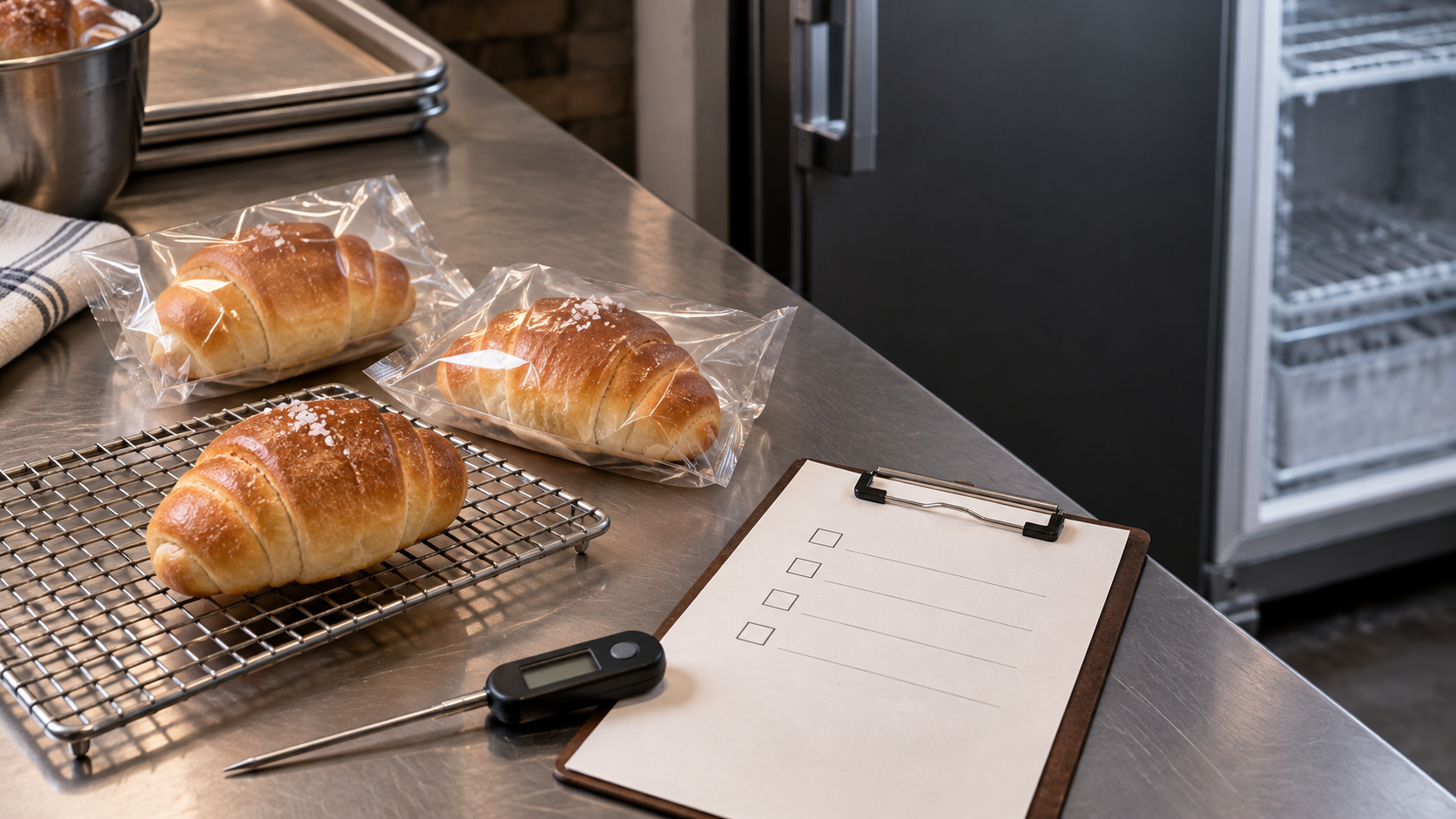
Freeze finished Salt Bread only after you have approved the complete frozen route against the fresh roll your customer normally receives. Use the same finished roll, cooling point, package and customer-stage standard; record the freezer period and condition, the proposed thaw or reheat route, and the result at handoff. Compare the butter-fried base, crust, crumb, salt finish, package and customer-facing condition with a fresh control. A roll that survives a freezer is not automatically a roll you can promise as fresh, warm, crisp, safe, shelf-stable, or suitable for sale under your local rules.
- A finished-roll freeze route is different from frozen dough: decide which product stage you are actually approving before changing ingredients or proofing.
- Freeze only a defined, fully cooled and packaged finished product, then compare it with a fresh control at the customer-stage endpoint.
- Record the actual package, storage period and condition, thaw or reheat route, and service interval; do not reduce the decision to a freezer temperature or a calendar claim.
- Score the features customers notice in Salt Bread: butter-fried base, crust, crumb, salt finish, shape, package condition and handoff experience.
- A quality comparison does not establish food safety, shelf life, labelling, marketing language or legal sale approval; those belong to the locally applicable program and authority.
Freezing a finished roll is a new customer route
A freezer can make a production schedule feel more flexible, but it also creates a second version of the product: bake, cool, package, freeze, store, thaw or reheat, then hand over. That version cannot borrow approval from the fresh Salt Bread simply because both started from the same formula. The American Society of Baking describes blast freezing of finished bread and rolls as a route followed by frozen storage and a thawing step for retail sale. For Salt Bread, the relevant question is narrower: can this defined route still deliver the crisp butter-fried base, crumb, salt finish and package condition you promise?
Do not confuse this with frozen dough. Frozen dough is held before proofing and baking, so it brings different yeast, dough-strength and proofing questions. This note is about a fully baked Salt Bread roll that has already reached its normal finished-product standard. Keep that boundary clear in the production record; otherwise a team can change the product stage, storage method and service plan at once and learn very little from the result.
| Decision | Define before the trial | Why it changes the result |
|---|---|---|
| Product stage | Fully baked Salt Bread versus dough or part-baked product | Each stage has a different process and cannot inherit the other's approval |
| Fresh control | The current finished roll and ordinary customer handoff | Gives the frozen route a meaningful comparison instead of a memory |
| Frozen route | Cooling endpoint, package, freezer location, storage period, thaw or reheat step and service interval | Makes the proposed route reproducible |
| Release standard | Base crispness, crust, crumb, salt, shape, package and customer-stage condition | Connects the trial to what the customer actually receives |
Start with one defined fresh control
Select representative rolls from a normal batch, not the best-looking piece from the rack. Let each roll reach the bakery's approved cooling endpoint, then use the same package that you propose to freeze. Keep the fresh control on its usual service route. Put the comparison roll through the defined frozen route. The American Society of Baking's bread-evaluation guidance is useful here: scoring works against a bakery-defined standard and considers both external and internal qualities. For Salt Bread, that means judging the complete roll rather than praising a warm center while ignoring a softened base or damaged finish.
Write down conditions instead of treating them as background details. Record the batch or product version, bake and cooling endpoint, package, date and time placed in frozen storage, observed freezer condition, removal time, thaw or reheat route, and the time the customer-stage check occurs. This is not a claim that one storage period fits every bakery. It is the minimum context needed to compare the same route later or identify what changed when the result drifts.
- Define the current fresh Salt Bread standard at customer handoff, including the intended base, crust, crumb, salt finish, package and service condition.
- Choose representative finished rolls from one normal batch and cool them to the locally approved packaging point.
- Keep one roll on the ordinary fresh route; package the comparison roll in the proposed freezer package and record its storage condition and period.
- Use one stated thaw or reheat route. Do not also change the package, formula, salt finish, oven setting or display rule in the same comparison.
- Inspect both rolls at the same customer-stage moment and record release, hold, or one next change to test.
- Repeat before making a routine menu promise, especially after a package, freezer, service route or product standard changes.
Score the whole Salt Bread, not just whether it became warm
A warm thawed or reheated roll can still be a weaker Salt Bread. Compare the base after the proposed service interval, not only as it leaves the oven or microwave. Check whether the crust still has the intended bite, whether the crumb is acceptably resilient rather than dry or gummy, whether the salt finish remains balanced, and whether the package introduces visible moisture, crush damage or transfer. Record what the customer would see and eat, not only an operator's preference at the bench.
Research on frozen baked and part-baked breads reports that storage time, temperature history and water movement can affect firmness and staling behavior. That supports disciplined comparison, not a universal freezer specification for Salt Bread. USDA consumer guidance says commercially baked bread and rolls can retain quality in a freezer for three months, but that household quality guidance is not a commercial shelf-life, safety, labelling or freshness claim. Your bakery still needs to validate the exact product and its local customer route.
| Observation at handoff | First useful question | Do not assume |
|---|---|---|
| Base has softened | Did cooling, package, thawing exposure or the service interval change first? | Freezing alone is the only cause |
| Crumb feels firm or dry | How does the storage period and temperature history compare with the fresh control? | A longer reheat automatically restores the product |
| Package is fogged or the finish has transferred | At which cooling, freezing, thawing or display handoff did moisture appear? | A tighter package is automatically better |
| Salt finish seems different | Was the same salt, application point, package and service interval used? | Adding more salt corrects a route problem |
| One roll is acceptable and another is not | Were the rolls representative of the batch and handled through the same route? | The better-looking roll proves the process |
Use a short freeze–thaw approval record
The record should help a small team decide, not create decorative precision. It should show exactly what was frozen, how it was handled, what the customer-stage comparison found, and which single next action follows. Keep it with the current Salt Bread product standard so a later package or service change does not silently use an old result.
For a Korean bakery operator, this is a capacity decision as well as a quality decision. A route that makes more units available but leaves the butter-fried base, finish or handoff less reliable may weaken the very product customers return for. Approve a narrow, repeatable frozen route first. If it fails, hold the promise, trace the first meaningful difference and change one condition before retesting.
| Record field | What to enter | What it supports |
|---|---|---|
| Fresh reference | Date, product version, batch point, cooling endpoint and ordinary handoff condition | A credible fresh control |
| Frozen route | Package, freezer location and observed condition, storage period, thaw or reheat route and service interval | A route another shift can repeat |
| Customer-stage score | Base, crust, crumb, salt, shape, package and decision notes | Release, hold or targeted retest |
| Next action | Keep, stop, or one stated variable to change; plus the decision owner | A practical operating decision rather than an anecdote |
Use the frozen-route record with these Salt Bread controls
- Salt Bread Reheat Standard: Decide Whether a Warm-Up Still Delivers the Product You Promise
Use this when the proposed frozen route includes a reheat step and needs a defined customer-stage endpoint.
- Salt Bread Packaging: Keep the Crisp Butter-Fried Base on the Way to the Customer
Choose and test the package before asking it to carry a frozen and thawed finished roll.
- Salt Bread Display Control: Protect the Crisp Base Through the Counter Window
Set the customer-stage check after thawing or reheating reaches the counter.
Frequently asked questions
Questions operators ask
Can I call frozen-and-thawed Salt Bread fresh-baked?
Do not make that claim from this quality record. Product descriptions, food claims and labelling are governed by the locally applicable rules and your bakery's written program. Decide the wording only after the product route and applicable requirements have been reviewed.
Does the USDA three-month freezer guidance become my bakery's selling window?
No. The USDA statement is consumer quality guidance for commercially baked breads and rolls, not a validation of your Salt Bread's freezer route, shelf life, food safety, label or commercial promise. Test your own defined product and follow the applicable local requirements.
Can I use the same record for frozen Salt Bread dough?
No. Frozen dough is stored before proofing and baking, so yeast activity, dough strength, thawing and proofing become part of a different process. Start a separate controlled trial for the product stage you intend to sell.
If the thawed roll is softer, should I simply reheat it longer?
Not before identifying the first changed condition. Compare the exact storage, package, thaw or reheat and service interval with the fresh control. A stronger reheat can change the crust or crumb while hiding the original cause.
Technical references
Sources used for this field note
Related field notes

Why learn from MasterBaker
First-hand bakery work, translated into measurable decisions
MasterBaker.io is led by Joonho Jang (장준호), a Le Cordon Bleu-trained owner-chef who develops, produces, and sells bakery products in Korea. The flagship salt bread grew from a product sold and locally praised in Joonho Jang's bakery. These field notes turn that operating experience into temperatures, weights, endpoints, QC, costing, and release decisions rather than anonymous recipe summaries. Read Joonho Jang's method and evidence policy.