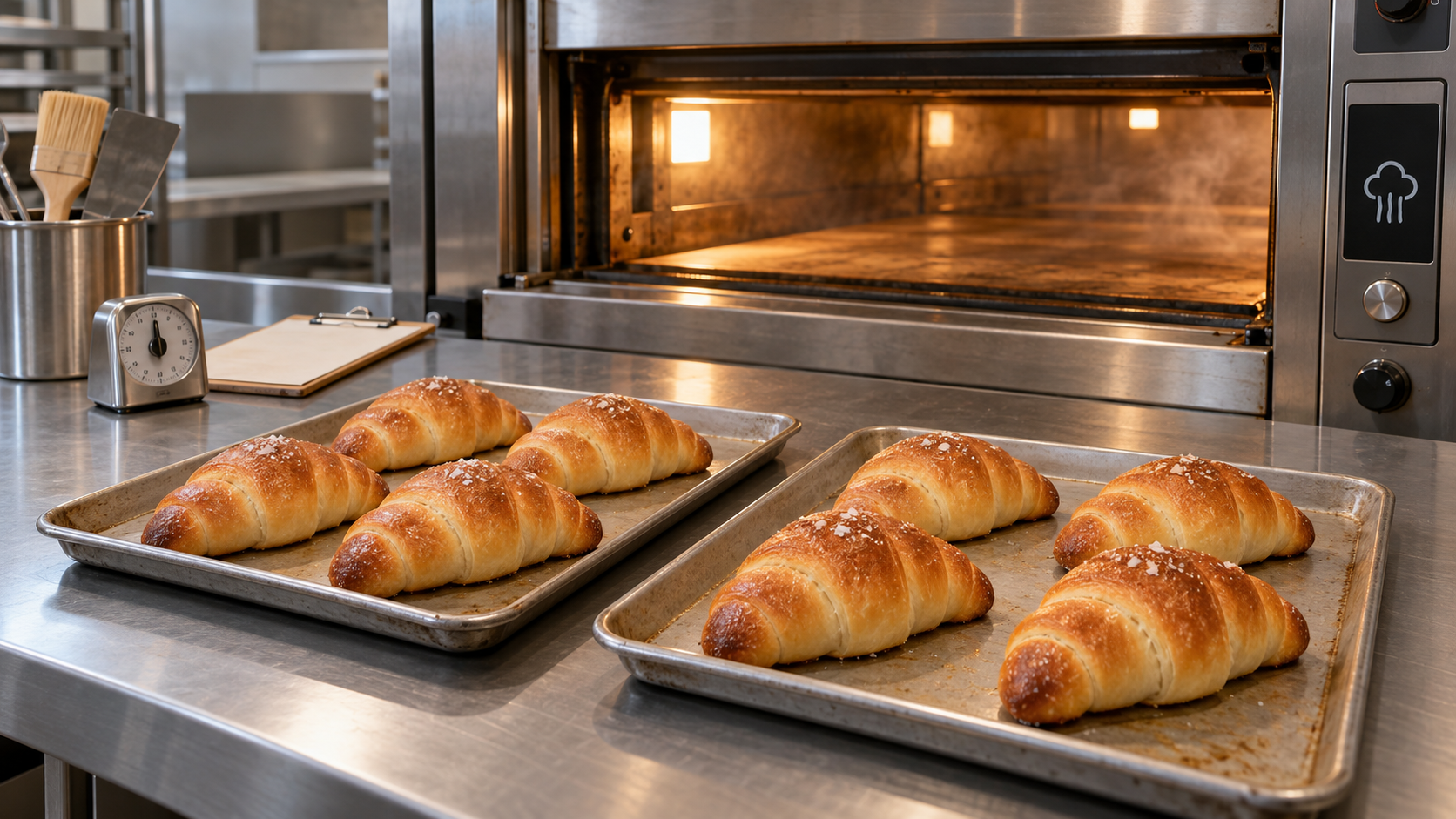
Quick answer
The operating answer
Use steam for Salt Bread only when a defined steam route improves the finished roll your customer receives without weakening its butter-fried base, colour, shape, crumb, or service reliability. Keep the approved dry bake as the control, change one steam setting or injection event, and compare representative rolls at the same customer-stage point. A steam function is not a universal upgrade: its effect depends on the oven, load, pan contact, dough condition, bake profile, venting, cooling, and the crisp-base standard you are trying to protect.
- Steam is a bake variable, not a default setting to copy from another oven or bread style.
- Keep dough, proof, piece weight, butter portion, pan, rack position, load, bake profile, cooling, and review point stable while comparing one stated steam route.
- Score the complete Salt Bread at the customer-stage endpoint: base, crust, colour, volume, seam, crumb, salt finish, and service condition.
- Record the oven model, programme or control state, injection event, load and venting condition so another shift can repeat the comparison.
- A better-looking roll does not establish food safety, shelf life, allergen control, labelling, or permission to make a new customer claim.
Steam changes the early bake, so test it as a route change
Salt Bread needs a deliberate balance: the roll must expand and set without losing the butter-fed base that gives the product its characteristic crispness. Adding steam changes the oven environment during the part of the bake when the surface is still setting. That means it can affect more than top colour. It can also change spread, seam opening, surface sheen, moisture movement and how the base behaves after cooling.
Equipment controls are not interchangeable. RATIONAL's iCombi Pro manual describes flash steam as moisture added at the beginning of baking that condenses on the food surface; in manual cooking, its steam injection sprays water onto the heating element. Those descriptions explain why the same button name is not a transferable Salt Bread recipe. A deck oven, combi oven and convection oven can deliver moisture, airflow and recovery differently. Start from the actual manual for the oven in front of you.
| Keep fixed for the first comparison | Change deliberately | Why it matters |
|---|---|---|
| Dough version, final proof point, dough and butter portion, shaping, pan and rack position | One named steam route or no-steam control | Prevents a proof or make-up difference from being mistaken for a steam result |
| Oven preheat, load size, bake profile and door-opening pattern | Only the injection event or programme humidity setting | Lets the team observe the oven's actual response rather than a different recovery condition |
| Cooling point, package and customer-stage review time | Nothing else in the customer route | A glossy exit from the oven is not the same as a successful crisp-base handoff |
Run a small bake-off with a dry control
Use ordinary, representative pieces from one defined batch—not the best-shaped roll saved for a photograph. Divide comparable rolls between the current approved dry route and one candidate steam route. If the oven cannot run the two routes in the same load, repeat the control under the same documented conditions before judging the candidate. The aim is not to prove that every Salt Bread needs steam. It is to decide whether this oven, formula and service route justify a change to this bakery's standard.
Published bread research supports the need for a controlled comparison, not a copied setting. Le-Bail and colleagues changed steam amount in one deck oven and measured heating, volume, moisture loss and crust-to-crumb ratio; Altamirano-Fortoul and colleagues found that their tested steam amounts changed crust colour, gloss, firmness and water-vapour behaviour. Those studies use particular bread formulas, ovens and steam quantities. Their numeric settings are not a Salt Bread programme for another bakery.
- Write the present approved dry-bake route, including oven identifier, pan, rack position, normal load, bake profile, cooling endpoint and intended customer-stage check.
- Name one candidate change exactly as the oven records it: for example, one flash-steam level, one manual injection event, or one stated humidity programme. Follow the manufacturer instructions and safety warnings for that model.
- Keep all other listed conditions fixed. Do not also change oven temperature, time, airflow, venting, proof, butter portion, pan or rack position in the same trial.
- Bake representative control and candidate rolls, then inspect each at the same finished stage after the normal cooling and service interval.
- Record release, hold, or one next variable to test. Repeat a promising route before making it the standing bake card or a customer promise.
Score the complete roll—not only oven spring or shine
Steam can make a surface look attractive while moving the real failure elsewhere. A Salt Bread roll can appear taller yet have a less reliable butter-fried base; it can show more sheen while the crust or salt finish changes after cooling. Judge against the bakery's current product reference at the same handoff point, with the same light and enough time for the surface to settle.
Use notes that identify the first meaningful difference. A single preference such as ‘more open’ does not tell the next shift whether to keep the candidate route. The useful observation identifies which feature changed, where it appeared, and whether the candidate still meets the customer-facing reference.
| Finished-stage observation | First useful question | Do not conclude |
|---|---|---|
| Base is less crisp after cooling | Did the steam route, pan contact, cooling interval or display condition differ first? | More bake time will automatically fix the base |
| Roll spreads or seam opens differently | Were proof point, portion pairing and rack position genuinely comparable? | Steam alone caused the shape change |
| Top colour or sheen changes | Does the candidate still meet the planned crust, salt finish and customer-stage standard? | A shinier top is automatically a better product |
| Crumb or cavity changes | Does the difference remain after the same cooling and cut point? | One cut sample proves every roll in the batch |
| Results shift between oven loads | What changed in load, recovery, injection delivery, airflow or door opening? | The control setting is stable under every load |
Keep a steam bake-off card with the current oven standard
The record should be short enough to use during production and specific enough to repeat. Its purpose is not decorative precision or a claim that a single bake validates all ovens. It is a way to make the candidate route visible when a new shift, programme, oven load or equipment change reopens the decision.
As a Korean bakery founder deciding what can be defended on an ordinary service day, I would release a steam route only when it improves or preserves the whole finished Salt Bread—not just the first impression at the oven. If the candidate misses the crisp-base or handoff reference, hold the change and test one new condition rather than layering extra time, heat, airflow and steam onto a result nobody can interpret.
| Bake-off card field | What to write | What it supports |
|---|---|---|
| Control route | Oven identifier, programme, pan, rack, load, bake profile and cooling point | A real baseline rather than a remembered bake |
| Candidate route | Exact steam control, injection event or humidity setting; plus any stated venting condition | A route another trained operator can repeat |
| Finished-stage score | Base, crust, colour, shape, seam, crumb, salt finish and service condition | A release or hold decision tied to the customer product |
| Next action | Keep, reject, or the one variable to change next; date and decision owner | A controlled next test instead of a stack of untraceable adjustments |
Use the steam bake-off beside these Salt Bread controls
- Salt Bread Oven Loading: Control Pan Contact, Rack Position, and Oven Recovery for a Crisp Base
Use this when the bake-off identifies a pan, rack, load or recovery difference rather than a repeatable steam effect.
- Salt Bread Butter Leakage: How to Build the Crisp Fried Base
Check this next when a candidate route changes where butter releases or how the base develops.
- Salt Bread Display Control: Protect the Crisp Base Through the Counter Window
Use the customer-stage counter check after the bake-off if the difference appears after cooling rather than at oven exit.
Frequently asked questions
Questions operators ask
Does Salt Bread always need steam?
No. The question is whether one defined steam route improves or preserves the finished Salt Bread your bakery intends to serve. Compare it with the approved dry control in your own oven instead of treating a steam feature as a universal requirement.
What steam setting should I use for Salt Bread?
There is no transferable setting. Ovens differ in how they add and remove moisture, circulate air, recover after loading and report controls. Use the manufacturer instructions for your model, state one candidate setting, and compare it with your dry-bake control through the finished service stage.
Can I change steam, temperature and bake time together?
Not if you need to know what caused the result. Keep the current bake profile and change one named steam condition first. If the candidate misses, identify the first meaningful difference and test one next condition in a new comparison.
Does a successful steam bake-off prove the rolls are safe or have a longer shelf life?
No. This is a quality and process comparison. Food safety, allergen control, cooling, holding, shelf life, labelling and legal sale need the bakery's applicable programme and local requirements.
Technical references
Sources used for this field note
Related field notes

Why learn from MasterBaker
First-hand bakery work, translated into measurable decisions
MasterBaker.io is led by Joonho Jang (장준호), a Le Cordon Bleu-trained owner-chef who develops, produces, and sells bakery products in Korea. The flagship salt bread grew from a product sold and locally praised in Joonho Jang's bakery. These field notes turn that operating experience into temperatures, weights, endpoints, QC, costing, and release decisions rather than anonymous recipe summaries. Read Joonho Jang's method and evidence policy.