Quick answer
The operating answer
Identify the probe, check it against a suitable reference using the manufacturer’s instructions, record the observed reading and your acceptance limit, and take it out of service if it fails. A properly prepared ice-water mixture provides a useful check at 0°C (32°F), but a pass at that point does not prove accuracy at every production temperature. Use a suitable reference for the intended range and follow your local food-safety plan. If a probe fails, assess the decisions made since its last reliable check rather than simply adjusting it and moving on.
- A check compares a reading with a reference; adjustment and a subsequent verification are separate actions.
- An ice-water check is one point near 0°C, not proof across the entire working range.
- Identify the probe, record the actual reading and the acceptance basis, and repeat the check after any permitted adjustment.
- Remove a failed or damaged probe from use, use a verified replacement, and assess affected records and product decisions.
- Clean and sanitize food-contact probes according to the equipment instructions and applicable food-safety procedures.
A temperature record is only as useful as its instrument
A bakery may use the same probe for dough, cream filling, cooling checks or a receiving decision. Those are different measurement ranges and purposes. A plausible number on a screen does not establish that the sensor is accurate, that its sensing area was in the right place, or that the recorded product decision was safe. Give each probe an identity and a written use: which measurement, what range, who checks it, and what happens when the check fails.
The USDA Food Safety and Inspection Service describes ice water and boiling water checks and emphasizes the manufacturer’s insertion instructions. The FDA Food Code sets accuracy and calibration provisions for food temperature devices in a US model code; local adoption and requirements vary. The bakery should choose its own written acceptance limit and check frequency from its equipment instructions, food-safety plan and applicable rules rather than borrowing a universal frequency from another operation.
Check a probe at the ice point
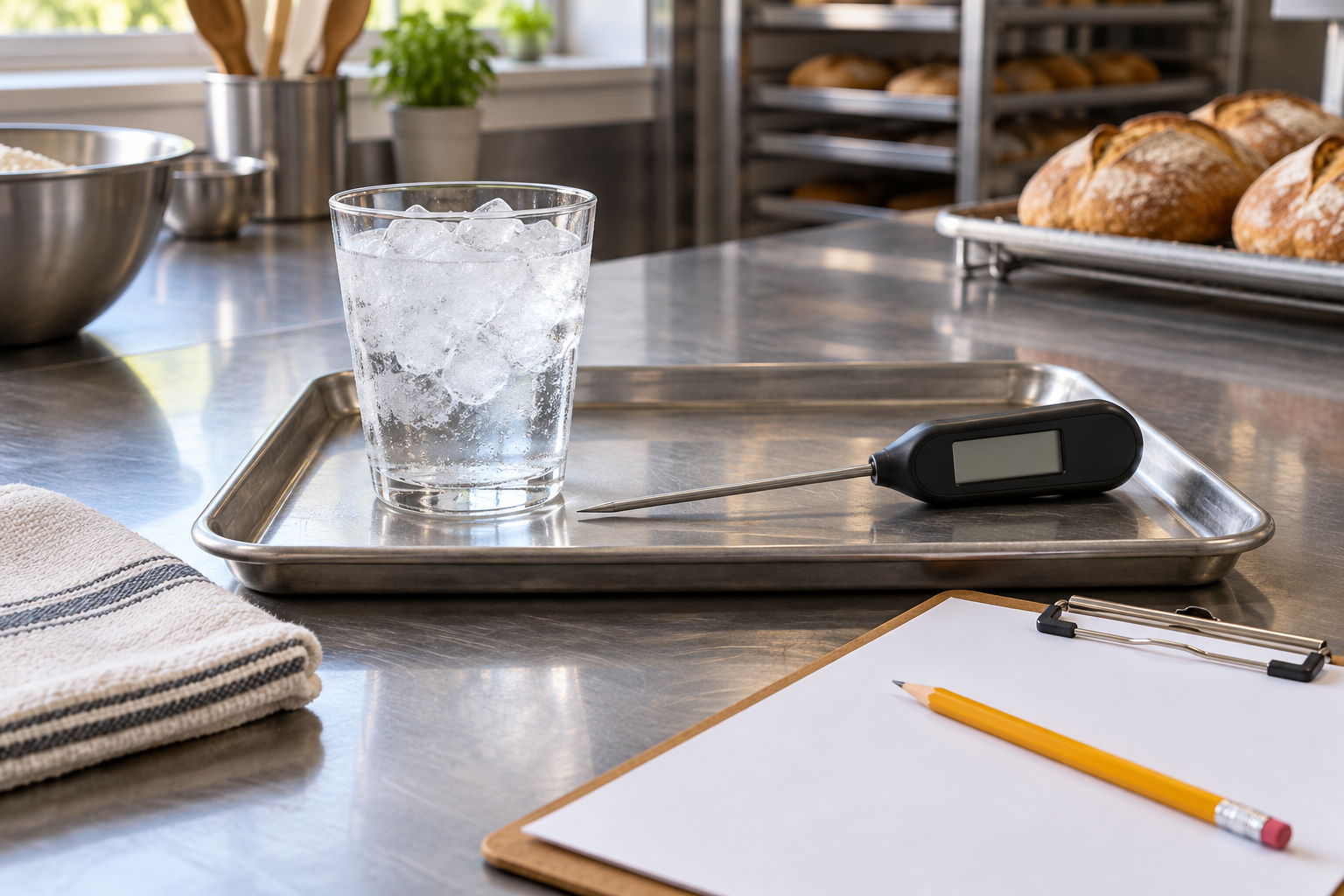
The USDA ice-water method gives a reference of 0°C (32°F). Fill a large glass with ice, add drinking water and stir well. Insert the sensing area into the mixture without touching the glass sides or bottom; USDA describes at least two inches of stem immersion for its general method. Follow the actual instrument’s instructions for the sensing area, minimum immersion and permitted exposure, keeping the electronics dry where required. Wait at least 30 seconds and until the reading stabilizes, then read without withdrawing the sensor.
Record the observed value and reference value in the same units. For example, a reading of 1.2°C against 0.0°C has a +1.2°C difference. That number alone is not a universal pass or failure: compare it with the written limit that applies to this instrument and its use. If the probe cannot be checked correctly in that mixture, use a reference method suitable for its design rather than forcing a shallow or unsuitable sensor into the glass.
- Identify the probe and inspect the tip, cable, housing and display for damage.
- Prepare the ice-water mixture with drinking water; stir and position the sensing area without contact with the container.
- Allow the reading to stabilize; record the actual reading, reference, units and difference.
- Compare with the documented acceptance limit and record the operator, time and decision.
- If an adjustment is permitted, follow the maker’s instructions, then repeat and record the check.
- Clean and sanitize the food-contact portion before returning the instrument to service under the bakery’s procedure.
One reference point does not cover the whole working range
An ice point check is especially relevant near cold temperatures. It does not demonstrate that a probe reading near a hot cooking endpoint is accurate. If the instrument is used at a materially different temperature, select a reference or comparison appropriate to that range, with the required accuracy and traceability for the bakery’s use. A boiling-water check needs particular care: USDA gives 100°C (212°F) at sea level, but boiling temperature changes with atmospheric pressure and elevation. Do not apply the sea-level value blindly or use a hot bath beyond the probe’s rating.
Probe placement is a separate source of error. Follow the manufacturer’s sensing-area and immersion instructions; measure the intended location and wait for a stable reading. A good ice-point result cannot correct a probe placed against a container, too shallow in a product, or in the wrong portion of a batch.
When a check fails, protect the decision as well as the probe
Label and remove a failed, damaged or suspect probe from service. Use a verified replacement. If the maker permits adjustment, correct it and repeat the check; otherwise repair or replace the instrument as instructed. A passing recheck establishes the later check result, not the accuracy of readings taken before it.
Identify the last satisfactory check and the measurements made since then. Review the affected products, times and decisions under the bakery’s food-safety plan, involving the person responsible for release and, where required, local authorities or a qualified food-safety professional. Do not apply an estimated offset to old readings and declare products safe without a documented basis. If the records cannot establish what happened, treat that uncertainty as part of the hold and investigation decision.
A reusable check record
Keep the record next to the probe register so the next shift can trace both the instrument and the decision. Write actual values rather than a tick alone. Repeat the process after a drop, suspected damage, adjustment or other event specified in your plan; a routine schedule should reflect the instrument, use and applicable rules.
| Record field | What to enter | Why it matters |
|---|---|---|
| Probe and use | ID, model, intended range and location | Links readings to the actual instrument |
| Reference and method | Ice point or other reference, units and method | Shows what was compared and at which temperature |
| Result | Reference value, observed value, difference and written limit | Makes the pass or fail decision reproducible |
| Response | Pass, hold, adjustment and recheck, replacement and responsible person | Connects a failure to a controlled next action |
| Lookback | Last satisfactory check and affected decisions reviewed | Keeps a later recheck from erasing uncertainty about earlier readings |
Keep instrument checks connected to the production record
For dough, combine the verified probe with the defined measurement point, timing and mixing record. For a chilled filling, use the applicable safety procedure and product-specific controls: a thermometer check by itself does not establish safe holding, shelf life or legal compliance. These records help a small bakery tell an actual product change from a questionable measurement before changing a formula or releasing a batch.
Continue the production record
- Dough Mixing Discharge Check
Connect the probe reading to a defined dough measurement point and mixer conditions.
- K-Bread Batch Records
Trace the first process change in the shift record.
Frequently asked questions
Questions operators ask
Does a 0°C pass prove the probe is accurate at a hot cooking temperature?
No. It is a single-point check. Use a reference appropriate to the intended temperature range and the instrument’s specifications.
What should I do if the probe has no adjustment function?
Remove it from service if it fails the written limit, use a verified replacement, and follow the maker’s repair or replacement instructions. Review potentially affected earlier decisions under the food-safety plan.
Technical references
Sources used for this field note
Related field notes

Why learn from MasterBaker
First-hand bakery work, translated into measurable decisions
MasterBaker.io is led by Joonho Jang (장준호), a Le Cordon Bleu-trained owner-chef who develops, produces, and sells bakery products in Korea. The flagship salt bread grew from a product sold and locally praised in Joonho Jang's bakery. These field notes turn that operating experience into temperatures, weights, endpoints, QC, costing, and release decisions rather than anonymous recipe summaries. Read Joonho Jang's method and evidence policy.