Quick answer
The operating answer
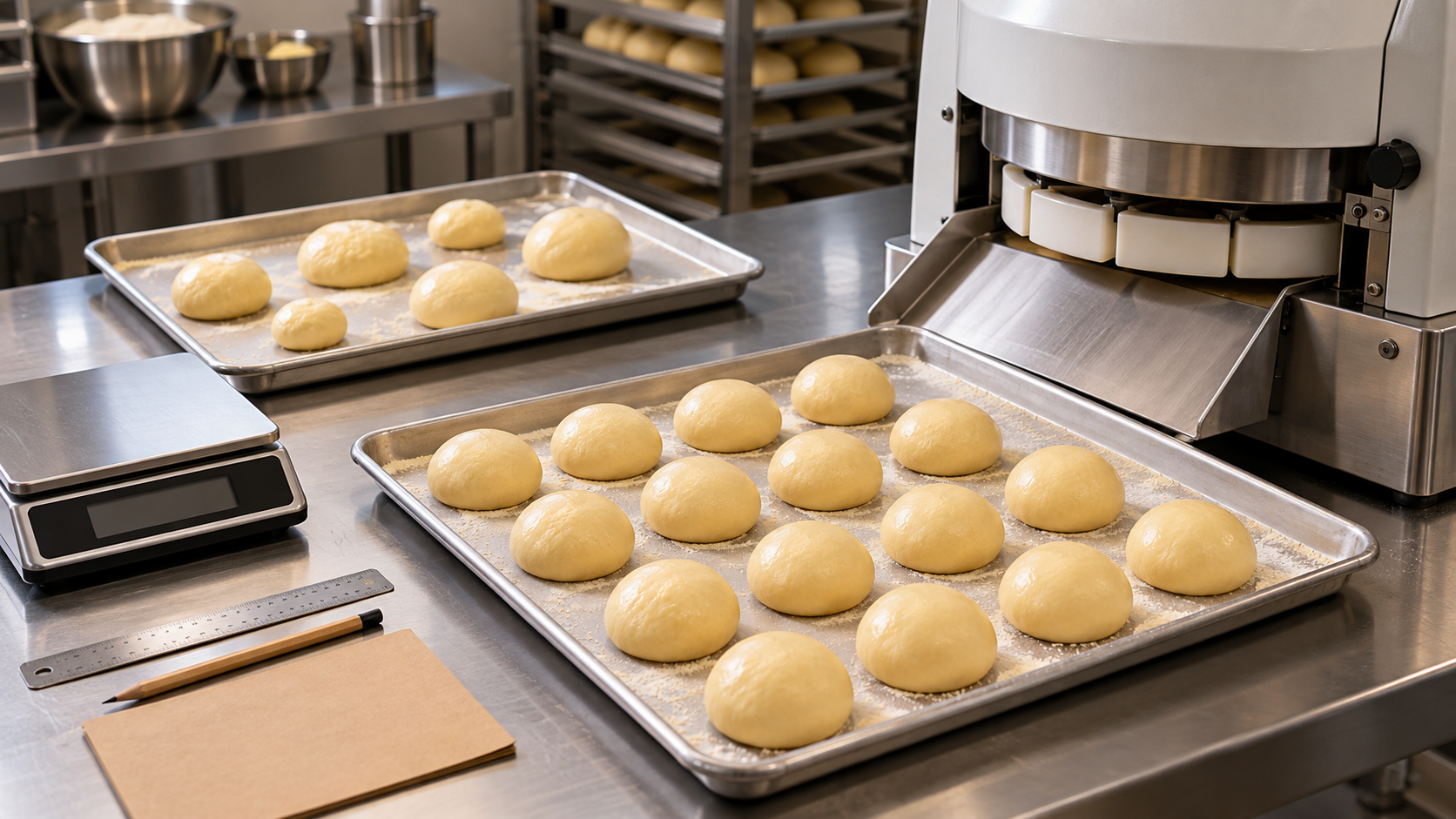
Commission a dough divider-rounder by treating it as a change to the whole make-up route, not a shortcut for weighing. First confirm that the dough, batch size, piece-weight range, plate or head, and operating procedure are within the specific machine maker's instructions. Then compare representative machine-divided pieces with the current accepted route through rest, shaping if used, proof, bake, cooling, and the product check that matters to the bakery. Record piece mass, shape, handling, and the first point at which the route differs. Approve the setting only when the defined product repeats; a fast, round-looking piece at the machine does not prove the finished bun. This is a production-quality comparison, not a safety, shelf-life, or legal-sale approval.
- A divider-rounder portions by the machine's mechanism and settings, so dough condition, batch mass, the fitted plate or head, and the maker's stated operating range belong in the commissioning record.
- Weigh representative pieces across the run rather than accepting one early piece; a volumetric or mechanical setting does not make a finished-product standard by itself.
- Compare the complete route: division, rounding, any bench rest or shaping, proof, bake, cooling, and the bakery's defined product check.
- When weight, shape, surface, proof response, or bake result changes, locate the first changed condition before changing dough formula, divider setting, rounding time, flour use, and proof together.
- Equipment commissioning does not establish food safety, allergen controls, shelf life, labelling, or legal sale requirements.
The divider-rounder changes the make-up route
A divider-rounder can make a small bakery faster, but it does more than remove a hand-weighing step. It turns a bulk dough mass into repeated pieces through a particular chamber, plate, pressure, cut and rounding action. Those pieces then enter the rest of the route with a particular mass, shape, surface tension and handling history. If the bakery calls the machine setting 'the weight' and stops looking after discharge, it has replaced a visible production decision with a number that may not describe the bun the customer receives.
The American Society of Baking describes dividing as the start of make-up and notes that dough consistency and density matter in volumetric division. That is why a prior hand-made standard is a useful control: it lets the bakery ask whether a defined machine route produces comparable pieces, not whether the machine makes pieces quickly. The equipment maker's manual remains the authority for its own approved dough range, batch load, fitted tooling, guarding, cleaning and adjustment procedure.
| Commissioning input | Write it before the trial | Why it matters |
|---|---|---|
| Machine configuration | Manufacturer, model, fitted plate or head, stated piece range and the current maker-approved operating procedure | A setting cannot be interpreted apart from the actual tooling and manual |
| Dough presented to the machine | Product dough, batch mass, current mixing and floor-time route, and condition at division | A divider responds to the dough that enters it, not only to a dial or lever |
| Reference route | Current accepted hand division or another approved make-up route through finished-product check | Creates a comparison instead of a machine demonstration |
| Release decision | The product observations that must repeat and the person who may release, hold, or request one retest | Keeps speed from becoming the only approval criterion |
Start with the machine's actual limits, then create one comparable run
Do not set a batch simply by multiplying a target bun mass by the number of divisions. First use the maker's manual for the specific machine and installed plate or head to identify the permitted total dough load, piece range and operation sequence. For example, the Doyon DSA manual describes its units as volumetric divider-rounders and lists different total and individual weight ranges by model. That illustrates the general commissioning principle: model-specific ranges are not interchangeable, and they do not automatically suit an enriched dough used by another bakery.
Choose one ordinary product route and keep it legible. Use the usual formula, planned batch size, mixer, floor-time route, bench flour practice, proof and oven program. Divide one comparable set by the current accepted method and one by the proposed machine method, or use the current method as a documented reference if production cannot run side by side. Do not begin by changing the formula, water, mixer endpoint and divider pressure together; an attractive dough ball would not tell you which change made the finished result different.
- Read the machine-specific installation, safety, food-contact cleaning, batch-load and operating instructions before a product trial; stop if the proposed route is outside them.
- Write the control product route and the machine route, including dough condition, total load, fitted tooling, machine setting, operator sequence and any flour or release aid permitted by the maker.
- Collect representative pieces from early, middle and late positions in the run. Mark their route without putting product-identification claims on food not intended for sale.
- Weigh each selected raw piece on the same verified scale and record the values individually; also note visible shape, seams, surface damage or sticking.
- Carry the selected pieces through the same stated rest, proof, bake, cooling and finished-product check as the control.
- Release, hold, or run one focused follow-up trial from the completed record. Preserve the control until the proposed machine route is repeatable.
Measure variation without inventing a universal tolerance
A target piece mass is a product decision, not a value a generic article can set for every bun. It depends on the bakery's formula, finished-product specification, yield, applicable labelling or weight rules, and the relevant machine. Instead of borrowing a tolerance, make the first record transparent. List each raw mass, the target used by the bakery, the difference from that target, the machine position or sample point, and the finished observation. This shows whether an adjustment improved the stated product, rather than merely moving a mean closer to a desired number.
For a simple internal summary, calculate each difference as actual raw piece mass minus the bakery's written target. Also calculate the range as the largest selected mass minus the smallest selected mass. These are descriptions of that one trial, not proof of a compliant product or a guaranteed machine capability. If the range is wider or the finished buns drift, first look at the earliest observable difference: dough at the divider, uneven presentation or load, machine setting, sticking, rounding, or the next handling stage.
| Field on the divider-rounder record | What to enter | How to use it |
|---|---|---|
| Target and sample masses | Bakery target; each raw sample mass; early, middle or late sample position | See the distribution instead of approving the first convenient piece |
| Difference and range | Actual minus target for each piece; highest selected mass minus lowest selected mass | Describe the trial before deciding whether an adjustment is needed |
| Make-up observations | Dough condition, spreading, cut completeness, sticking, seams, rounding and handling notes | Locate the first meaningful change rather than blaming the baked bun alone |
| Finished check | Proof response, bake shape, crumb or product-specific acceptance observation, and decision owner | Connect the machine setting to the customer-facing product |
Diagnose the first changed condition before retuning everything
A rough piece after division does not automatically mean the dough needs more water, the rounder needs more time, or the proof must be extended. Begin at the divider and move forward. Was the dough within the stated machine route? Did the batch load, fitted head or plate, setting and operator sequence match the written trial? Did sticking, incomplete cutting, a visibly uneven piece, or a surface seam appear before the proof? Those observations keep a later volume or colour difference from being assigned to the wrong stage.
The ASB's dough-processing overview places dividing and rounding among the operations between mixing and proofing. Use that sequence in the record. If the raw machine piece is already different from the control, do not compensate with a new proof or oven setting in the same test. If raw pieces match but proof or bake differs, trace the next unshared handling condition. One focused change creates a result the founder-chef can reuse when a second operator, dough batch or product size is introduced.
| Observed difference | First useful check | Hold constant in the next trial |
|---|---|---|
| Selected pieces vary in raw mass | Confirm the written dough condition, machine load, tooling and setting before changing the formula | Formula, mixer route and target while one equipment or presentation condition is checked |
| Pieces do not cut or round cleanly | Check the maker's operating procedure, batch range, correct setup and the first point of sticking or incomplete division | The approved dough route while one allowed setup condition is corrected |
| Raw masses look comparable but proof shape differs | Compare the first unshared resting, transfer, seam or handling condition after discharge | Divider settings and proof program while the one handling difference is tested |
| Bake result differs after a machine change | Confirm whether the difference was already visible in raw mass, shape or proof before changing the oven | Oven program and product route while the first changed make-up condition is tested |
Make the approval record usable on the next shift
A divider-rounder approval is not a one-time photo of neatly rounded dough. Keep a short record with the model and tooling, manual range checked, dough route, total load, setting, raw samples, finished comparison, decision and the owner of the next action. This gives a new operator something better than an informal instruction to 'turn it until it looks right.' It also makes later changes visible: a different dough size, revised formula, new plate, altered batch scale or product route should not quietly inherit the earlier approval.
This production record does not decide whether the equipment is safe to operate, whether food-contact surfaces are adequately cleaned, whether the finished product is safe to hold, or whether a packaged bun can be sold under local rules. Follow the machine manufacturer and locally applicable food-safety, worker-safety, labelling and legal requirements for those controls. The record answers the narrower quality question: does this declared divider-rounder route repeatedly deliver the specific enriched bun route the bakery intends to make?
Use the divider-rounder record with these production controls
- Dough Mixing Discharge Check: Decide Whether the Batch Is Ready for Fermentation
Use this first when the dough entering the divider-rounder is not consistently developed or uniform.
- Salt Bread Batch Scaling: Keep Dough Temperature, Piece Weight, and Butter Release Stable as You Grow
Use this when a divider-rounder trial is part of a larger change in batch size and make-up capacity.
- Bakery Ingredient Lot Approval: Test the Delivery Before It Changes Your Production Day
Use this when a new flour or other ingredient lot changes the dough presented to the equipment.
Frequently asked questions
Questions operators ask
Can I set the divider-rounder by weighing only the first piece?
No. Use representative early, middle and late pieces from the defined run, then carry selected samples through the stated product route. One early piece does not describe the later load, the full make-up sequence, or the finished bun.
What piece-weight tolerance should I use for enriched buns?
There is no universal tolerance in this field note. Set the product target and acceptance basis from your formula, product specification, applicable rules and specific equipment route. Record every selected raw mass and finished observation rather than borrowing a tolerance from another machine or product.
Should I change water if the machine-divided pieces are inconsistent?
Not as the first response. Check whether the dough entering the machine, total load, fitted tooling, setting, operator sequence or visible sticking changed first. Altering water at the same time as the machine setup removes the comparison you need.
Does a successful divider-rounder trial approve food safety or product shelf life?
No. It is a quality and make-up comparison. Follow the manufacturer and locally applicable requirements for equipment safety, cleaning, food safety, allergens, holding, shelf life, labelling and legal sale.
Technical references
Sources used for this field note
Related field notes

Why learn from MasterBaker
First-hand bakery work, translated into measurable decisions
MasterBaker.io is led by Joonho Jang (장준호), a Le Cordon Bleu-trained owner-chef who develops, produces, and sells bakery products in Korea. The flagship salt bread grew from a product sold and locally praised in Joonho Jang's bakery. These field notes turn that operating experience into temperatures, weights, endpoints, QC, costing, and release decisions rather than anonymous recipe summaries. Read Joonho Jang's method and evidence policy.