Quick answer
The operating answer
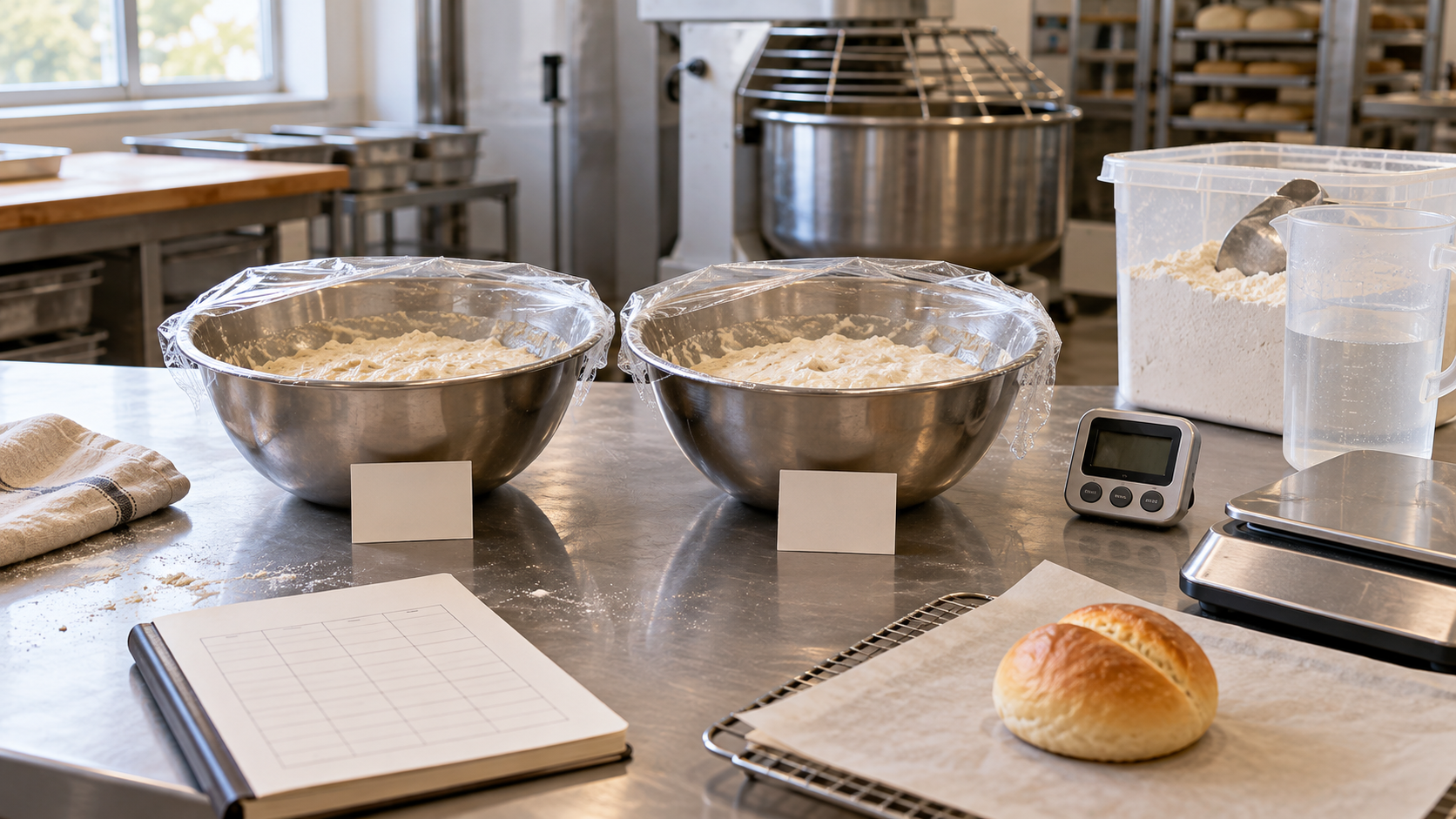
Add an autolyse to an enriched dough only when a controlled comparison shows that the rest improves the finished route your bakery actually runs. Keep the formula, flour lot, water amount, mixer, batch size, make-up, fermentation, bake, and handoff condition defined; compare the current route with a flour-and-water pre-mix rest, then add the remaining ingredients and finish both routes to the same product endpoint. Record what changed in handling, mixing, make-up, finished appearance, and customer-facing result. A rest can change hydration and handling, but it is not a universal replacement for an approved mix route or proof plan.
- Autolyse is a flour-and-water hydration rest, not another name for bulk fermentation or a permission to leave every ingredient in an uncontrolled hold.
- For an enriched dough, test the rest as one named route change; keep the actual formula, water quantity, material condition, mixer, and downstream path comparable.
- Judge the complete product route, not only whether the dough feels easier at the bench. Make-up, proofing, bake, cooling, and handoff may reveal a different tradeoff.
- Keep the last approved route until a locally documented comparison repeats. A hydration-rest decision does not validate food safety, shelf life, allergen controls, or legal sale.
A hydration rest is a production change, not a shortcut
An autolyse is a rest after flour and water are combined and before the dough is completed. The American Society of Baking describes the rest as continued hydration of flour components and development of processing characteristics; it also distinguishes it from bulk fermentation. That distinction matters in a small bakery: a flour-and-water rest changes a deliberate part of the mix route, whereas fermentation, proofing, and product cooling have their own product-specific controls.
For an enriched dough, the practical question is not whether autolyse is fashionable or whether it makes one sample feel pleasant. It is whether the proposed route can be repeated with the bakery's flour, water, mixing energy, fat and sugar addition sequence, make-up requirement, oven, and customer handoff. A dough that seems easier to extend after a rest can still produce an unwanted downstream result if other stages are changed at the same time. Treat the rest as a testable production decision rather than a borrowed timer.
Build a fair control and candidate route
Choose an ordinary, already approved batch condition. Keep the flour identity or defined lot, total formula water, batch size, mixer and bowl, target batch temperature approach, pan or tray, proof route, oven route, cooling, and handoff route identifiable. Make a control with the bakery's current mixing sequence. For the candidate, pre-mix the defined flour and water, cover it according to the bakery's own procedure, hold it for a stated local trial interval, then add the remaining ingredients and complete the same intended route.
Do not alter hydration, sugar, fat, yeast, salt, mixing speed, and fermentation plan together simply because the dough feels different. Water absorption is product-specific, and the American Society of Baking notes that water amount influences dough handling and finished-product attributes. One controlled change gives the bakery a chance to learn whether the rest—not an unrecorded adjustment—accounts for the difference.
- Write the control route and the candidate rest route before mixing; name the only intentional difference.
- Weigh the same defined formula, record the flour and water identifiers, and keep the total water unchanged unless a separate hydration trial is the stated question.
- For the candidate, combine only the intended flour and water portion, cover it, and record the local start and finish time plus its observed condition before the remaining ingredients are added.
- Finish both routes through the same mixer, make-up, fermentation, bake, cooling, and handoff checkpoints; do not declare success from an early dough feel alone.
- Compare the recorded endpoints, keep the current standard or nominate one next test, and do not write a permanent method from a single attractive batch.
Score the product route, not just the mixing bowl
The rest earns its place only if it helps the bakery make the intended product more repeatably under its normal constraints. Before starting, define the observable comparison points that matter to that product: whether the dough incorporates cleanly, whether it reaches the required handling condition at a reasonable and repeatable mix route, whether portions and shapes stay consistent, whether the proof and bake behave as expected, and whether the finished product meets the bakery's own customer-facing reference.
Dough handling is useful evidence, but it is only one stage. The American Society of Baking separates extensibility, elasticity, resistance to deformation, and stickiness as different handling properties. Record the actual observation rather than calling every softer dough an improvement. For example, a candidate may be easier to extend yet lose the shape control needed for the next operation. The record should make that tradeoff visible before the team changes its standard.
| Comparison point | What to record | Decision it supports |
|---|---|---|
| Starting conditions | Formula version, flour and water reference, batch size, mixer, intended control and candidate route | Whether the two batches can be compared fairly |
| Rest route | Flour-and-water portion, covered hold start and finish, observed pre-mix condition, and the one intended route difference | Whether the bakery is testing an autolyse rather than several hidden changes |
| Mix and make-up | Incorporation, dough handling words defined by the team, mix route, portioning and shape observations | Whether a handling benefit survives the next production stage |
| Finished route | Proof, bake, cooling, package or handoff condition against the approved product reference | Whether the candidate improves the customer-facing product rather than only the bowl observation |
| Decision | Keep current route, repeat candidate, or name one next variable and decision owner | A stable standard and a traceable next trial |
Know when to stop the comparison
Stop treating the run as a fair autolyse test if its starting conditions diverge: a different flour or water amount, a substituted ingredient, a changed batch size, a different mixer loading, an unrecorded temperature shift, or a rushed make-up and bake route. These are not failures to hide. They are reasons to keep the result as an observation and run a fresh, narrower comparison when the ordinary route is available.
If the candidate does not produce a useful repeatable advantage, retain the approved route. If it does, repeat the candidate under ordinary conditions and write the local rest method with the same care as any other production instruction: formula version, inputs, covered-hold condition, observation point, remaining mix route, and finished-product release reference. This quality method does not establish food safety, shelf life, allergen control, or permission to sell; those decisions remain under the bakery's written program and applicable local requirements.
Keep the hydration-rest trial connected to the rest of the route
- Dough Mixing Discharge Check: Decide Whether the Batch Is Ready for Fermentation
Use the discharge check after either route to keep the mixer decision based on the product's actual handling and temperature reference.
- What Final Dough Temperature Should Enriched K-Bread Reach?
Use this next when the comparison indicates a repeatable dough-temperature question rather than a hydration-rest effect.
- Why the Same Bread Recipe Behaves Differently in Different Kitchens
Use this guide to identify the local flour, water, mixer, fermentation, or oven condition that should be isolated in the next trial.
Frequently asked questions
Questions operators ask
Is autolyse the same as bulk fermentation?
No. An autolyse is a flour-and-water hydration rest before the dough is completed. Bulk fermentation is a separate stage in the finished dough route. Record and control them as different operations.
Should I add every enriched-dough ingredient to the autolyse?
Use the exact route you are testing and record it. This field note describes a flour-and-water pre-mix comparison; it does not prescribe a universal ingredient sequence for every formula.
Can I reduce mixing time automatically after an autolyse?
No. Compare the candidate with the approved route at the product's own discharge and finished-product checkpoints. Change one named variable at a time instead of assuming that a rest dictates a new mixer setting.
Does an easier-to-handle dough prove that the new route is better?
No. It is one observation. Check whether the same candidate still meets the required make-up, fermentation, bake, cooling, and customer-handoff reference before changing the standard.
Technical references
Sources used for this field note
Related field notes

Why learn from MasterBaker
First-hand bakery work, translated into measurable decisions
MasterBaker.io is led by Joonho Jang (장준호), a Le Cordon Bleu-trained owner-chef who develops, produces, and sells bakery products in Korea. The flagship salt bread grew from a product sold and locally praised in Joonho Jang's bakery. These field notes turn that operating experience into temperatures, weights, endpoints, QC, costing, and release decisions rather than anonymous recipe summaries. Read Joonho Jang's method and evidence policy.