Quick answer
The operating answer
Do not promise that leftover Korean cream cheese garlic bread can be sold tomorrow simply because it still looks good. First identify exactly what product state you have—unbaked, assembled, baked but never served, held for pickup, returned, or exposed at service—and trace its actual time, temperature, packaging, and handling route. Then apply the food-safety and local legal controls that govern that route. Only after that gate is clear should you compare a retained control with a proposed next-day re-bake at the customer endpoint. A later bake can improve the crust; it cannot erase an unknown history or turn a quality check into a shelf-life approval.
- A product name is not a storage decision: record the actual state and route of each retained bun.
- Do not group a customer-returned or unknown-history item with a never-served, traceable production hold.
- Resolve the applicable food-safety, date-marking, allergen, packaging, and local legal controls before a quality re-bake comparison.
- Compare a proposed next-day route with a defined fresh control at the same customer-stage point; change one decision variable at a time.
- Use a short state card to make release, hold, rework, or discard decisions visible across shifts.
Start with the route, not with the crust
A crisp re-bake can disguise a dry edge or refresh the garlic aroma, which is why a leftover bun can feel like an easy next-day sale. But the bakery needs to make two different decisions. The first is whether the bun has a known, permitted route through the bakery’s food-safety and legal controls. The second is whether that route still delivers the intended six-cut structure, cream-cheese filling, garlic-butter finish, and customer handoff. Do not let a successful second decision stand in for the first.
Separate products by what actually happened, not by what you hoped to do with them. A fully baked bun that remained under the bakery’s documented control is different from a customer return. An assembled but unbaked bun is different from a re-baked item held at the counter. An item with a missing time or temperature record is not made traceable by a new label. These distinctions give the next operator a usable decision instead of a vague instruction to “save leftovers.”
| Product state at close | First record to check | Do not assume |
|---|---|---|
| Never-served baked bun, held under the bakery’s control | Production time, cooling/holding route, packaging, allergen and date information, plus the applicable local rule | A clean package or good appearance alone makes it suitable for sale tomorrow |
| Assembled but not re-baked | Ingredient and assembly records, time/temperature route, covered storage instructions, and the planned cook/re-bake procedure | Its unfinished state gives it the same route as a raw or freshly assembled bun |
| Held for pickup or on display | When and where it was held, whether the route remained controlled, and the applicable disposition rule | An unsold item has the same history as an item still in production |
| Customer returned, unlabelled, or unknown-history item | Whether the bakery can establish its route at all | Another bake or a new package can restore a saleable status |
Use the safety gate before a quality trial
For a bakery with dairy filling, the relevant rules depend on the ingredients, product state, time and temperature history, packaging, and jurisdiction. The current FDA Food Code is a U.S. model code, not Korean law or a universal selling rule. Its treatment of refrigerated ready-to-eat time/temperature-control-for-safety food, date marking, cooling, and time as a public-health control illustrates why a bakery must use its own applicable plan and local authority requirements rather than inventing a next-day rule from texture alone.
The practical gate is simple: if the route or required record is unknown, do not create a quality experiment around it. Hold or discard it according to the bakery’s controls. If the route is known and allowed, keep the safety decision documented separately from the customer-quality comparison. This avoids teaching the team that an oven timer is a corrective action for missing traceability, an exceeded hold, allergen uncertainty, or a customer return.
- Write the product state and the last known controlled point: bake or assembly time, packaging state, location, and handoff status.
- Check the ingredient and allergen information, intended storage/use directions, applicable time and temperature controls, date marking, and local legal requirements. Escalate a gap to the responsible food-safety decision maker before any rework trial.
- Name the disposition for an unknown or prohibited route. Do not relabel, repackage, or re-bake it into a new category.
- Only for a permitted, fully documented route, make a small quality comparison against the normal fresh service standard.
Approve a next-day re-bake as a separate customer promise
When the food-safety gate permits a local evaluation, compare a fresh control with the retained route at the same customer-stage review point. Keep the bun type, six-cut geometry, filling target, garlic-butter application, package, service interval, and review method explicit. Change one planned condition at a time—such as the retained route or the re-bake profile—rather than adding more dip, a new package, and a hotter oven together.
Inspect what the customer receives: surface crispness, base condition, filling appearance, six-cut stability, leakage, grease transfer, package contact, eating temperature, and the interval to handoff. A pleasing result on a rack is not enough if the cream shifts in the container or the crust softens before collection. Repeat a promising route on a normal operating day before making it a written option.
| Observation after proposed re-bake | First useful question | One defensible next action |
|---|---|---|
| Crust is crisp but filling looks broken, dry, or displaced | Did the retained product state, re-bake exposure, or filling condition first differ from the fresh control? | Hold the route and test one named condition only after the safety gate remains satisfied |
| Base softens again in the package | Did the actual package, closure, carry interval, and customer-stage point match the control? | Compare the same approved package route before changing the recipe or oven |
| Team cannot confirm the retained item’s history | What is the last documented controlled point? | Do not use it for a customer-quality comparison; follow the bakery’s hold/discard procedure |
| Second trial is acceptable but not repeatable | Which lot, service pace, package, or re-bake condition changed? | Keep the route provisional and repeat with a complete state card |
Keep a state card with the retained product, not in someone’s memory
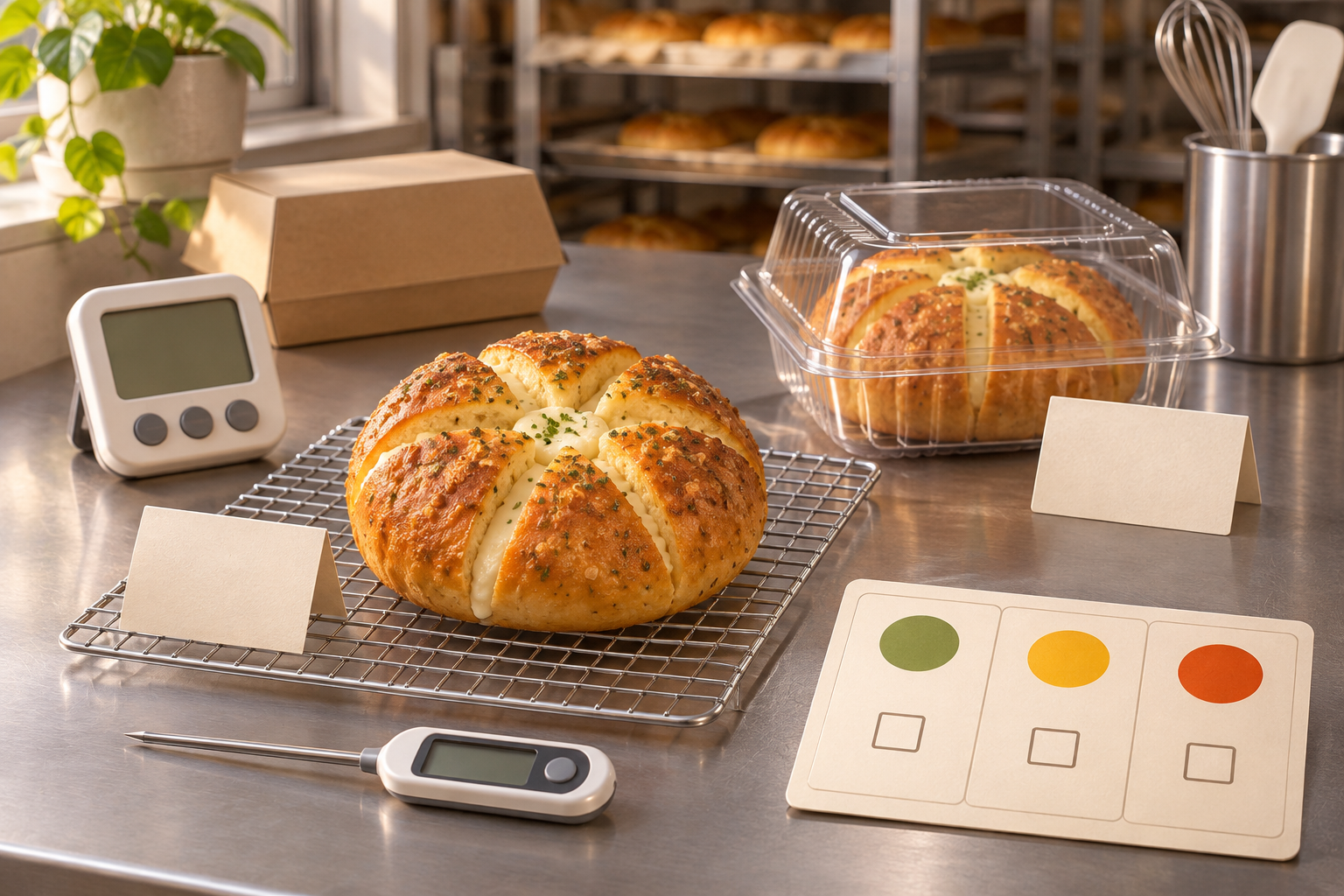
A state card is deliberately shorter than a formula sheet. Its job is to make the next decision recoverable at close, on the next shift, and during a review. It is useful only when it follows the product: a blank card left by the oven cannot prove where a particular bun has been. This is a quality and traceability aid, not a substitute for a HACCP plan, shelf-life study, or local approval.
As a founder deciding whether a Korean bakery product can remain trustworthy after service, I would protect the clear customer promise first: fresh service stays the standing standard unless a separately controlled route has been allowed and can repeat. Saving one bun is not a gain if the next shift inherits a product it cannot identify, explain, or hand over with confidence.
| State-card field | What to enter | Decision it supports |
|---|---|---|
| Identity | Product version, relevant ingredient/allergen version, batch or lot reference, and item count | Separates a known product from a look-alike leftover |
| Last controlled point | Assembly/bake time, packaging state, location, service or pickup status, and responsible person | Makes the route reviewable at close and on the next shift |
| Applicable control check | The bakery’s relevant storage, time, date, disposition, and local-rule check—not a copied generic limit | Stops a quality re-bake from bypassing the safety gate |
| Quality comparison result | Fresh control, proposed route, customer-stage observations, and one release/hold/next-test decision | Makes a repeatable customer-quality decision possible |
Use the next-day decision with these garlic-bread controls
- Korean Cream Cheese Garlic Bread Re-Bake Queue: Keep Every Six-Cut Bun Crisp, Full, and Sellable
Use this for the normal live re-bake queue after a product route has been allowed and identified.
- How Should You Pack Korean Cream Cheese Garlic Bread for Pickup Without Turning the Crust Soft?
Check the actual package and handoff route when a permitted re-bake must travel to a customer.
- Korean Cream Cheese Garlic Bread Allergen Control: Keep Dairy, Egg, and Wheat Separate on a Fast Re-Bake Line
Keep product identity and allergen controls visible when an item crosses a shift or storage boundary.
Frequently asked questions
Questions operators ask
Can I re-bake leftover cream cheese garlic bread tomorrow if the crust still looks good?
Not from appearance alone. First establish the exact product state and its documented time, temperature, packaging, handling, allergen, and local compliance route. Only a route permitted by the bakery’s applicable controls can move to a separate next-day quality comparison. A new bake cannot correct an unknown or prohibited history.
Can a customer return go back into the next day’s re-bake batch?
Do not treat a customer return as equivalent to an item that stayed under the bakery’s documented control. Follow the applicable local food-safety and business rules and the bakery’s disposition procedure; do not use a new package or another bake to recreate traceability.
Does a date label prove a retained garlic bread is safe to sell?
No. A date is only one part of a controlled route. The bakery still needs the applicable storage, time, handling, ingredient/allergen, packaging, and local legal controls, plus a quality decision for the product it intends to hand to a customer.
What should I compare if a next-day route is permitted locally?
Compare a defined fresh control with the retained route at the same customer-stage point. Record the product state, re-bake condition, package, service interval, crust, base, six-cut structure, filling, leakage, and package result. Change one planned condition at a time and repeat a promising route before making it routine.
Technical references
Sources used for this field note
Related field notes
- Korean Cream Cheese Garlic Bread Re-Bake Queue: Keep Every Six-Cut Bun Crisp, Full, and Sellable
- How Should You Pack Korean Cream Cheese Garlic Bread for Pickup Without Turning the Crust Soft?
- Korean Cream Cheese Garlic Bread Allergen Control: Keep Dairy, Egg, and Wheat Separate on a Fast Re-Bake Line

Why learn from MasterBaker
First-hand bakery work, translated into measurable decisions
MasterBaker.io is led by Joonho Jang (장준호), a Le Cordon Bleu-trained owner-chef who develops, produces, and sells bakery products in Korea. The flagship salt bread grew from a product sold and locally praised in Joonho Jang's bakery. These field notes turn that operating experience into temperatures, weights, endpoints, QC, costing, and release decisions rather than anonymous recipe summaries. Read Joonho Jang's method and evidence policy.